
Calderdale Metropolitan Borough Council appeal evidence
Refused over highway safety in Calderdale Metropolitan?
Learn which access and visibility points harmed selected appeals, and what supported the parking-area access.
Recently refused?
Create a free account for a private planning workspace.
No payment at signup. Refusal-review ordering may not be open.
- Matched locally
- 11 of 96
- eligible decision families
- Allowed
- 1
- matched appeal records
- Dismissed
- 10
- matched appeal records
- Householder
- 8
- of 11 matched records
AI-assisted. Cited sources and wording were checked before publication. Based on 5 source-linked examples shown below. Review method and limits.
Planning Data area point: Calderdale LPA (53.721195, −1.973456). This is the published representative point for the authority boundary, not a town hall, camera position or appeal site.
Calderdale Metropolitan Borough Council appeal findings
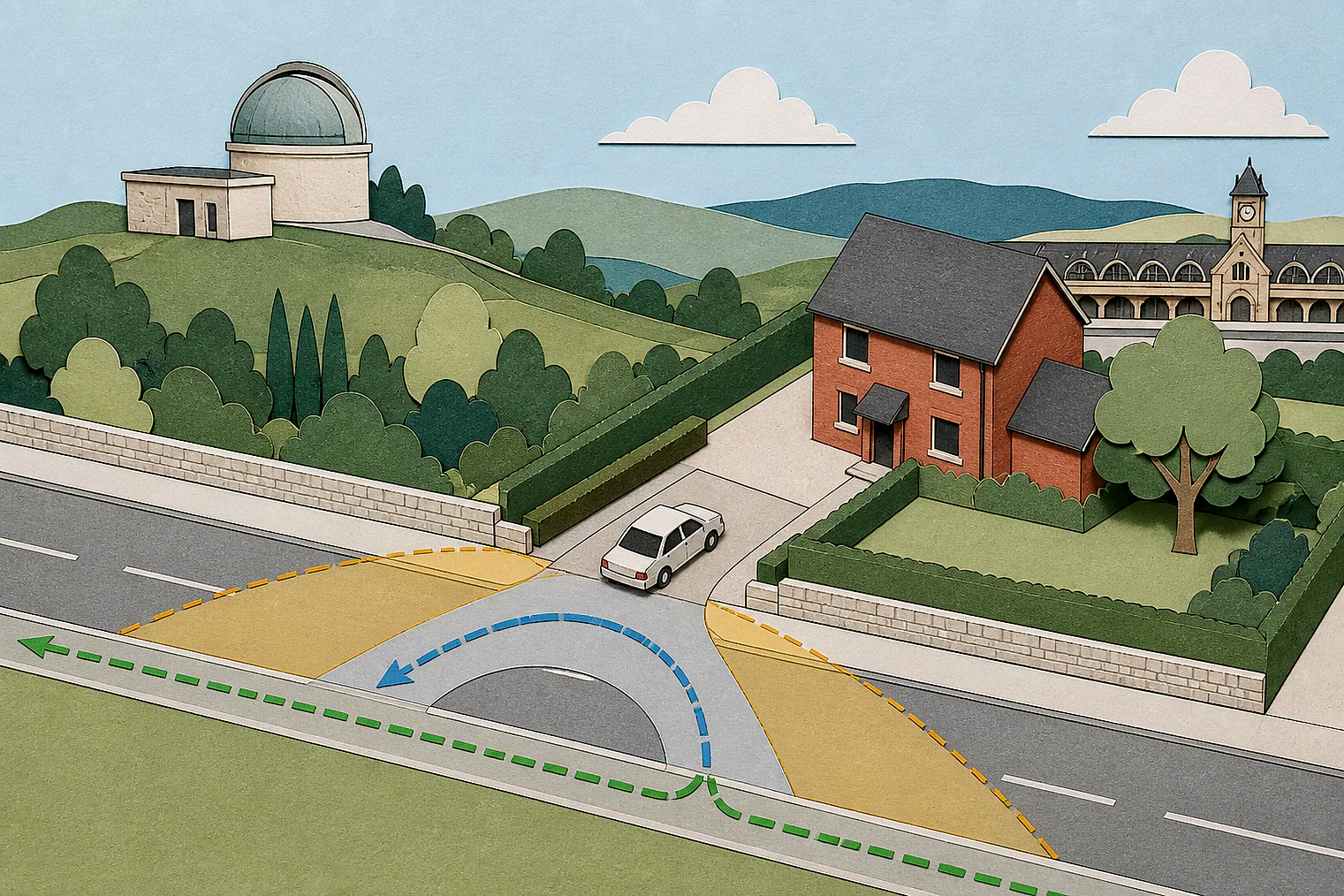
Visibility splays and reversing in Calderdale
Some of the selected examples sit at the edge of this issue: 89794 concerns wildlife habitat, and 88867 records no highway-safety objection.
Counted against appeals
Splays and reversing counted against access
Splays blocked outside the site
Walls and hedges outside the appellant’s control left visibility below expected standards on the classified A-road.
Mirrors did not cure access risks
Low domestic use and driveway mirrors did not remove reversing manoeuvres or improve pedestrian visibility of emerging vehicles.
Off-street parking found harmful
The Inspector concluded the proposed off-street parking with dropped kerb would harm highway safety.
Helped or needed
What supported the parking-area access
Below-standard splays were not enough
The Inspector found no evidence that splays below 43m would cause road-safety or traffic-flow problems.
An acceptable access could be achieved
For the excavated parking area, the Inspector found the access would not severely affect the road network.
Your refusal notice
Check these details
- Does the refusal show that your visibility splays fall below the required standard?
- Are walls or hedges outside your control blocking the view?
- Does the refusal explain why low use or mirrors would not help?
The displayed comparison is an excavated parking area, not every type of vehicle access. These decisions do not predict another result.
Appeal evidence examples
Compare allowed and dismissed appeal reasoning
Each example separates the development, the Inspector-stated issue that selected it, and the reasoning from the decision. Compare the facts as well as the outcome: these examples do not predict how a different proposal would be decided.
Allowed appeal examples
1 example
22 August 2023 · Allowed
Development described in the decision
for the excavation of ground for parking area with decking above.
Issue identified by the Inspector
The main issue in this appeal is the effect of the development on highway safety.
Paragraph 4 · Source page 2
Reasoning from the decision
In the absence of evidence that road safety issues or that problems of traffic flow would occur as a result of visibility splays below the 43m standard I find that an acceptable access to the site can be achieved and that the proposal would not have a severe impact on the road network. It follows that the proposal would comply with Policy BT4 of the CLP which, amongst other things, requires the layout of accesses to ensure the safe and free flow of traffic in the interests of highway safety.
Paragraph 10 · Source page 3
Dismissed appeal examples
4 examples
18 January 2024 · Dismissed
Development described in the decision
off street parking with dropped kerb.
Issue identified by the Inspector
The main issue is the effect of the development on the highway safety.
Paragraph 4 · Source page 1
Reasoning from the decision
I conclude that the proposed development would harm highway safety. There is conflict with Policy BT4 of the Calderdale Local Plan 2018/19-2032/33 (2023) which seeks amongst other things to ensure that new development provides for safe and efficient movement by pedestrians and vehicles.
Paragraph 7 · Source page 2
3 June 2026 · Dismissed
Development described in the decision
the construction of [address].
Issue identified by the Inspector
These are the effect of the proposed development on: • A designated wildlife habitat; • The risk of flooding and water resource management; • Protected trees; and • Highway safety and pedestrian connectivity.
Paragraph 5 · Source page 1
Reasoning from the decision
A recent approval by the Council and the allocation of land at [name] indicates that the WHN within Calderdale is not sacrosanct. However, in this case, the extent of it would be fragmented by the proposal and an area of disconnected land would be created. In this way, the physical continuity of the Network would be damaged contrary to Policy GN2. It is unclear whether the proposal would affect the movement of species, but its overall nature conservation value would be diminished. In essence, this is because about half of the site would be of no biodiversity value.
Paragraph 14 · Source page 3
15 May 2026 · Dismissed
Development described in the decision
vinyl window graphics.
Issue identified by the Inspector
The Council has not raised any objections to the adverts on public or highway safety grounds. Based on the evidence before me and my site visit observations, I have no reason to disagree.
Paragraph 6 · Source page 1
Reasoning from the decision
I have considered whether a smaller number of window vinyl graphics would be acceptable and, therefore, whether the advertisements could be allowed in part. Even a reduced number of graphics would retain the same design characteristics, including the full-pane coverage, bold colouring, and strong visual imagery, which are the primary sources of harm. The reduction in number would not materially alter their prominence or their discordant relationship with the surrounding streetscape. Therefore, I am not persuaded that a reduction in the scheme would address my concerns in terms of amenity and the effect on the character and appearance of the HBCA.
Paragraph 14 · Source page 3
26 February 2026 · Dismissed
Development described in the decision
described as: “The proposal involves the excavation and regrading of the existing front garden to create a hardstanding area, measuring approx 6 x 6 metres, to provide off-street parking for 2 vehicles. The works will include demolition of the existing front boundary wall to facilitate vehicle access, and the installation of a dropped kerb along the frontage, subject to the relevant highways approval. A permeable surface will be used to the driveway to comply with sustainable drainage requirements. An electric vehicle (EV) charging point will be installed to support the use of low-emission vehicles, as I don't have an electricity supply to my off-street garage. The property fronts an A road (A649); therefore, the application is being submitted due to the proposed direct vehicular access onto a classified highway. Appropriate visibility splays will be maintained, and any necessary measures to ensure highway safety will be addressed in line with council guidance.”
Issue identified by the Inspector
The main issues are the effect of the proposed development on: a) the character and appearance of the site and the surrounding area, including the setting of 186 – [address], which is a grade II listed building1; and, 1 [name]: 1184457 b) highway safety, with regard to vehicle access and egress arrangements and visibility.
Paragraph 4 · Source pages 1, 2
Reasoning from the decision
Moreover, visibility from the proposed access would be significantly constrained by neighbouring boundary walls and hedges, which are outside the appellant’s control. As a result, the visibility splays that would be achievable within the appellants control would fall short of those normally required for a road of this speed3. The addition of a further access in this vicinity that fails to meet the expected standards would increase the likelihood of highway safety issues arising on this classified A-road. This would not be sufficiently mitigated by the intended low intensity domestic use or by installation of driveway mirrors. The latter would neither remove the need for reversing manoeuvres at the site nor improve pedestrian visibility of vehicles emerging from it.
Paragraph 16 · Source page 3