
Dorset Council appeal evidence
Refused over neighbours’ living conditions in Dorset?
See how selected Dorset appeals addressed privacy, noise and daylight concerns for neighbours.
Recently refused?
Create a free account for a private planning workspace.
No payment at signup. Refusal-review ordering may not be open.
- Matched locally
- 51 of 177
- eligible decision families
- Allowed
- 15
- matched appeal records
- Dismissed
- 37
- matched appeal records
- Householder
- 41
- of 52 matched records
AI-assisted. Cited sources and wording were checked before publication. Based on 5 source-linked examples shown below. Review method and limits.
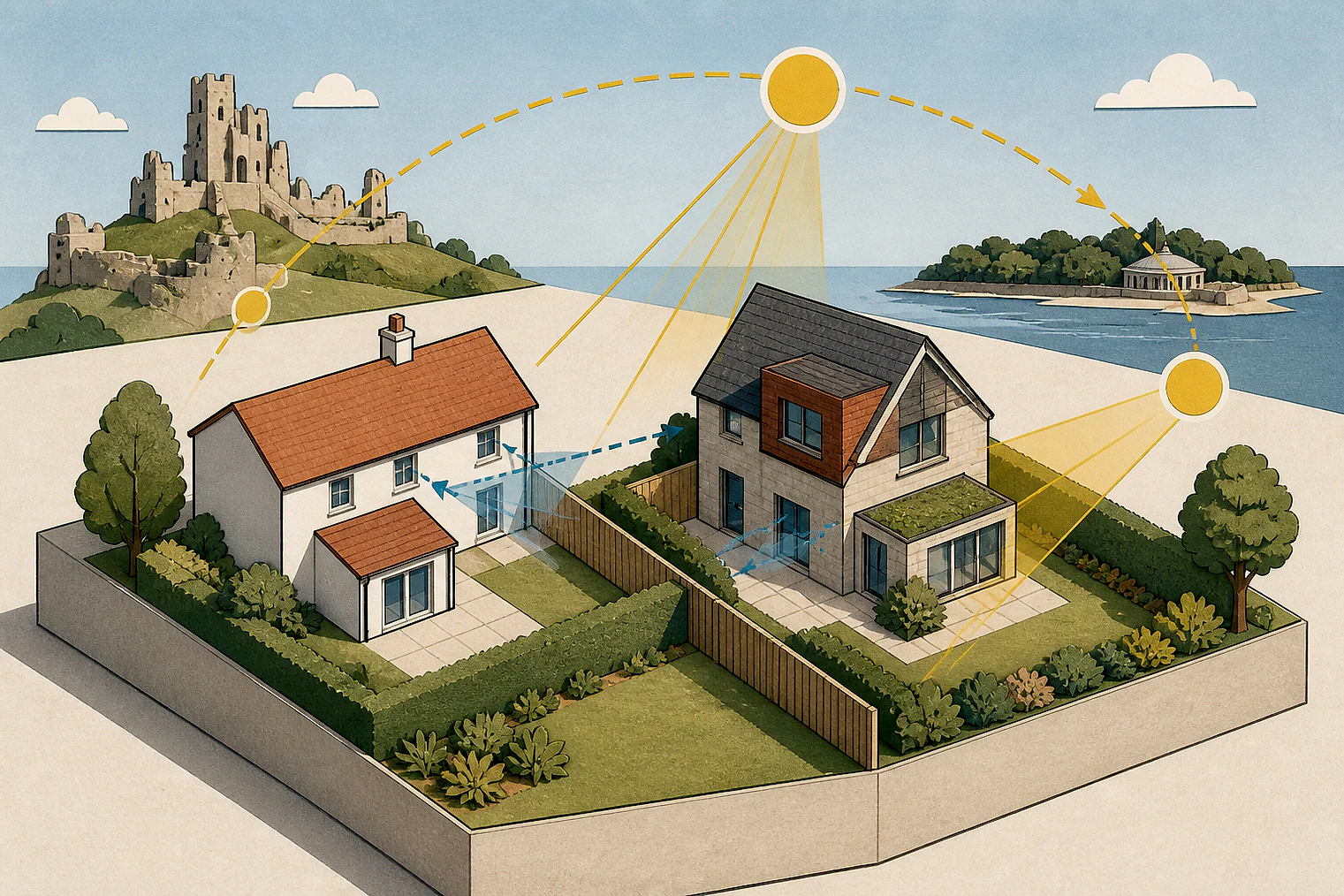
Planning Data area point: Dorset LPA (50.806307, −2.333431). This is the published representative point for the authority boundary, not a town hall, camera position or appeal site.
Dorset Council appeal findings
Privacy, daylight and noise in Dorset examples
The selected examples have a higher share of allowed appeals than the matched local set. The dismissed extracts give little privacy analysis.
Counted against appeals
Privacy harm in dismissed Dorset appeals
Harm to No 15 and No 59
The Inspector concluded that each proposal would harm a neighbour’s living conditions regarding privacy.
Loss of privacy
The Inspector concluded that the proposal conflicted with requirements to minimise adverse effects from loss of privacy.
Helped or needed
Operating hours and northern sky
Operating hours and noise
The Council had not given enough substantive evidence that operating-hour restrictions would fail to protect neighbours from noise and disturbance.
Higher parapet and northern sky
The extract says the higher parapet would restrict some northern sky, yet living conditions were not affected.
Your refusal notice
Check these details
- Does the refusal identify a specific privacy effect on a neighbouring home?
- Does it explain any claimed loss of sky or daylight?
- Is there substantive evidence that operating-hour limits would not control noise?
The selected extracts cover differing proposal types, so they cannot decide how another Dorset site would be treated. These decisions do not predict another result.
Appeal evidence examples
Compare allowed and dismissed appeal reasoning
Each example separates the development, the Inspector-stated issue that selected it, and the reasoning from the decision. Compare the facts as well as the outcome: these examples do not predict how a different proposal would be decided.
Allowed appeal examples
2 examples
24 June 2026 · Allowed
Development described in the decision
retention of [name] and B in B8 storage use together with the retention of area of hardstanding, portacabins, containers and associated structures
Issue identified by the Inspector
The main issues are: • the effect of the proposed development on the living conditions of the occupants of neighbouring dwellings with regard to noise and disturbance; and • the effect of the proposed development on the character and appearance of the surrounding area.
Paragraph 4 · Source pages 1, 2
Reasoning from the decision
The Council highlights that the appeal scheme would provide the opportunity to bring the whole site under control by imposing planning conditions such as restricting operating hours. However, it contends that, on balance, this would not result in adequate living conditions for neighbouring residents. There is limited substantive evidence before me to adequately demonstrate that the restriction of operating hours would fail to adequately protect the living conditions of neighbouring occupants regarding noise and disturbance, especially considering the fall-back position I have identified above.
Paragraph 27 · Source page 4
4 June 2026 · Allowed
Development described in the decision
the erection of a first-floor extension to provide 1 no. unit of residential accommodation.
Issue identified by the Inspector
The main issues are: • the effect of the proposal on the occupiers of No [address] in relation to daylight; • the effect of the proposal on the occupiers of No [address] in relation to outlook, daylight and privacy; and • whether the unit of accommodation would provide satisfactory living conditions for its occupiers in relation to bin/recycling storage, cycle/mobility scooter parking and private amenity/garden space/drying areas.
Paragraph 3 · Source page 1
Reasoning from the decision
No 10 backs onto the small courtyard rear garden/amenity space of No [address], a two-storey property accessed off [address]. As seen from this direction No 10 is a single storey brick building with low parapet allowing views of some northern sky above from the courtyard, the rear facing ground floor living room window and the rear facing first floor bedroom windows4. The proposal for an 1 See cross-section in Committee report. 2 Contrary to the Council’s decision notice, living conditions are not therefore affected. 3 The pitched roof element adjacent to [address] would not obscure any southern sky as seen from the window as it is approximately at windowsill level. [address] from the rear facing ground floor living room window is affected by a canopy over the patio. additional first floor would involve increasing the height of the parapet wall, with a further mansard type sloping roof above incorporating three rooflights. This would restrict the view of some northern sky from the courtyard and rear windows.
Paragraph 8 · Source pages 2, 3
Dismissed appeal examples
3 examples
13 May 2026 · Dismissed
Development described in the decision
dormer to the front and raised patio and steps to the rear.
Issue identified by the Inspector
The main issue is the effect of the proposal on the living conditions of the neighbouring occupiers of 19 [site address] with regard to privacy and outlook.
Paragraph 4 · Source page 1
Reasoning from the decision
Accordingly, the proposal would conflict with the [name], Weymouth & Portland Local Plan (2015) policy ENV16, insofar as it seeks high quality design that minimises adverse effects on the living conditions of future and existing occupants within the development and close to it, regarding loss of privacy. Similarly, the proposal would conflict with the relevant paragraphs of the National Planning Policy Framework (2024), insofar as they seek high quality design with a high standard of amenity for existing and future users.
Paragraph 9 · Source page 2
23 April 2024 · Dismissed
Development described in the decision
raise roof to form a two-storey dwelling with attached garage and covered walkway.
Issue identified by the Inspector
The main issues are the effect of the proposed development on: • the character and appearance of the area; and • the living conditions of the occupiers of [address] (No 15), with particular regard to privacy.
Paragraph 3 · Source page 1
Reasoning from the decision
I therefore find that the proposed development would have an unacceptable and harmful effect on the living conditions of the occupiers of No 15, with particular regard to privacy. It would conflict with Policy HE2 of the [name] which provides that, amongst other things, development will be permitted if it is compatible with or improves its surroundings in terms of its relationship to nearby properties including minimising general disturbance to amenity.
Paragraph 13 · Source page 3
2 June 2026 · Dismissed
Development described in the decision
erect roof extension (hip to gable) to facilitate loft conversion with internal alterations. Demolish outbuilding and erect store/summerhouse.
Issue identified by the Inspector
The main issues are: • The effect of the proposal on the living conditions of the occupiers of No [address] (No 59) in regard to privacy; and • Whether the proposal would preserve or enhance the character or appearance of the Chickerell Conservation Area (CA).
Paragraph 4 · Source page 1
Reasoning from the decision
Consequently, the proposal would harm the living conditions of No 59 in regard to privacy. Accordingly, the proposal would conflict with the [name], Weymouth & Portland Local Plan (2015) (the Local Plan) policy ENV16 insofar as it seeks to safeguard neighbouring amenity. The proposal would also conflict with the National Planning Policy Framework (2024) (the Framework) paragraph 135(f) insofar as it seeks to ensure a high standard of amenity for existing and future users.
Paragraph 9 · Source page 2