
Durham County Council appeal evidence
Refused over neighbour living conditions in Durham?
See the privacy, outlook and daylight effects cited in selected Durham appeal examples.
Recently refused?
Create a free account for a private planning workspace.
No payment at signup. Refusal-review ordering may not be open.
- Matched locally
- 13 of 57
- eligible decision families
- Allowed
- 1
- matched appeal records
- Dismissed
- 12
- matched appeal records
- Householder
- 11
- of 13 matched records
AI-assisted. Cited sources and wording were checked before publication. Based on 5 source-linked examples shown below. Review method and limits.
Planning Data area point: County Durham LPA (54.695442, −1.839557). This is the published representative point for the authority boundary, not a town hall, camera position or appeal site.
Durham County Council appeal findings
Privacy, outlook and daylight in Durham refusals
The selected examples include one allowed appeal. Their outcome mix differs from the matched local set, and one dismissal concerns future occupiers’ private amenity space.
Counted against appeals
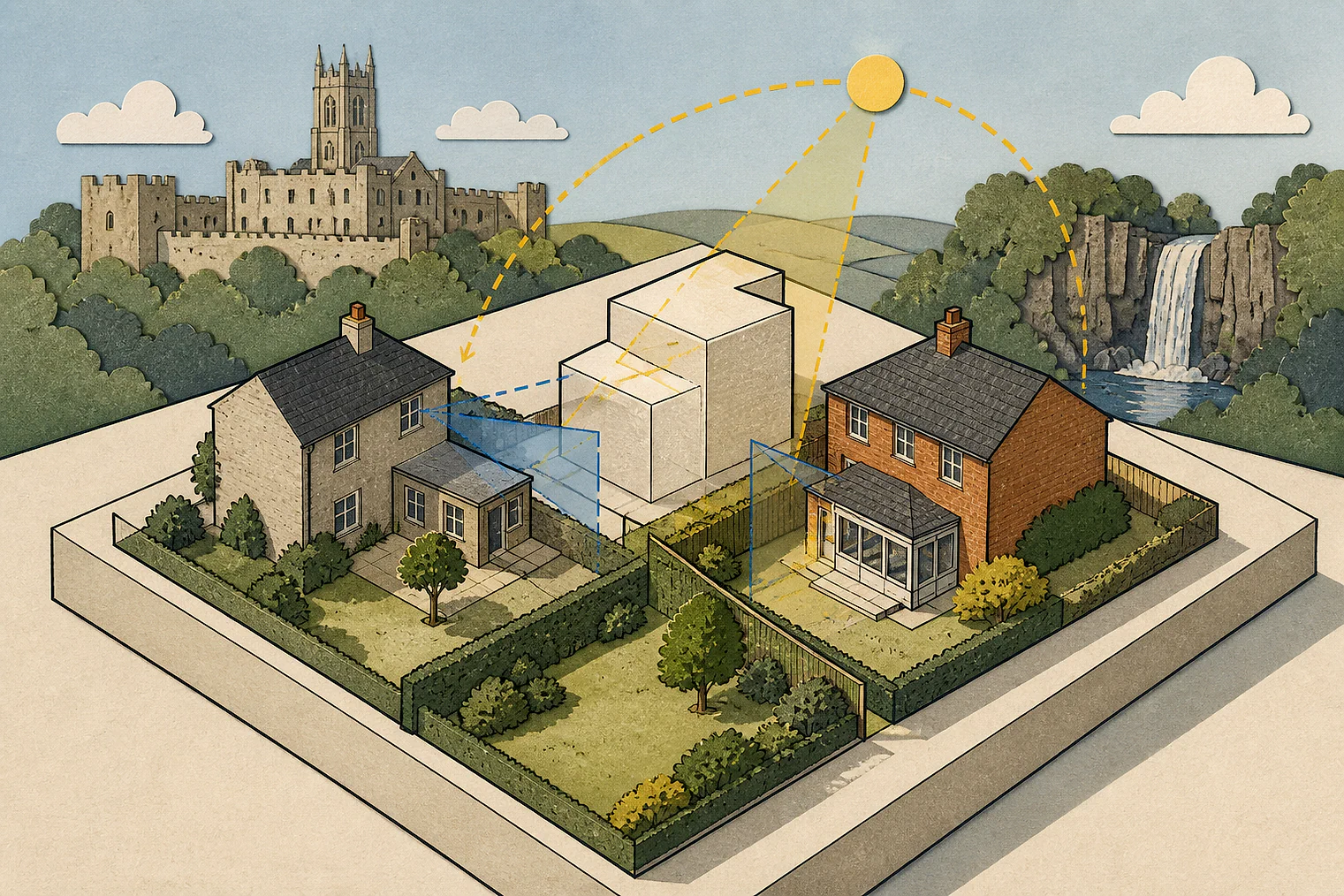
Overlooking, dominance and lost light
Boundary walls did not prevent overlooking
The fire-escape staircase would add overlooking and reduce privacy. Boundary walls were not enough mitigation.
Overbearing presence caused privacy loss
The Inspector concluded that the development unacceptably affected neighbours through overbearing presence and loss of privacy.
Outlook and daylight found harmful
The decision concludes that the rear two-storey extension would harm neighbours’ outlook and daylight/sunlight.
Helped or needed
The patio-and-fence allowed example
No material privacy or outlook harm
For the patio extension and replacement fence, the Inspector found no materially adverse effect on neighbours’ privacy or outlook.
Your refusal notice
Check these details
- Does the refusal identify overlooking, lost privacy, outlook or daylight?
- Do your drawings show why boundary treatment prevents overlooking?
- Is the claimed harm to neighbours or future occupants?
Only one displayed allowed example is available, and its extract gives a conclusion rather than the earlier analysis. These decisions do not predict another result.
Appeal evidence examples
Compare allowed and dismissed appeal reasoning
Each example separates the development, the Inspector-stated issue that selected it, and the reasoning from the decision. Compare the facts as well as the outcome: these examples do not predict how a different proposal would be decided.
Allowed appeal examples
1 example
7 January 2025 · Allowed
Development described in the decision
the extension of an existing patio and the erection of a replacement fence.
Issue identified by the Inspector
The main issue is the effect of the development on the living conditions of the occupiers of the neighbouring property known as [name] with particular regard to privacy and outlook.
Paragraph 5 · Source page 2
Reasoning from the decision
Consequently, I find that there are no materially adverse effects arising from the development which would harm the living conditions of the occupiers of [name] with regard to privacy and outlook. There is, therefore, no conflict with County Durham Plan Policies 29 and 31, which amongst other things, seek to ensure that new development is of high quality and provides a high standard of amenity for existing and future users.
Paragraph 13 · Source page 3
Dismissed appeal examples
4 examples
19 February 2024 · Dismissed
Development described in the decision
Installation of [name] to Rear of Property.
Issue identified by the Inspector
The main issue is the effect of the proposed development upon the living conditions of occupiers of neighbouring properties, with particular regard to privacy and overlooking.
Paragraph 7 · Source page 2
Reasoning from the decision
County Durham Plan (CDP) Policy 31 refers, in part, to matters of amenity. Where proposals have unacceptable impacts upon living conditions arising from overlooking and loss of privacy, they will not be permitted unless satisfactory mitigation measures can be demonstrated. I am not persuaded that the appeal site’s boundary walls provide sufficient mitigation, or that other mitigation measures exist and thus, for the reasons I have set out, the proposed external fire escape staircase would result in an additional loss of privacy for, and increased overlooking of, neighbouring properties. This would cause material harm to the living conditions of occupiers of those properties, particularly Greenacres and [name]. The appeal proposal is, for reasons set out, contrary to CDP Policy 31 and the provisions of the Framework which seeks, at Part 12, to achieve well-design and beautiful places with high standards of amenity for existing and future users.
Paragraph 15 · Source page 3
29 March 2023 · Dismissed
Development described in the decision
rear two storey extension with roof light and internal alterations.
Issue identified by the Inspector
The main issue is the effect of the proposed development on the living conditions of the occupiers of [address], with regard to outlook and daylight/sunlight.
Paragraph 2 · Source page 1
Reasoning from the decision
For the reasons set out above, the proposal would cause harm to the living conditions of the occupiers of [address], with regard to outlook and daylight/sunlight, in conflict with policies 29 and 31 of the County Durham Plan (2020). These policies seek proposals that provide high standards of amenity, minimising the impact of development for the occupiers of adjacent properties and can demonstrate there would be no unacceptable impact on living
Paragraph 7 · Source page 2
30 June 2026 · Dismissed
Development described in the decision
a proposed dwelling and access.
Issue identified by the Inspector
The main issues in determination of the appeal are the effect of the proposal on: • character and appearance of the area; and • the living conditions of future occupiers, with regard to private amenity space.
Paragraph 4 · Source page 1
Reasoning from the decision
Consequently, the proposed development would adversely affect the living conditions of future occupiers, with regard to private amenity space. It would be contrary to Policy 31 of the CDP. These seek amongst other matters, for future occupiers of new development to have acceptable living conditions.
Paragraph 24 · Source page 5
24 June 2026 · Dismissed
Development described in the decision
Extension to lower ground floor to form living room.
Issue identified by the Inspector
The main issues in determination of the appeal are the effect the development has on: • the living conditions of neighbouring residents at 7 and [address] (No 7 and No 9), with particular reference to overbearing and privacy; and • the character and appearance of the surrounding area.
Paragraph 8 · Source page 2
Reasoning from the decision
Drawing the above together, in comparison with the approved scheme and considering it on its own merits, the development has unacceptably affected the living conditions of the neighbouring occupiers at No 7 and No 9, by reason of its overbearing presence and loss of privacy. It therefore conflicts with Policies 29 and 31 of the County Durham Plan 2020 (CDP) and Section 12 of the National Planning Policy Framework 2024 (the Framework). These provisions seek, amongst other matters, to secure development that achieves a high standard of amenity for existing users and avoids unacceptable impacts, including overlooking, visual dominance and loss of privacy to the occupants of nearby properties.
Paragraph 19 · Source page 4