
London Borough of Ealing appeal evidence
Refused over highway safety in Ealing?
See what raised highway-safety concerns in the selected examples and what helped comparable Ealing crossover appeals.
Recently refused?
Create a free account for a private planning workspace.
No payment at signup. Refusal-review ordering may not be open.
- Matched locally
- 13 of 167
- eligible decision families
- Allowed
- 5
- matched appeal records
- Dismissed
- 8
- matched appeal records
- Householder
- 10
- of 13 matched records
AI-assisted. Cited sources and wording were checked before publication. Based on 5 source-linked examples shown below. Review method and limits.
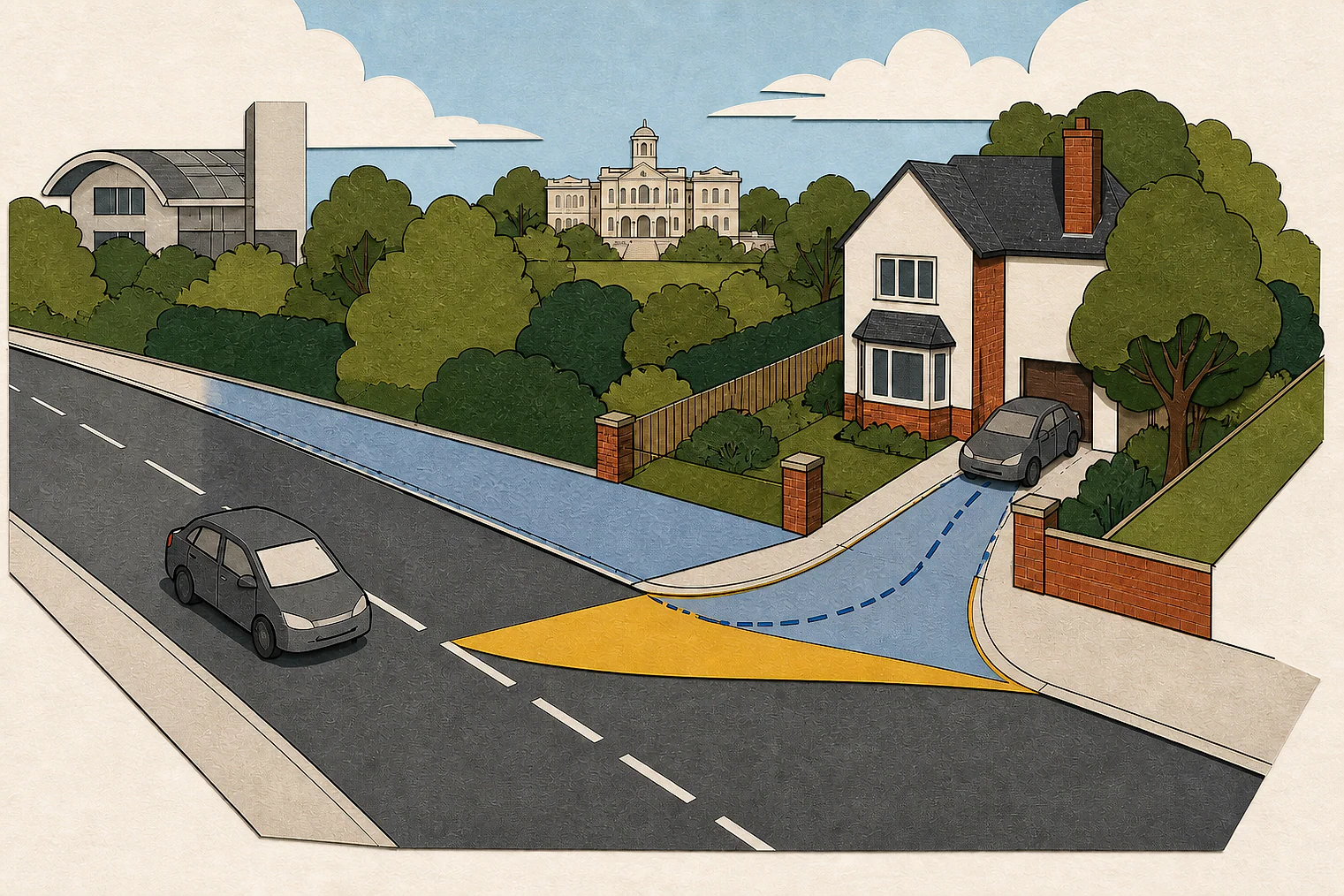
Planning Data area point: Ealing LPA (51.522222, −0.33448). This is the published representative point for the authority boundary, not a town hall, camera position or appeal site.
London Borough of Ealing appeal findings
Ealing crossovers, driveways and driver distraction
Some selected dismissals give only a conclusion, not the underlying analysis. The multifunction hub example also includes advertisement safety, so it sits at the edge of a home-access comparison.
Counted against appeals
Ealing access and display safety concerns
Changing images distracted drivers
The Inspector considered the hub’s siting, scale, brightness and changing images a distraction to drivers that harmed highway safety.
A condition did not mitigate harm
The Inspector concluded that a suggested condition would not mitigate the highway-safety harm from creating an access and driveway.
Safe highway use was harmed
The Inspector concluded that the front driveway and EV-charging proposal would harm safe highway use for all users.
Helped or needed
Evidence behind allowed Ealing crossovers
No evidence for second crossover harm
The Inspector said there was no substantive evidence explaining why a second dropped kerb would harm highway safety.
Nearby crossovers supported comparison
The proposal was comparable to nearby properties where the Council was satisfied a vehicular crossover would not affect highway safety.
No significant conflict was shown
The Inspector was not persuaded the reversing arrangement would significantly increase conflict between road users.
Your refusal notice
Check these details
- Does the refusal identify a specific safety harm and evidence for it?
- Would your vehicle movements create conflict with pedestrians or other road users?
- Are there comparable nearby crossovers that support your access arrangement?
The conclusion-only extracts limit comparisons with the crossover and driveway reasoning shown here. These decisions do not predict another result.
Appeal evidence examples
Compare allowed and dismissed appeal reasoning
Each example separates the development, the Inspector-stated issue that selected it, and the reasoning from the decision. Compare the facts as well as the outcome: these examples do not predict how a different proposal would be decided.
Allowed appeal examples
2 examples
9 January 2026 · Allowed
Development described in the decision
crossover and insertion of kerb dropdown to create parking access on to front garden.
Issue identified by the Inspector
The main issue is the effect of the proposed development on highway safety.
Paragraph 4 · Source page 1
Reasoning from the decision
I have had regard to the guidelines with regards the quantum of crossovers per dwelling set out in the Crossover Application Pack. The proposed development would conflict with these guidelines through the introduction of a second vehicular crossover for a single residential property. However, whilst the Council state that harm to highway safety would occur as a result of a second dropped kerb, no substantive evidence is before me as to why harm would result from such an arrangement. Given my observations above with regards the effect of the proposed development on highway safety, I therefore accord the conflict with the requirements of the Crossover Application Pack limited weight.
Paragraph 11 · Source page 2
1 October 2021 · Allowed
Development described in the decision
the formation of a vehicular crossover.
Issue identified by the Inspector
The main issue is the effect of the proposal on highway safety.
Paragraph 4 · Source page 2
Reasoning from the decision
Whilst the appeal proposal would necessitate a vehicle to either enter or leave the site in reverse gear, I am unable to identify how the arrangement proposed would not be compliant with the DKAPR. It would be comparable to the circumstances at two nearby properties where the Council were recently satisfied that the provision of a vehicular crossover would not impact on highway safety. Based on the evidence that is before me, I am not persuaded that the proposal would introduce any significant increase in the potential for conflict between road users that would impact upon highway safety. I therefore find no conflict with Policy 1.1 of the Ealing Development Strategy 2026 – Development Plan Document insofar as it seeks to support sustainable, safe, and convenient transport networks in the Borough. Policy 6.3 of the LP 2016 is also referenced in the decision notice but this has been superseded and is not relevant.
Paragraph 10 · Source page 3
Dismissed appeal examples
3 examples
5 May 2026 · Dismissed
Development described in the decision
described as the installation of a modern, multifunction Hub unit featuring an integral advertisement display and defibrillator.
Issue identified by the Inspector
The main issues in respect of Appeal A are the effect of the proposal upon (i) the character and appearance of the area and (ii) the effect upon highway safety. The main issues in respect of Appeal B are the effect of the proposed advertisement upon (i) the visual amenity of the area and (ii) public safety.
Paragraph 7 · Source page 2
Reasoning from the decision
I consider that these factors would mean that the proposed multifunctional hub would be a particularly unwelcome distraction to drivers, causing an adverse impact upon highway safety. Therefore, I conclude that the proposed development, by its siting with regard to appeal A, and by it siting, scale, brightness and its changing images with regard appeal B, would not accord to LP policies D3 and D8 which require proposed development to achieve safe environments.
Paragraph 18 · Source page 3
24 March 2026 · Dismissed
Development described in the decision
creation of a vehicular access and driveway.
Issue identified by the Inspector
The main issue is the effect of the proposal on highway safety, with particular regard to parking.
Paragraph 5 · Source page 1
Reasoning from the decision
Given the above, the proposal would be harmful to highway safety and would conflict with the National Planning Policy Framework (the ‘Framework’), which requires applications for development to create places that are safe and allow for access by emergency vehicles. The condition suggested by the appellant would not mitigate this harm.
Paragraph 9 · Source page 2
17 September 2025 · Dismissed
Development described in the decision
creating a front driveway to allow off-street parking and EV-charging.
Issue identified by the Inspector
The main issues are: • Whether the proposed development would preserve or enhance the character or appearance of the Acton Green Conservation Area (CA). • The effect of the proposal on highway safety.
Paragraph 4 · Source page 1
Reasoning from the decision
With this and the above in mind, the proposals would be harmful to the safe use of the highway for all users. It would thus conflict with London Plan (2021) Policy T6 and Policy 1.1 (f) of the Ealing Development (Core) Strategy (2012) insofar as they seek to ensure development does not have an adverse effect on the highway network. The proposal would conflict with the Dropped Kerb Application Pack for Residents (July 2021) insofar as it seeks good design that does not have an adverse impact on pedestrian and highway safety. The proposal would also conflict with relevant paragraphs within the National Planning Policy Framework (2024), insofar as they seek to protect the highway network and promote sustainable transport and safe, healthy streets.
Paragraph 17 · Source page 3