
Local planning policy field guide
East Suffolk Council planning policy summary
Explore East Suffolk Council’s planning requirements for common proposals, with the local tests, application evidence and official documents gathered in one place.
AI-generated from the linked official sources; not editorially reviewed. How these summaries are prepared.
- Local answers
- 16
- Official documents cited
- 2
- Planning sections
- 12
- Sources checked
- 5 September 2026
What this guide covers
Current district-wide policies in the adopted Suffolk Coastal Local Plan and Waveney Local Plan relevant to common residential proposals. The applicable plan depends on the former district area. Policies maps, site allocations, made neighbourhood plans, supplementary documents, local validation requirements, the emerging East Suffolk Local Plan and address-specific constraints must also be checked where relevant.
Popular checks
Start with a common planning question
Section 1
Consent, policy and location
Current development plan and policy hierarchy
What current plan documents and retained policies does the authority say form the development plan, and how should conflicts or transitions be handled?
East Suffolk currently has two principal adopted Local Plans: the Suffolk Coastal Local Plan applies in the former Suffolk Coastal area and the Waveney Local Plan applies in the former Waveney area until a district-wide replacement is adopted.
- When this answer applies
- First establish which former district contains the site, then use that plan with its policies map and any made neighbourhood plan or other adopted development-plan document.
Details and exceptions
- The emerging East Suffolk Local Plan is not yet the adopted replacement; check its weight and any later adoption at the application date.
Sources used
- Suffolk Coastal Local Plan (opens in a new tab)Development plan— Foreword and Introduction, printed pages 1–4, PDF pages 10–13
- Waveney Local Plan (opens in a new tab)Development plan— Foreword and section 1, printed pages 1–5, PDF pages 9–13
Settlement boundaries
How does the authority treat development inside or outside defined settlement limits?
Policy SCLP3.3 treats development within defined settlement boundaries as acceptable in principle, subject to other policies, and treats land outside boundaries and allocations as countryside; Waveney Policy WLP1.2 sets the corresponding settlement hierarchy and distribution framework for its plan area.
- When this answer applies
- Relevant to the principle and scale of new development; the adopted policies map establishes the exact boundary and allocation.
Details and exceptions
- A position inside a boundary does not override design, amenity, infrastructure, environmental or site-specific policy, and land outside a boundary may proceed only through an applicable countryside or other exception.
Sources used
- Suffolk Coastal Local Plan (opens in a new tab)Development plan— Policy SCLP3.3, printed page 50, PDF page 59
- Waveney Local Plan (opens in a new tab)Development plan— Policy WLP1.2, printed page 34, PDF page 42
Countryside development
What does the authority say about development in the countryside or rural areas outside settlements?
Suffolk Coastal Policy SCLP5.3 limits countryside housing to specified categories such as affordable exceptions, qualifying infill, replacement, subdivision, conversion and essential rural-worker homes. Waveney Policy WLP8.7 provides a separate limited infill route in defined circumstances.
- When this answer applies
- Relevant to residential proposals outside settlement boundaries and allocated sites in the applicable former district.
Details and exceptions
- Each route has its own detailed tests and must be applied with the policies map, landscape, access, ecology and amenity policies; it is not a general presumption for countryside housing.
Sources used
- Suffolk Coastal Local Plan (opens in a new tab)Development plan— Policy SCLP5.3, printed pages 88–90, PDF pages 97–99
- Waveney Local Plan (opens in a new tab)Development plan— Policy WLP8.7, printed pages 212–214, PDF pages 220–222
Other planning topics9
Keep these national checklist topics in mind alongside the local requirements above.
- Neighbourhood plan applicability
- Site allocations and site-specific policy
- Design codes and masterplans
- Green Belt development
- Local separation and green-wedge designations
- Planning permission and application route
- Permitted development and local limitations
- Prior approval requirements
- Article 4 directions
Section 2
Neighbour amenity
Privacy, overlooking and separation
How does the authority assess privacy, overlooking and separation between buildings or amenity areas?
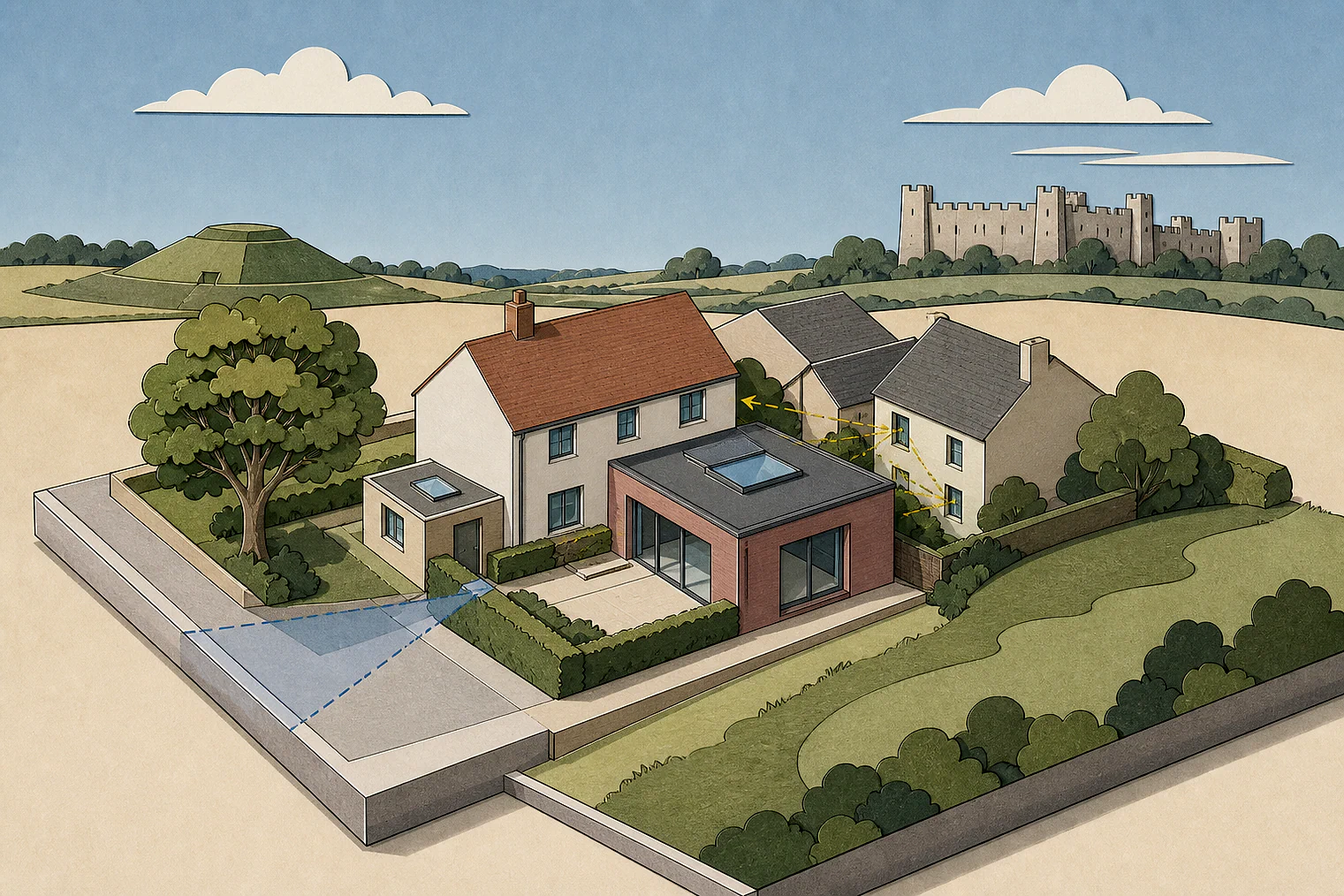
Suffolk Coastal Policy SCLP11.2 protects privacy, outlook, daylight and sunlight and considers noise, lighting and air quality; Waveney Policy WLP8.33 expressly resists unacceptable overlooking, light loss and overbearing effects in infill schemes.
- When this answer applies
- Relevant where a proposal could affect existing or future residents, especially infill, extensions and closely spaced housing.
Details and exceptions
- Neither cited policy creates a universal separation or 45-degree rule; window relationships, levels, orientation, use and context require case-specific assessment.
Sources used
- Suffolk Coastal Local Plan (opens in a new tab)Development plan— Policy SCLP11.2, printed pages 185–187, PDF pages 194–196
- Waveney Local Plan (opens in a new tab)Development plan— Policy WLP8.33, printed pages 261–262, PDF pages 269–270
Other planning topics5
Keep these national checklist topics in mind alongside the local requirements above.
- Daylight, sunlight, overshadowing and overbearing impact
- Outlook and enclosure
- Noise and vibration
- Odour, fumes and dust
- Artificial light and glare
Section 3
Design, form and character
Character, context and placemaking
What does the authority say about responding to local character, townscape, context, public realm, legibility and inclusive or safe design?
Policies SCLP11.1 and WLP8.29 require high-quality development that responds to local character, landscape, heritage, scale, form, materials, movement, public realm, safety and inclusive design.
- When this answer applies
- Applies to development across both plan areas.
Details and exceptions
- The design response is site-specific and should use relevant conservation-area appraisals, neighbourhood plans, design codes and landscape evidence.
Sources used
- Suffolk Coastal Local Plan (opens in a new tab)Development plan— Policy SCLP11.1, printed pages 184–185, PDF pages 193–194
- Waveney Local Plan (opens in a new tab)Development plan— Policy WLP8.29, printed pages 255–257, PDF pages 263–265
Related local appeal evidence
Area character and appearance
51 matched decision families in this local evidence view.
- 9 allowed
- 42 dismissed
Other planning topics8
Keep these national checklist topics in mind alongside the local requirements above.
- Layout, siting and building lines
- Scale, height and massing
- Side spacing and terracing
- Extensions
- Roof alterations and dormers
- Outbuildings and ancillary structures
- Materials and architectural detail
- Boundaries, frontages and entrances
Section 4
Residential quality and housing form
Infill, backland and garden development
What does the authority say about infill, backland and residential-garden development?
Policies SCLP5.7 and WLP8.33 assess infill against scale, siting, design, local character, access, parking, trees and residential amenity; the Waveney policy expressly considers overlooking, loss of light and overbearing effects.
- When this answer applies
- Relevant to small gaps, backland plots and garden sites in built-up areas or qualifying rural locations.
Details and exceptions
- The proposal must first satisfy the relevant settlement or countryside policy; being described as infill does not establish acceptability.
Sources used
- Suffolk Coastal Local Plan (opens in a new tab)Development plan— Policy SCLP5.7, printed pages 95–96, PDF pages 104–105
- Waveney Local Plan (opens in a new tab)Development plan— Policy WLP8.33, printed pages 261–262, PDF pages 269–270
Other planning topics11
Keep these national checklist topics in mind alongside the local requirements above.
- Internal space standards
- Private amenity space
- Shared amenity and play space
- Accessible and adaptable homes
- Housing mix, size and density
- Older-person, care and supported housing
- Build to rent
- Student and co-living accommodation
- Annexes and ancillary accommodation
- Subdivision and flat conversion
- HMOs and room-based shared housing
Section 5
Movement, parking and servicing
Vehicle parking
What does the authority say about vehicle-parking quantities, dimensions, layout and flexibility?
Policy SCLP7.2 requires safe, secure and appropriate vehicle and cycle parking, electric-vehicle charging and surface-water management, with the amount informed by the Suffolk Guidance for Parking rather than one district-wide number in the policy.
- When this answer applies
- Relevant to new development and changes of use that create parking or servicing demand in the former Suffolk Coastal area; corresponding Waveney transport policy applies there.
Details and exceptions
- Use the current edition of Suffolk parking guidance and current Building Regulations charging requirements.
Sources used
- Suffolk Coastal Local Plan (opens in a new tab)Development plan— Policy SCLP7.2, printed pages 135–137, PDF pages 144–146
- Waveney Local Plan (opens in a new tab)Development plan— Policy WLP8.21, printed pages 236–238, PDF pages 244–246
Other planning topics9
Keep these national checklist topics in mind alongside the local requirements above.
- Access, highway safety and visibility
- Accessible parking
- Cycle parking and storage
- Electric-vehicle charging
- Turning, emergency access and tracking
- Servicing, loading and deliveries
- Refuse and recycling storage and collection
- Active travel and public transport
- Transport impacts, mitigation and monitoring
Section 6
Heritage, archaeology and views
Other planning topics5
Keep these national checklist topics in mind alongside the local requirements above.
- Listed buildings and their setting
- Conservation areas
- Non-designated heritage assets
- Archaeology
- Historic landscapes and important views
Section 7
Nature, landscape and open space
Other planning topics10
Keep these national checklist topics in mind alongside the local requirements above.
- Trees and tree preservation
- Hedgerows
- Ancient woodland and veteran trees
- Protected species
- Designated habitats and impact zones
- Biodiversity net gain
- Nationally designated landscapes
- Landscape character and visual impact
- Local Green Space
- Green infrastructure, open space and recreation
Section 8
Flooding, environment and climate
Flood risk and the sequential approach
What does the authority say about flood zones, sequential and exception tests, vulnerability, levels and resilience?
Policies SCLP9.5 and WLP8.24 apply the sequential and, where required, exception approach to flood risk, require proportionate site-specific assessment and seek development that is safe without increasing risk elsewhere.
- When this answer applies
- Relevant to sites at risk from any source of flooding and to proposals for which current national policy requires a sequential test or Flood Risk Assessment.
Details and exceptions
- Use current national policy, flood maps, climate allowances and the latest strategic flood-risk evidence.
Sources used
- Suffolk Coastal Local Plan (opens in a new tab)Development plan— Policy SCLP9.5, printed pages 159–161, PDF pages 168–170
- Waveney Local Plan (opens in a new tab)Development plan— Policy WLP8.24, printed pages 243–246, PDF pages 251–254
Drainage and sustainable drainage
What does the authority say about surface-water hierarchy, runoff, attenuation, SuDS, adoption and maintenance?
Policy SCLP9.6 requires sustainable drainage on major development unless shown inappropriate and seeks greenfield runoff or at least 30% betterment on brownfield sites; WLP8.24 also requires appropriate sustainable drainage and protection of receiving waters.
- When this answer applies
- SCLP9.6 defines major development here as ten or more homes, at least 1,000 square metres of floorspace or a site of at least one hectare; other current national drainage triggers may also apply.
Details and exceptions
- Detailed discharge rates, drainage hierarchy, water quality, maintenance and adoption arrangements depend on the site and current flood-authority guidance.
Sources used
- Suffolk Coastal Local Plan (opens in a new tab)Development plan— Policy SCLP9.6, printed pages 161–163, PDF pages 170–172
- Waveney Local Plan (opens in a new tab)Development plan— Policy WLP8.24, printed pages 243–246, PDF pages 251–254
Coastal change and erosion
What does the authority say about coastal change, erosion, tidal and shoreline-management areas?
Policies SCLP9.3 and WLP8.25 tightly control development in Coastal Change Management Areas and require a Coastal Erosion Vulnerability Assessment for proposals in the mapped area and within 30 metres landward of it; permanent residential development is not supported in the Waveney area.
- When this answer applies
- Relevant to sites in or close to a mapped Coastal Change Management Area or shoreline management-policy boundary.
Details and exceptions
- Check the latest policies map, shoreline-management evidence and the precise development lifetime; the Suffolk Coastal policy also flags a wider consideration distance at soft cliffs.
Sources used
- Suffolk Coastal Local Plan (opens in a new tab)Development plan— Policy SCLP9.3, printed pages 154–157, PDF pages 163–166
- Waveney Local Plan (opens in a new tab)Development plan— Policy WLP8.25, printed pages 246–249, PDF pages 254–257
Water efficiency
What does the authority say about potable-water efficiency and consumption standards?
Policies SCLP9.2 and WLP8.28 require new homes to achieve an internal water-use rate of 110 litres per person per day, subject in the Waveney policy to feasibility and viability.
- When this answer applies
- Relevant to new residential development in both plan areas.
Details and exceptions
- Confirm the current optional Building Regulations requirement and evidence route at application and building-control stages.
Sources used
- Suffolk Coastal Local Plan (opens in a new tab)Development plan— Policy SCLP9.2, printed pages 150–153, PDF pages 159–162
- Waveney Local Plan (opens in a new tab)Development plan— Policy WLP8.28, printed pages 252–254, PDF pages 260–262
Other planning topics7
Keep these national checklist topics in mind alongside the local requirements above.
- Contaminated land
- Land stability and mining legacy
- Air quality
- Water environment, wastewater and nutrients
- Energy, carbon and sustainable construction
- Overheating and climate resilience
- Agricultural land and soils
Section 9
Housing delivery and contributions
Affordable housing
What does the authority say about affordable-housing thresholds, percentages, tenure or mix, delivery and exceptions?
Policy SCLP5.10 seeks one affordable home for every three homes on qualifying Suffolk Coastal schemes and sets a 50% rented, 25% shared-ownership and 25% discounted-home-ownership mix. Waveney Policy WLP8.2 sets area-based targets of 20%, 30% or 40% and seeks half of affordable provision as rented tenure.
- When this answer applies
- SCLP5.10 applies to sites capable of ten or more homes or at least 0.5 hectares; WLP8.2 applies to sites capable of eleven or more homes, subject in both cases to their full policy wording.
Details and exceptions
- Check current national affordable-housing policy, any current council guidance and the site's viability before relying on an adopted-plan threshold or tenure split.
- On-site provision is preferred, with off-site provision or a contribution only in the policy's stated circumstances.
Sources used
- Suffolk Coastal Local Plan (opens in a new tab)Development plan— Policy SCLP5.10, printed pages 106–109, PDF pages 115–118
- Waveney Local Plan (opens in a new tab)Development plan— Policy WLP8.2, printed pages 204–206, PDF pages 212–214
Other planning topics4
Keep these national checklist topics in mind alongside the local requirements above.
- Community Infrastructure Levy
- Section 106 and infrastructure contributions
- Viability
- Delivery, phasing and monitoring
Section 10
Application evidence and validation
Heritage and archaeology evidence
What does the authority say about when heritage statements, impact assessments, appraisals and archaeological evidence are required?
Policies SCLP11.3 and WLP8.37 require proportionate, expert heritage evidence for proposals that could affect a heritage asset or its setting, including archaeological assessment where the potential for remains exists.
- When this answer applies
- Relevant to listed buildings, conservation areas, scheduled monuments, archaeological sites, non-designated assets, historic landscapes and their settings.
Details and exceptions
- Evidence depth depends on significance and likely impact; the Historic Environment Record and current national heritage policy should inform the assessment.
Sources used
- Suffolk Coastal Local Plan (opens in a new tab)Development plan— Policy SCLP11.3, printed pages 188–192, PDF pages 197–201
- Waveney Local Plan (opens in a new tab)Development plan— Policy WLP8.37, printed pages 270–273, PDF pages 278–281
Trees, landscape, ecology and BNG evidence
What does the authority say about when tree, landscape, ecological, protected-species and biodiversity-net-gain evidence is required?
Policies SCLP10.1 and WLP8.34 require ecological evidence where protected or priority species, habitats or designated sites may be affected and apply an avoid, mitigate and compensate approach while supporting habitat connections and enhancement.
- When this answer applies
- Relevant where desk study, site features or designated-site pathways indicate a potential ecological effect.
Details and exceptions
- Survey timing and scope must suit the species and current law; mandatory biodiversity net gain and Habitats Regulations assessment are separate current requirements where triggered.
Sources used
- Suffolk Coastal Local Plan (opens in a new tab)Development plan— Policy SCLP10.1, printed pages 168–172, PDF pages 177–181
- Waveney Local Plan (opens in a new tab)Development plan— Policy WLP8.34, printed pages 263–266, PDF pages 271–274
Transport, parking and travel evidence
What does the authority say about when access drawings, parking evidence, transport statements or assessments, tracking and travel plans are required?
Policies SCLP7.1 and WLP8.21 require transport effects to be addressed and identify proportionate Transport Statements, Transport Assessments and Travel Plans for housing and other development, alongside safe access and walking, cycling and public-transport measures.
- When this answer applies
- Relevant to proposals that create material trip generation or network effects.
Details and exceptions
- The plans contain scale thresholds, but current highway guidance and the development's actual effects determine the appropriate document; agree scope with the highway authority.
Sources used
- Suffolk Coastal Local Plan (opens in a new tab)Development plan— Policy SCLP7.1, printed pages 132–134, PDF pages 141–143
- Waveney Local Plan (opens in a new tab)Development plan— Policy WLP8.21, printed pages 236–238, PDF pages 244–246
Energy, sustainability and climate evidence
What does the authority say about when energy, carbon, sustainability, overheating and water-efficiency evidence is required?
Policy SCLP9.2 applies an energy-performance requirement to residential schemes over ten homes and a BREEAM requirement to qualifying non-residential floorspace; WLP8.28 requires a Sustainability Statement for major housing and larger non-residential proposals.
- When this answer applies
- Relevant to major residential development and non-residential schemes meeting the policy floorspace threshold.
Details and exceptions
- The exact plan-era carbon and BREEAM benchmarks must be reconciled with current Building Regulations, national policy and any current local guidance before design or validation.
Sources used
- Suffolk Coastal Local Plan (opens in a new tab)Development plan— Policy SCLP9.2, printed pages 150–153, PDF pages 159–162
- Waveney Local Plan (opens in a new tab)Development plan— Policy WLP8.28, printed pages 252–254, PDF pages 260–262
Other planning topics8
Keep these national checklist topics in mind alongside the local requirements above.
- Local validation list and core information
- Design and Access and Planning Statements
- Flood, drainage and water evidence
- Ground and pollution evidence
- Affordable housing, viability and contributions evidence
- Construction, demolition and waste evidence
- Environmental Impact Assessment
- Fire statements and planning-gateway evidence
Section 11
Economic, community and specialist uses
Other planning topics22
Keep these national checklist topics in mind alongside the local requirements above.
- Employment sites and premises
- Retail, town centres and main-town-centre uses
- Community facilities
- Tourism and visitor accommodation
- Agriculture and farm diversification
- Rural workers' dwellings
- Equestrian development
- Traveller, Gypsy and showpeople sites
- Caravan, camping and holiday parks
- Aviation, airports and aerodrome safeguarding
- Telecommunications
- Advertisements and signage
- Shopfront design
- Solar energy
- Wind energy
- Battery energy storage
- Other renewable and low-carbon infrastructure
- Hazardous installations and pipelines
- Defence, radar and technical safeguarding
- Ports and strategic transport infrastructure
- Minerals
- Waste development
Section 12
Separate consents and private matters
Other planning topics6
Keep these national checklist topics in mind alongside the local requirements above.
- Building Regulations
- Party Wall matters
- Private rights to light
- Covenants, boundaries and ownership
- Highway licences and adoption
- Environmental and other permits
Source library
Official documents used
Every requirement above links to its supporting document and source location. Browse all of the cited East Suffolk Council sources together here.
Browse 2 cited documents
- Suffolk Coastal Local Plan (opens in a new tab)Development plan
East Suffolk Council
View official document page (opens in a new tab) - Waveney Local Plan (opens in a new tab)Development plan
East Suffolk Council · Adopted 20 March 2019
View official document page (opens in a new tab)