
Epsom and Ewell Borough Council appeal evidence
Refused over neighbour living conditions in Epsom and Ewell?
See the selected evidence on noise, privacy and the limited allowed comparison.
Recently refused?
Create a free account for a private planning workspace.
No payment at signup. Refusal-review ordering may not be open.
- Matched locally
- 18 of 67
- eligible decision families
- Allowed
- 5
- matched appeal records
- Dismissed
- 13
- matched appeal records
- Householder
- 13
- of 18 matched records
AI-assisted. Cited sources and wording were checked before publication. Based on 5 source-linked examples shown below. Review method and limits.
Planning Data area point: Epsom and Ewell LPA (51.339172, −0.261422). This is the published representative point for the authority boundary, not a town hall, camera position or appeal site.
Epsom and Ewell Borough Council appeal findings
Neighbour noise and privacy in Epsom and Ewell
Among the selected examples, the only allowed extract concerns future occupants, not neighbours, and records only the Inspector’s conclusion.
Counted against appeals
Noise evidence and privacy harm
Noise protection needed proof
For the hub, the Inspector found insufficient evidence that neighbours’ living conditions would not be harmed and referred to noise pollution.
Privacy harm at one neighbour
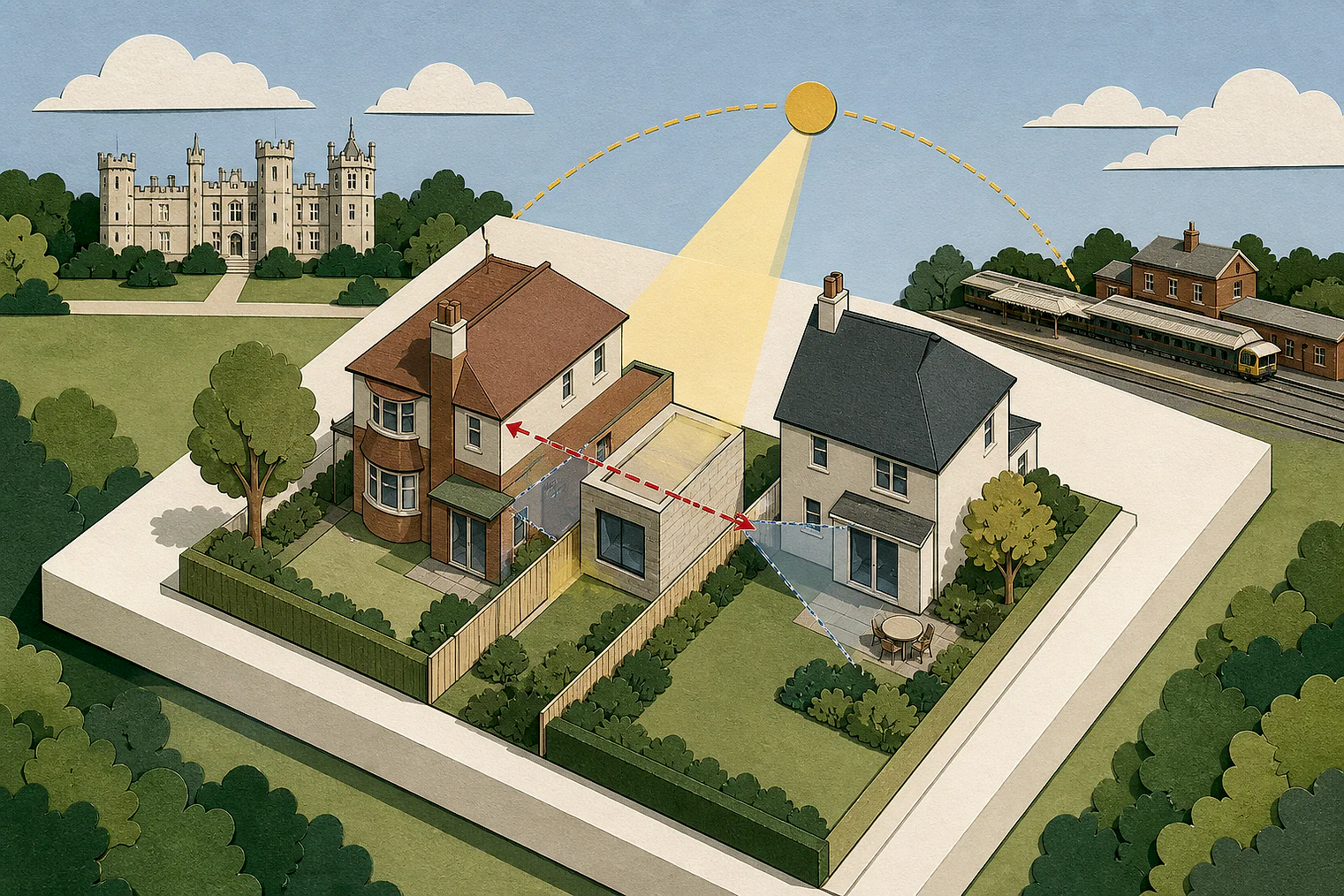
The extension scheme did not harm daylight, sunlight or privacy at No 1, but was found to harm privacy at No 5.
Helped or needed
Allowed loft conversion conclusion
No adverse effect concluded
The Inspector concluded the loft conversion and rear extension would not adversely affect future occupants. The extract gives no supporting analysis.
Your refusal notice
Check these details
- Does the refusal say what evidence is needed to avoid neighbour noise harm?
- Which neighbour’s privacy does the refusal say would be affected?
- Does the refusal distinguish existing neighbours from future occupants?
In the selected examples, 90248 and 86427 find no neighbour harm but do not explain why the appeals were dismissed. These decisions do not predict another result.
Appeal evidence examples
Compare allowed and dismissed appeal reasoning
Each example separates the development, the Inspector-stated issue that selected it, and the reasoning from the decision. Compare the facts as well as the outcome: these examples do not predict how a different proposal would be decided.
Allowed appeal examples
1 example
11 July 2024 · Allowed
Development described in the decision
Loft conversion to detached bungalow with the demolishing of rear day room to replaced with a new extension across the rear of building.
Issue identified by the Inspector
I consider that the main issues in this case are its effect on the character and appearance of the area and on the living conditions of neighbouring residents.
Paragraph 3 · Source page 2
Reasoning from the decision
I conclude that the proposal would not adversely affect the living conditions of future occupants and in this respect, it is consistent with DM9 and DM10 of the DMPD and policy CS5 of the [name].
Paragraph 11 · Source page 3
Dismissed appeal examples
4 examples
11 June 2026 · Dismissed
Development described in the decision
Installation of 1No. [address] [name] and associated advertisement panels on either side of the unit.
Issue identified by the Inspector
The main issues in respect of Appeal A is the effect of the proposal on the character and appearance of the area; and the effect on living conditions of neighbouring occupiers, with particular regard to noise and disturbance.
Paragraph 5 · Source page 2
Reasoning from the decision
For the reasons above, I conclude that the street hub would not unduly harm the living conditions of neighbouring occupiers. In relation to Appeal A, the proposal would comply with Policies CS5 and CS6 of the CS and Policy DM10 of the DMPD insofar as they require proposals to have regard to the amenities of neighbouring Appeal Decisions 6005158 and 6005159 occupiers. Nor would there be conflict with the aims of the Framework which seeks to create places that are safe, inclusive and accessible and which promote health and well-being, with a high standard of amenity for existing and future users.
Paragraph 19 · Source pages 3, 4
19 May 2026 · Dismissed
Development described in the decision
the installation of 1No. [address] Hub.
Issue identified by the Inspector
For appeal A, the main issues are the effect of the proposal on: the character and appearance of the area, and; the living conditions of nearby residents with particular regard to noise.
Paragraph 5 · Source page 2
Reasoning from the decision
I conclude therefore that there is insufficient evidence that the proposal would not harm the living conditions of neighbouring residents. As a consequence, the proposal would conflict with CS Policy CS6 and DMD Policy DM10 insofar as they require proposals to have regard to the amenities of neighbours and minimise noise pollution.
Paragraph 16 · Source page 3
24 March 2026 · Dismissed
Development described in the decision
four new dwellings.
Issue identified by the Inspector
The main issues are: • the effect of the proposed development on the character and appearance of the area; • the effect of the proposed development on protected species; • whether or not the mandatory biodiversity net gain (BNG) requirements are met; • the effect of the proposed development on the living conditions of neighbouring occupiers, with particular reference to privacy; and • whether or not the proposed development would provide adequate living conditions for future occupiers, with particular reference to the provision of living space.
Paragraph 4 · Source page 1
Reasoning from the decision
I conclude that the proposed development would not result in a harmful effect on the living conditions of neighbouring occupiers, with particular reference to privacy. In this regard, there would be no conflict with Policies DM10 and DM16 of the DMPD which require development proposals to have regard to the amenities of neighbours and require the privacy of homes and gardens to be maintained. For the same reasons, the proposed development would not conflict with the Framework insofar as it requires a high standard of amenity for existing users.
Paragraph 22 · Source page 4
4 April 2025 · Dismissed
Development described in the decision
described as ‘Lower ground extension below patio. 3.5m ground floor pitched roof rear extension with 2 x skylights, rear doors and large window and internal alterations. [name] above existing ground floor porch with internal alterations. Loft conversion with adjustment to roof form and two characterful rear dormer windows to rear hip and skylight above flat part of roof.’
Issue identified by the Inspector
The effect of the proposal on the living conditions of the neighbouring occupiers of 1 and [address] (nos 1 and 5), with particular regard to daylight, sunlight and privacy; and
Paragraph 2 · Source page 1
Reasoning from the decision
The proposal would not cause harm with regard to loss of daylight or sunlight, and nor via loss of privacy to occupants at no 1. However , the appeal scheme would adversely affect the living conditions of the neighbouring occupiers at no 5, with particular regard to privacy. Therefore, in that respect, the proposal conflicts with Policy DM10 of the DMPD, which seeks to respect living conditions of occupants and neighbours. The proposal does not conflict with Policy DM9, as it does not relate to living conditions.
Paragraph 11 · Source page 3