
Fareham Borough Council appeal evidence
Refused over neighbour living conditions in Fareham?
See which neighbour effects were found unacceptable in Fareham, and what the selected family-room decision concluded.
Recently refused?
Create a free account for a private planning workspace.
No payment at signup. Refusal-review ordering may not be open.
- Matched locally
- 6 of 20
- eligible decision families
- Allowed
- 1
- matched appeal records
- Dismissed
- 5
- matched appeal records
- Householder
- 4
- of 6 matched records
AI-assisted. Cited sources and wording were checked before publication. Based on 5 source-linked examples shown below. Review method and limits.
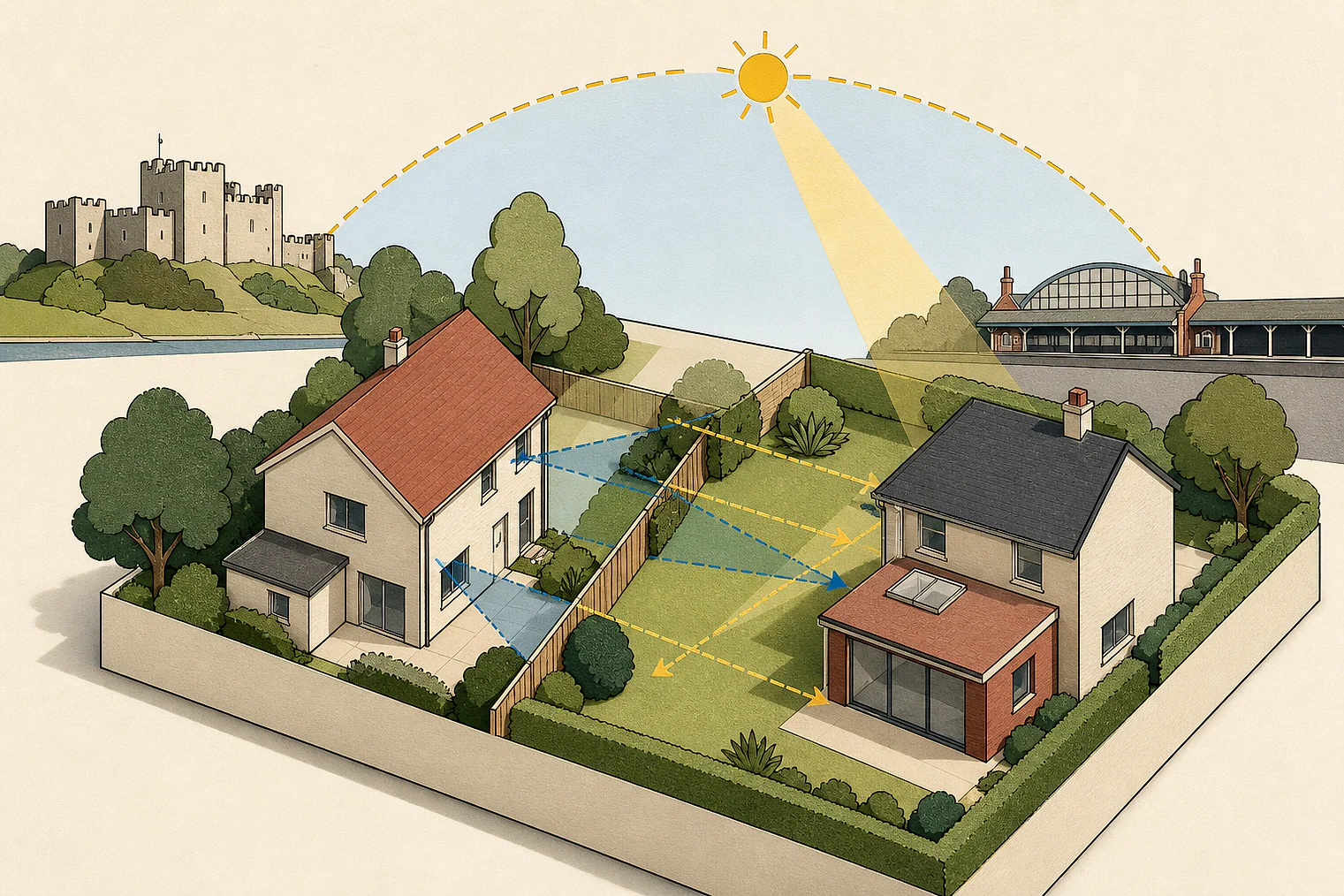
Planning Data area point: Fareham LPA (50.852632, −1.224654). This is the published representative point for the authority boundary, not a town hall, camera position or appeal site.
Fareham Borough Council appeal findings
Fareham’s privacy, light and noise findings
Several selected examples give conclusion-only extracts. Appeal 14147 found no significant neighbour harm, so it is outside the concern findings.
Counted against appeals
Unacceptable effects on Fareham neighbours
Conditions did not cure the harm
In appeal 83598, suggested conditions and amelioration measures did not remove unacceptable living conditions for No 4.
Privacy was a named issue
Appeals 25693 and 25671 named privacy as the issue, then concluded the proposals would unacceptably affect neighbouring occupiers’ living conditions.
Helped or needed
Family room’s neighbour finding
No harm across listed effects
Appeal 4031 concluded the family room would not harm neighbours’ outlook, daylight, privacy, light spill or noise.
Your refusal notice
Check these details
- Which neighbour and living condition does the refusal identify?
- Does it specify privacy, outlook, daylight, light spill or noise?
- Would changes remove harm rather than rely on conditions?
In selected example 4031, the family-room extract is conclusion-only, so it does not show how the Inspector reached the finding. These decisions do not predict another result.
Appeal evidence examples
Compare allowed and dismissed appeal reasoning
Each example separates the development, the Inspector-stated issue that selected it, and the reasoning from the decision. Compare the facts as well as the outcome: these examples do not predict how a different proposal would be decided.
Allowed appeal examples
1 example
30 September 2021 · Allowed
Development described in the decision
No verified development description was available for this example.
Issue identified by the Inspector
The main issues are the effect of the development on: • the character and appearance of the area; and • the living conditions of the occupiers of neighbouring houses having regard to outlook, daylight, privacy, light spill and noise.
Paragraph 5 · Source page 2
Reasoning from the decision
Considering the above, I find that the family room would not cause harm to the living conditions of the occupiers of neighbouring houses having regard to outlook, daylight, privacy, light spill and noise. Consequently, it would comply with Policy DSP3 of the Fareham Local Plan Part 2: Development Sites and Policies, June 2015. This policy includes that development should ensure no unacceptable adverse impact upon living conditions of neighbouring development by way of loss of sunlight, daylight, outlook and privacy. It would also be consistent with the Framework which seeks to ensure that development would provide a high standard of amenity for existing users, such as the occupiers of neighbouring houses.
Paragraph 17 · Source page 4
Dismissed appeal examples
4 examples
30 January 2026 · Dismissed
Development described in the decision
to sever land, demolish garage and erect pair of semi detached 2 & 3 bed bungalows with parking. Creation of new vehicular access for parking for existing house.
Issue identified by the Inspector
The main issues in this case are: - The effect of the scheme upon the character and appearance of the area; - The effect upon the living conditions of nearby residents, with particular regard to noise and disturbance; and - The effect upon protected habitat sites.
Paragraph 2 · Source page 1
Reasoning from the decision
The scheme would result in unacceptable living conditions for the occupiers of No 4, and the suggested conditions and amelioration measures would not mitigate these harms. There would be conflict with the requirements of LP Policy D2 as it requires, amongst other things, that development does not have an unacceptable adverse impact upon the environmental conditions of neighbouring occupants.
Paragraph 13 · Source page 3
22 December 2022 · Dismissed
Development described in the decision
described as external alterations to include a front extension, a rear balcony, a first floor side extension and a second floor extension.
Issue identified by the Inspector
The main issues are the effects of the proposals on: (i) the character and appearance of the surrounding area, and (ii) the living conditions of the occupiers of 12 and [address], with particular regard to privacy.
Paragraph 2 · Source page 1
Reasoning from the decision
For this reason I conclude that the proposal would have an unacceptable effect on the living conditions of occupiers of 12 and [address]. It therefore fails to comply with Policy DSP3 of the Fareham Local Plan Part 2: Development Sites and Policies (2015). This policy states that development proposals should ensure that there will be no unacceptable adverse impact upon living conditions on the site or neighbouring development, by way of the loss of sunlight, daylight, outlook and/or privacy.
Paragraph 8 · Source page 2
22 December 2022 · Dismissed
Development described in the decision
described as the raising of the roof to create rooms in roof space, the installation of rooflights, internal alterations and the erection of a porch.
Issue identified by the Inspector
The main issues are the effects of the proposals on: (i) the character and appearance of the surrounding area, and (ii) the living conditions of the occupiers of [address], with particular regard to privacy.
Paragraph 2 · Source page 1
Reasoning from the decision
For this reason, I conclude that the proposal would have an unacceptable effect on the living conditions of the occupiers of [address]. It therefore fails to comply with Policy DSP3 of the Fareham Local Plan Part 2: Development Sites and Policies (2015). This policy states that development proposals should ensure that there will be no unacceptable adverse impact upon living conditions on the site or neighbouring development, by way of the loss of sunlight, daylight, outlook and/or privacy.
Paragraph 8 · Source page 2
21 April 2022 · Dismissed
Development described in the decision
detached garage outbuilding with room above, associated storage, landscaping and access.
Issue identified by the Inspector
The main issues are the effect of the proposed development on: (a) the open character and appearance of the area, with particular regard to local amenities and the adjacent public footpath; and (b) the living conditions of neighbouring occupiers, with particular regard to overlooking.
Paragraph 3 · Source page 1
Reasoning from the decision
Accordingly, based on the above, I am satisfied that the appeal proposal would not lead to any significant harm to the living conditions of future neighbouring occupiers and would be compliant in this respect with policy DSP3 (Impact on living conditions) of the Fareham Borough Local Plan Part 2: Development Sites & Policies (2015).
Paragraph 17 · Source page 3