
London Borough of Hounslow appeal evidence
Refused over highway safety in Hounslow?
See why visibility, reversing and parking evidence mattered in selected Hounslow highway-safety appeals.
Recently refused?
Create a free account for a private planning workspace.
No payment at signup. Refusal-review ordering may not be open.
- Matched locally
- 22 of 286
- eligible decision families
- Allowed
- 4
- matched appeal records
- Dismissed
- 18
- matched appeal records
- Householder
- 18
- of 22 matched records
AI-assisted. Cited sources and wording were checked before publication. Based on 5 source-linked examples shown below. Review method and limits.
Planning Data area point: Hounslow LPA (51.468493, −0.366095). This is the published representative point for the authority boundary, not a town hall, camera position or appeal site.
London Borough of Hounslow appeal findings
Hounslow highway-safety evidence: visibility, reversing, parking
Selected example 50100 gives a conclusion, not detailed analysis. Example 90249 also gives only a highway-safety conclusion.
Counted against appeals
Blocked views, reversing and parking evidence
Obstructed south visibility
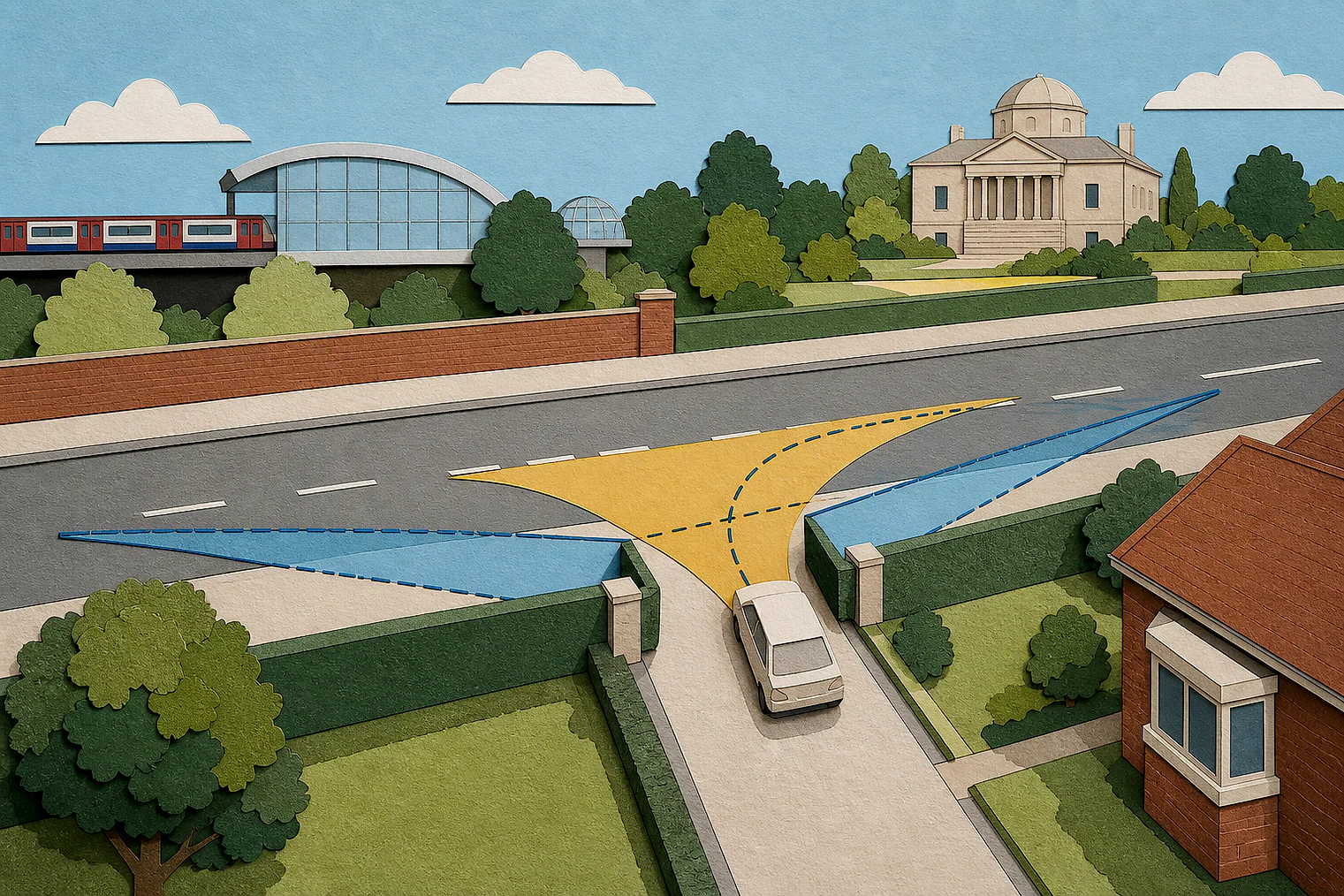
A post box, lamp post and street tree obstructed the south visibility splay at a crossover amid multi-directional traffic.
Reversing across a footway
Even modest vehicle movements required drivers to reverse across a footway with restricted visibility of other users.
Parking pressure needed testing
Without a parking stress survey, the effect of extra demand on highway safety could not be properly assessed.
Helped or needed
What the allowed crossover showed
No unacceptable safety impact
For the crossover, the Inspector found no unacceptable effect on highway or pedestrian safety.
Your refusal notice
Check these details
- Does the refusal identify anything blocking the needed visibility splay?
- Would drivers need to reverse across a footway with restricted visibility?
- Does the refusal need a parking stress survey or equivalent evidence?
Example 88250 is a nine-occupant HMO, so its parking evidence is an edge-of-scope comparison. These decisions do not predict another result.
Appeal evidence examples
Compare allowed and dismissed appeal reasoning
Each example separates the development, the Inspector-stated issue that selected it, and the reasoning from the decision. Compare the facts as well as the outcome: these examples do not predict how a different proposal would be decided.
Allowed appeal examples
1 example
25 April 2024 · Allowed
Development described in the decision
a crossover for vehicle access.
Issue identified by the Inspector
The main issue is the effect of the proposed crossover on pedestrian and highway safety.
Paragraph 2 · Source page 1
Reasoning from the decision
On balance, I find that in this instance there would not be an unacceptable impact on highway and pedestrian safety in harmful conflict with Policy EC2 of the Hounslow Local Plan 2015-2030 or with the Council’s SPD. I shall therefore allow the appeal. A condition requiring the development to be carried out in accordance with the approved plans is needed for the avoidance of doubt and is in the interests of proper planning.
Paragraph 9 · Source page 2
Dismissed appeal examples
4 examples
8 October 2025 · Dismissed
Development described in the decision
the formation of a dropped kerb to facilitate off-street parking, installation of a vehicle turntable and an electrical vehicle charging point together with associated alterations.
Issue identified by the Inspector
The main issue is the effect of the proposal on highway safety.
Paragraph 6 · Source page 2
Reasoning from the decision
By itself, the post-box impeding visibility for vehicles using the proposed crossover would lead to an unacceptable impact on highway safety due to the inadequate visibility splay combined with the competing multi directional traffic. This would be compounded by the placement of the lamp post near the post box and the large street tree, both of which would add an impediment to visibility. I am not convinced that vehicles, cyclists and motorcyclists would be visible to the south from the crossover, particularly given the competing multi-directional demands at this location. As such the proposal would provide an inadequate south visibility splay increasing the risk of conflict of users at this location resulting in an unacceptable impact on highway safety.
Paragraph 12 · Source page 2
11 June 2026 · Dismissed
Development described in the decision
change of use from car garage to sui generis i.e. MOT centre.
Issue identified by the Inspector
The main issues are: • the effect of the development on the living conditions of neighbouring occupants in regard to noise and disturbance; and • the effect of the development on highway safety.
Paragraph 3 · Source page 1
Reasoning from the decision
For the reasons detailed above the proposed development would have a harmful effect on highway safety. Therefore, it conflicts with Policy EC2 of the HLP which requires that developments demonstrate that adverse impacts on the transport network are avoided.
Paragraph 15 · Source page 3
5 May 2026 · Dismissed
Development described in the decision
Alteration from existing HMO (Use Class C4) to [name] (Use Class Sui Generis) for 9 occupants including a single storey rear infill
Issue identified by the Inspector
The Council does not contend that the proposed one-storey infill kitchen extension would cause harm to character and appearance of the area. Based on the evidence before me, I agree that its position at the rear of the building, its modest scale, and the use of materials that match the existing building, the extension proposed would not result in harm. Accordingly, the main issues are: • Whether the proposed 9 person HMO (Use Class Sui Generis) would be appropriately located, with particular regard to access to local services and public transport provision. • Whether the proposal provides acceptable living conditions for existing and future occupiers, with particular regard to internal space. • The effect of the development on the living conditions of neighbouring occupiers, with particular regard to noise and disturbance. • Whether the proposal provides adequate car parking provision and the effect on highway safety.
Paragraph 5 · Source page 2
Reasoning from the decision
Given that the proposal would increase number of occupants, each likely to form part of an independent household, the development could reasonably be expected to generate additional vehicle movements and corresponding rise in parking demand within the area. Overall, the proposal would be likely to place increased pressure on on-street parking. However, in the absence of a parking stress survey, the extent to which any additional parking demand would affect highway safety cannot be properly assessed. As such, the proposal would conflict with Policy EC2 of the Local Plan and the relevant SPD guidance.
Paragraph 17 · Source page 4
8 July 2024 · Dismissed
Development described in the decision
a dropped kerb.
Issue identified by the Inspector
The main issue is the effect of the proposed development on highway safety for users of [address].
Paragraph 2 · Source page 1
Reasoning from the decision
The number and frequency of vehicle movements using the new crossover would be modest. Even so, the appeal scheme would result in drivers crossing a footway in reverse with restricted visibility of others. I also note the appellant’s view that the off-road parking arrangement, as proposed, would reduce traffic congestion and incidences of damage to parked vehicles, and that it would enhance the safety of cyclists passing the site. I share the appellant’s view that a bus using the stopping place immediately opposite the site would not necessarily unduly distract drivers using the new crossover. However, these considerations do not outweigh the significant harm that I have identified. 10.On the main issue, I conclude that the proposed development would pose an unacceptable risk to highway safety for users of [address]. As such, it conflicts with Policy EC2 of the Council’s Local Plan 2015-2030, which expects development proposals to avoid adverse impacts on the transport network. It is also at odds with the National Planning Policy Framework (the Framework), which aims to ensure that developments create places that are safe and minimise the scope for conflict between pedestrians, cyclists and vehicles. 11.That the proposal would be a more accessible, convenient and safer alternative to on-street vehicle parking for the appellant is not in doubt. These are important matters to weigh in the planning balance as is the ability to recharge an electric vehicle close to the appeal property. Others support or raise no objection, including the neighbouring occupier at No 110. However, these considerations do not outweigh the identified harm.
Paragraph 9 · Source pages 2, 3