
Middlesbrough Borough Council appeal evidence
Refused over neighbour living conditions in Middlesbrough?
See which space, outlook and light problems inspectors identified in selected Middlesbrough examples.
Recently refused?
Create a free account for a private planning workspace.
No payment at signup. Refusal-review ordering may not be open.
- Matched locally
- 28 of 75
- eligible decision families
- Allowed
- 8
- matched appeal records
- Dismissed
- 20
- matched appeal records
- Householder
- 24
- of 28 matched records
AI-assisted. Cited sources and wording were checked before publication. Based on 5 source-linked examples shown below. Review method and limits.
Planning Data area point: Middlesbrough LPA (54.542497, −1.222454). This is the published representative point for the authority boundary, not a town hall, camera position or appeal site.
Middlesbrough Borough Council appeal findings
Middlesbrough evidence on rooms, space and neighbour harm
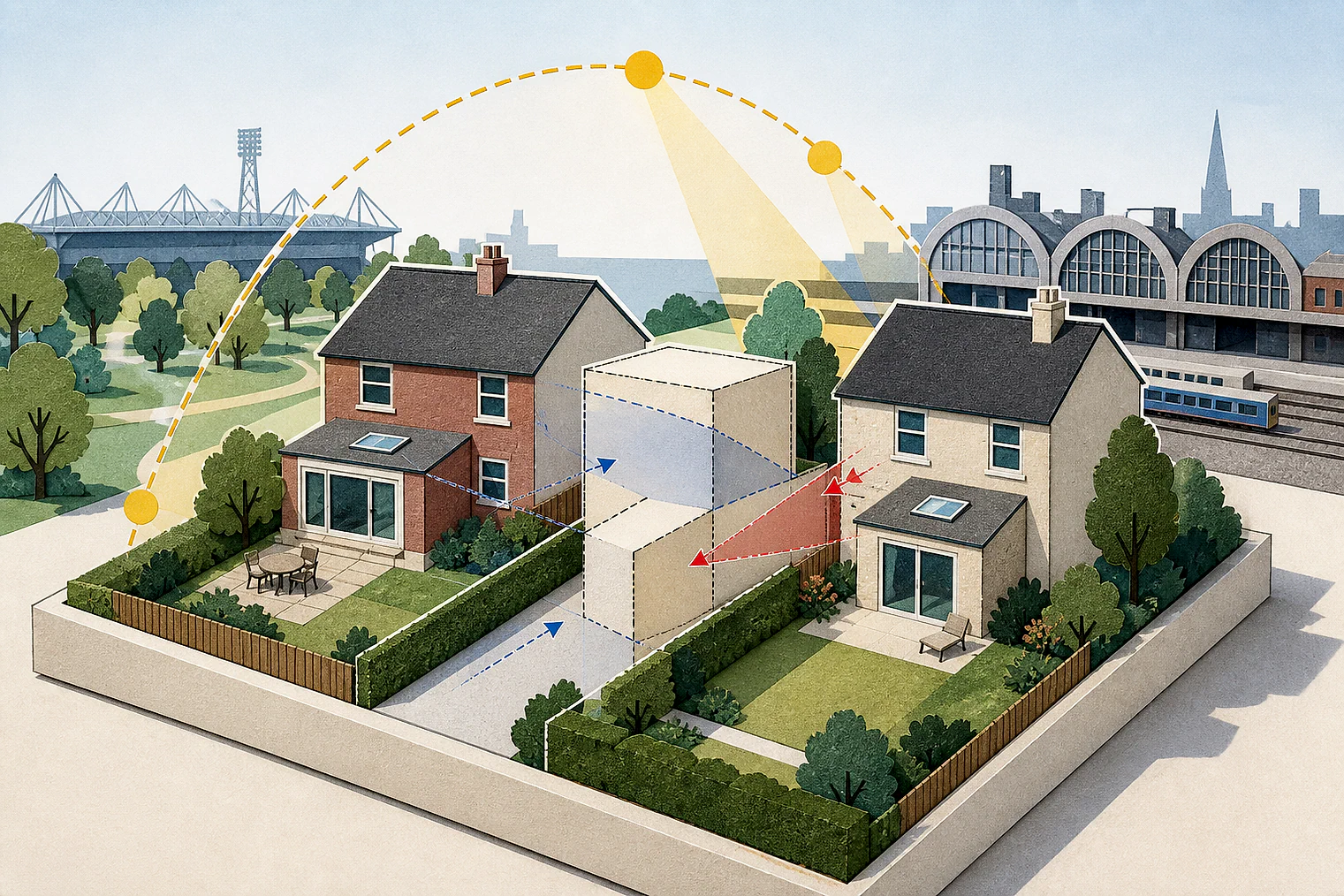
The selected examples lean more towards dismissals than the matched local set; the allowed extract gives no reason it succeeded, and a housing-layout example sits at this issue’s edge.
Counted against appeals
Cramped rooms, limited space and neighbour harm
Cramped HMO rooms
Two small bedrooms and cramped communal rooms were found unfit for their intended use.
Internal and external space
The Inspector concluded the HMO lacked adequate internal and external space for future occupiers.
Harm to neighbours
The retrospective summer-house extension was found to harm neighbouring occupiers’ living conditions.
Helped or needed
The allowed extension’s cited conclusion
No stated success factor
The cited conclusion finds unacceptable outlook and light harm to No 183’s occupants. It states no factor that helped the appeal.
Your refusal notice
Check these details
- Does the refusal identify cramped bedrooms or communal rooms?
- Does it explain whether internal and external space is usable?
- Does it identify specific outlook, light or neighbour effects?
The allowed extract’s conclusion finds harm but does not explain the allowed outcome. These decisions do not predict another result.
Appeal evidence examples
Compare allowed and dismissed appeal reasoning
Each example separates the development, the Inspector-stated issue that selected it, and the reasoning from the decision. Compare the facts as well as the outcome: these examples do not predict how a different proposal would be decided.
Allowed appeal examples
1 example
27 January 2026 · Allowed
Development described in the decision
single storey extension to rear (demolition of existing conservatory).
Issue identified by the Inspector
The main issues are the effect of the proposed development on a) the living conditions of the occupants of [address] with specific regard to outlook and light; and b) the character and appearance of the host dwelling and the area.
Paragraph 5 · Source page 1
Reasoning from the decision
I conclude therefor that the proposed development would result in unacceptable harm to the living conditions of occupants of No 183 with particular regard to outlook and light. As such it would fail to comply with Policy DC1 of the Middlesbrough Local Development Framework, [name] (2008) ([name]) which requires development to consider the effect upon the surrounding environment and amenities of occupiers of nearby properties amongst other things. The material harm arising from that conflict would be moderate.
Paragraph 10 · Source page 2
Dismissed appeal examples
4 examples
13 May 2026 · Dismissed
Development described in the decision
a change of use from dwellinghouse (Use Class C3) to 4-bedroom HMO (Use Class C4).
Issue identified by the Inspector
The main issue is whether the proposed House in [name] (“HMO”) would provide acceptable living conditions for future occupiers, with particular regard to whether living and amenity space would be adequate in terms of size and functionality.
Paragraph 2 · Source page 1
Reasoning from the decision
Overall, two of the bedrooms would be very small, and the size and layout of the communal rooms means that they would be cramped or crowded spaces, and unfit for their intended purpose. Because of this, I conclude that the proposed HMO would not provide acceptable living conditions for future occupiers. It would therefore conflict with Policy DC1 of the 2008 [name], which among other things seeks to ensure that all development is of high quality, with a high standard of amenity, and with the Interim Policy, the principal relevant requirements of which I have summarised above. There would also be conflict with 2 [name]: APP/W0734/W/25/3365937 the requirements of Paragraph 135 of the National Planning Policy Framework, which among other things seek to create places with a high standard of amenity for existing and future users.
Paragraph 9 · Source pages 2, 3
10 April 2026 · Dismissed
Development described in the decision
change of use from vacant dwellinghouse to HMO (Use Class C4).
Issue identified by the Inspector
The main issue is whether the development would provide adequate living conditions for future occupiers, with particular regard to internal and external space provision.
Paragraph 7 · Source page 2
Reasoning from the decision
The development would fail to provide adequate living conditions for future occupiers, with particular regard to internal and external space provision. It would be contrary to Policy DC1 of the Middlesbrough Local Development Framework Core [name] 2008 and the Interim Policy referred to above. It would also conflict with Policies HO8 and HO9 of the Publication Local Plan. These policies, among other provisions, seek to ensure that the layout of development is of high quality, the conversion of properties provides an acceptable standard of accommodation, and HMO accommodation provides a good standard of well proportioned, useable living space and amenity for occupiers. It would also conflict with Policy 135 of the Framework, which seeks to ensure that developments create places with a high standard of amenity for future users.
Paragraph 16 · Source page 3
23 March 2026 · Dismissed
Development described in the decision
erection of 4no. detached dwellings (demolition of existing bungalow) and associated works.
Issue identified by the Inspector
The main issues of the appeal are: • The effect of the proposed development on the character and appearance of the surrounding area; and • Whether the proposed development would provide adequate living conditions for future occupiers of the proposed dwellings and the approved houses at the adjacent Stonebridge site.
Paragraph 3 · Source page 1
Reasoning from the decision
Whilst the Proposed Site Layout drawing does not include a maintenance footpath around the properties, this would not detrimentally harm the living conditions of future occupiers. I note that the integral garages measure substandard against what is considered an acceptable length to be deemed a parking space, but I am not convinced that the integral garages would/could not be used at all for such purposes. Even if the driveways were used for parking purposes, this is not uncommon and given the level of space provided, I do not consider it likely that occupiers would need to convert the green space to hardstanding to accommodate additional parking. The possible erosion of the useable garden space and greenery is therefore of lesser concern to me.
Paragraph 19 · Source page 4
9 September 2025 · Dismissed
Development described in the decision
described as retrospective extension to existing summer house.
Issue identified by the Inspector
The main issue in this appeal is the effect of the development on the living conditions of occupiers of neighbouring properties.
Paragraph 3 · Source page 1
Reasoning from the decision
I find that the development would harm the living conditions of occupiers of neighbouring properties. There is conflict with Policies DC1 of the Middlesbrough Local Development Framework, [name] (2008) which amongst other things seeks to ensure developments are of high quality which have minimal effect on the amenities of occupiers of nearby properties.
Paragraph 8 · Source page 2