
North Devon District Council appeal evidence
Refused over neighbour living conditions in North Devon?
See how inspectors assessed enclosure and privacy in the selected North Devon examples.
Recently refused?
Create a free account for a private planning workspace.
No payment at signup. Refusal-review ordering may not be open.
- Matched locally
- 5 of 31
- eligible decision families
- Allowed
- 2
- matched appeal records
- Dismissed
- 3
- matched appeal records
- Householder
- 4
- of 5 matched records
AI-assisted. Cited sources and wording were checked before publication. Based on 5 source-linked examples shown below. Review method and limits.
Planning Data area point: North Devon LPA (51.049208, −3.934393). This is the published representative point for the authority boundary, not a town hall, camera position or appeal site.
North Devon District Council appeal findings
North Devon boundary massing and privacy
The selected examples for allowed appeals state conclusions rather than facts behind them. A dismissed privacy extract also reaches a no-harm conclusion.
Counted against appeals
Boundary bulk and overlooking concerns
Boundary massing enclosed neighbours
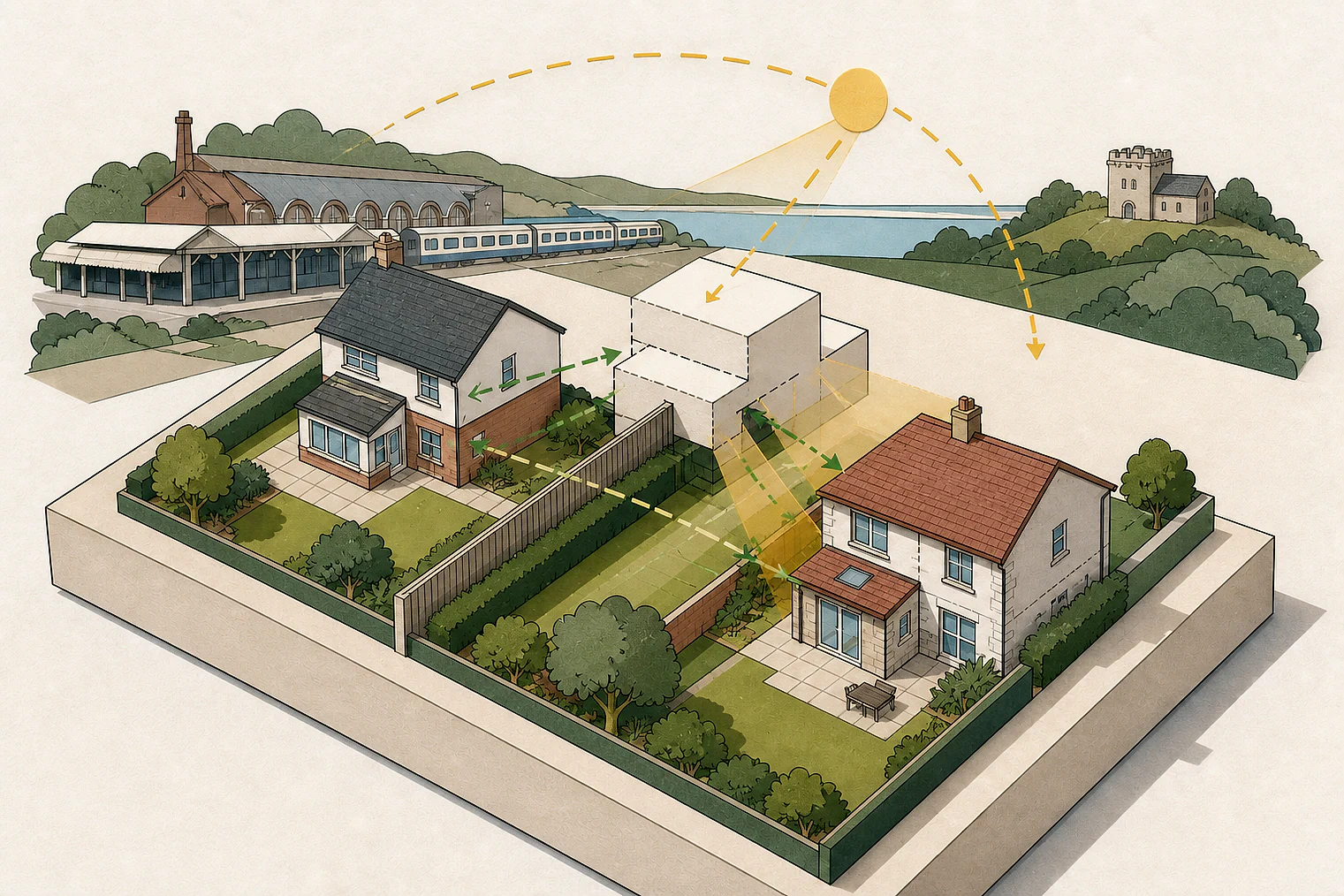
The building’s scale, massing and boundary position created unacceptable enclosure from a garden and ground-floor window. Planting would not overcome that harm.
First-floor window overlooked garden
The window would overlook a neighbouring garden and cause unacceptable privacy loss. Obscured glazing might cure it but could harm future residents’ living conditions.
Helped or needed
Allowed conclusions on living conditions
Future occupiers’ conditions accepted
The inspector concluded the conversion would provide acceptable living conditions for future occupiers.
Pensilva neighbours not significantly harmed
The inspector concluded the alterations and extension would not significantly harm Pensilva’s occupiers.
Your refusal notice
Check these details
- Does the refusal identify enclosure from boundary scale, massing or position?
- Could an upper-floor window overlook a neighbour’s garden?
- Does the refusal explain a privacy, enclosure or future-occupier concern?
The selected North Devon extracts do not explain why the privacy appeal was dismissed or the allowed decisions’ supporting detail. These decisions do not predict another result.
Appeal evidence examples
Compare allowed and dismissed appeal reasoning
Each example separates the development, the Inspector-stated issue that selected it, and the reasoning from the decision. Compare the facts as well as the outcome: these examples do not predict how a different proposal would be decided.
Allowed appeal examples
2 examples
10 March 2026 · Allowed
Development described in the decision
described as ‘conversion of redundant rural building to one dwelling and associated works’.
Issue identified by the Inspector
The main issues are whether the proposal would: • accord with the requirements of the Development Plan for the re-use of rural buildings, and • provide acceptable living conditions for its future occupiers. 1 The Planning Inspectorate ‘Procedural Guide: Planning Appeals – England’.
Paragraph 4 · Source page 1
Reasoning from the decision
For the reasons given above, the proposal would provide acceptable living conditions for its future occupiers. It would not therefore conflict with Local Plan policy DM04(a), which in any case does not refer specifically to internal amenity space. Local Plan policies DM01(b) and DM27 have also been referred to in the Decision Notice. However, they relate to effects from existing or allocated uses, or to matters that I consider above, rather than to internal space. Consequently, I find no conflict with these policies in respect of the living conditions of future occupiers.
Paragraph 15 · Source page 3
20 April 2023 · Allowed
Development described in the decision
alterations and extension to dwelling.
Issue identified by the Inspector
The main issues are the effect of the proposed development on: (a) the character and appearance of the host property and surrounding area; and (b) the living conditions of neighbouring occupiers.
Paragraph 2 · Source page 1
Reasoning from the decision
Accordingly, I find that the appeal proposal would not lead to any significant harm to the living conditions of the neighbouring occupiers of Pensilva and would comply with policies DM01 and DM25 (c) of the Local Plan, and paragraph 130 f) of the Framework. These seek, amongst other requirements, to ensure that new development does not significantly harm the amenities of the occupants of neighbouring properties.
Paragraph 12 · Source page 3
Dismissed appeal examples
3 examples
22 June 2023 · Dismissed
Development described in the decision
a rear extension and alterations.
Issue identified by the Inspector
The main issues are the effect of the proposed development on: • the character and appearance of the area; and • the living conditions of existing neighbouring occupiers, with particular regard to privacy.
Paragraph 3 · Source page 1
Reasoning from the decision
Consequently, I conclude that the proposed development would not cause significant harm to the living conditions of existing neighbouring occupiers, with particular regard to privacy. It would accord with Policy DM01 of the Local Plan in this respect.
Paragraph 8 · Source page 2
1 July 2022 · Dismissed
Development described in the decision
a workshop and storage building with log store.
Issue identified by the Inspector
The main issues are the effect of the proposed development on: • The street scene along [address]. • The living conditions of current and future occupiers of [address], with particular regard to daylight and outlook.
Paragraph 4 · Source page 1
Reasoning from the decision
I note that the appellant does not consider the proposal would have any overbearing effect. However, in my view the intended massing and positioning of the building along the property boundary, would have the effect of creating an unacceptable sense of enclosure when seen from the garden and ground floor window of No 6, beyond that experienced by either the recently erected fence or vegetation shown on the plans. [name] consider that additional planting and landscaping would partially assist in breaking up the uniform appearance of the building, the identified harm to living conditions would not be overcome by virtue of its overall scale, massing and its positioning in the plot.
Paragraph 14 · Source page 3
28 March 2022 · Dismissed
Development described in the decision
the alteration and extension of existing to provide improved living space.
Issue identified by the Inspector
The main issue in this appeal is the effect of the proposed development on the character and appearance of the host building and on the living conditions of nearby residents with reference to overlooking, loss of privacy and loss of outlook.
Paragraph 2 · Source page 1
Reasoning from the decision
The proposed extension would include substantially scaled windows at ground and first floor level on its northern elevation. In terms of overlooking and loss of privacy, there would be no harmful impact from the proposed ground floor window on the northern elevation of the extended dwelling. However, the proposed first floor window would look out over the neighbouring garden amenity area described above and, in my view, would result in an unacceptable loss of privacy of occupants at [address]. The use of obscured glazing for that proposed window may overcome concerns regarding loss of privacy but would be likely to adversely affect the living conditions of future residents at the appeal property.
Paragraph 9 · Source page 2