
London Borough of Richmond upon Thames appeal evidence
Refused over highway safety in Richmond upon Thames?
See which parking, turning and access details inspectors raised, and what supported the allowed examples.
Recently refused?
Create a free account for a private planning workspace.
No payment at signup. Refusal-review ordering may not be open.
- Matched locally
- 7 of 320
- eligible decision families
- Allowed
- 2
- matched appeal records
- Dismissed
- 4
- matched appeal records
- Householder
- 6
- of 7 matched records
AI-assisted. Cited sources and wording were checked before publication. Based on 5 source-linked examples shown below. Review method and limits.
Planning Data area point: Richmond upon Thames LPA (51.442737, −0.312335). This is the published representative point for the authority boundary, not a town hall, camera position or appeal site.
London Borough of Richmond upon Thames appeal findings
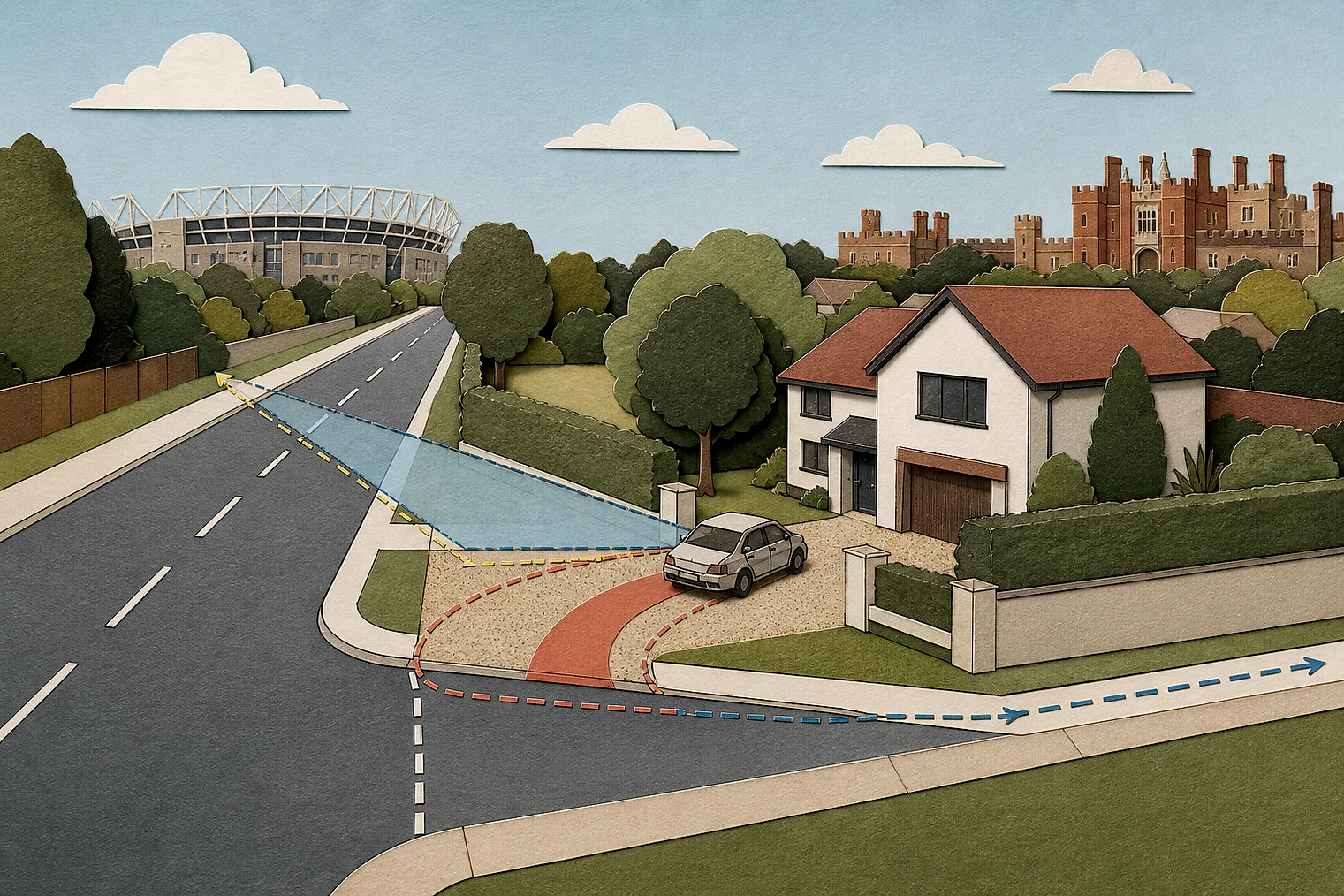
Parking stress, dropped kerbs and gate drawings
Selected examples have a different outcome mix from the matched local set; appeal 55329 also covers character and appearance, and its dismissed extract only states the highway-safety conclusion.
Counted against appeals
Parking stress and no-incident claims
Parking stress and turning space
In the mews-houses appeal, high parking stress, street parking and limited turning space led the Inspector to find unacceptable highway-safety effects.
An incident-free record was insufficient
For a dropped kerb, an incident-free record did not automatically remove the highway-safety risk already found.
Pedestrian safety harm was concluded
The cycle/bin-store extract concludes that the proposal would harm pedestrian and highway safety. It gives no specific reason in the displayed passage.
Helped or needed
Dropped kerbs and gate drawings
Easier entry and exit
Vehicles could enter and leave without manoeuvring around the kerb, improving traffic flow close to the junction.
Minor footway loss
The proposal retained kerbside parking and landscaping features, with only a minor loss of footway.
Installation tied to a drawing
For the vehicular gate, the Council had no comments on the appeal information, and a drawing condition could secure the installation.
Your refusal notice
Check these details
- Does the refusal rely on parking stress or limited turning space?
- Can vehicles enter and leave without manoeuvring near a junction?
- Do your plans clearly show the kerb or gate installation?
Appeal 55329 gives only a highway-safety conclusion, so it cannot show which site feature caused the concern. These decisions do not predict another result.
Appeal evidence examples
Compare allowed and dismissed appeal reasoning
Each example separates the development, the Inspector-stated issue that selected it, and the reasoning from the decision. Compare the facts as well as the outcome: these examples do not predict how a different proposal would be decided.
Allowed appeal examples
2 examples
22 December 2023 · Allowed
Development described in the decision
described as “the applicant would like to extend the existing dropped kerb leading into his property. As it stands the drop kerb extent appears to stop half between his drive way from the road onto the pavement”.
Issue identified by the Inspector
The main issue is the effect of the proposed development upon pedestrian and highway safety.
Paragraph 2 · Source page 1
Reasoning from the decision
Extending the dropped kerb would enable vehicles to enter and leave the appeal site more easily without having to manoeuvre around the kerb. This would improve the flow of traffic close to the junction and thus improve highway safety. In terms of compliance with the SPD, according to the plans the crossover already exceeds the 3.5m maximum width. Furthermore, the SPD only allows one vehicular access per individual property, rather than a shared access. The circumstances of the appeal site do not therefore fit within the specific provisions of the SPD. Nonetheless, the guidelines proscribing dropped kerb widths are intended to minimise their visual impact and the loss of landscaping, avoid the loss of large lengths of footway and retain kerbside parking. In this regard the proposed development meets the requirements of the SPD as there would be no reduction in kerbside parking, or landscaping features, and the loss of footway would be minor.
Paragraph 5 · Source page 2
9 May 2023 · Allowed
Development described in the decision
No verified development description was available for this example.
Issue identified by the Inspector
The main issues are the effects of the proposal upon the character and appearance of the host dwelling and the [address] ([name]) Conservation Area, and upon pedestrian and highway safety with specific regard to the proposed vehicular gate.
Paragraph 3 · Source page 1
Reasoning from the decision
The Council has raised no comments regarding the information provided with the appeal and I am satisfied that the installation could be secured by including reference to the relevant drawing in the plans condition. There would therefore be no harm to pedestrian or highway safety and no conflict with [name] LP44 or LP45 which, amongst other things, seek to ensure a transport network that is road and pedestrian safe.
Paragraph 18 · Source page 4
Dismissed appeal examples
3 examples
29 January 2026 · Dismissed
Development described in the decision
the removal of existing structures and construction of 3no. new mews type houses.
Issue identified by the Inspector
The appellant has provided signed and certified copies of a [name] (UU) which would provide a financial contribution towards off-site affordable housing in the borough. The Council has seen this. I am satisfied that the UU overcomes the third reason for refusal and therefore this matter falls away. As such the main issues are the effects of the proposal on: (i) the character and appearance of the street scene and whether it would preserve or enhance the character or appearance of the [address] Conservation Area, (ii) the living conditions of the occupiers of neighbouring residential properties, with particular regard to privacy and outlook, (iii) highway safety, with particular regard to on-street car parking, and (iv) whether the statutory requirements in respect of [name] would be met.
Paragraph 4 · Source pages 1, 2
Reasoning from the decision
The Transport Statement2 submitted with the application refers to a parking survey that accompanied the 2020 application which showed that the parking stress in the area was above 85%. In the absence of evidence to demonstrate otherwise I consider it likely that this remains the case and the proposal would unacceptably exacerbate an existing high level of parking stress in [address]. Given the 2 Paragraph 4.12v arrangement of parking in the street and limited turning space at the end in front of the appeal site I conclude that this would result in unacceptable effects on highway safety in the area. For these reasons the proposal conflicts with the policies cited above.
Paragraph 23 · Source pages 4, 5
12 January 2026 · Dismissed
Development described in the decision
dropped kerb with minor front boundary details.
Issue identified by the Inspector
The main issue if the effect of the proposed development on trees and highway-safety.
Paragraph 4 · Source page 1
Reasoning from the decision
The appellant has stated that there is no record of safety incidents arising from the existing dropped kerbs. However, the absence of safety incidents to date does not automatically remove the risk to highway safety. This does not therefore override the harm I have found above.
Paragraph 11 · Source page 2
8 August 2024 · Dismissed
Development described in the decision
erection of timber cycle/ bin store.
Issue identified by the Inspector
The main issues in this appeal are: a) The effect of the proposal on the character and appearance of the existing property and on the street scene, and b) The effect of the proposal on pedestrian and highway safety.
Paragraph 3 · Source page 1
Reasoning from the decision
I therefore conclude that the proposals would be harmful to pedestrian and highway safety. This would conflict with Policy LP45 of the Local Plan, and the Transport Supplementary Planning Document as well as the Framework and in particular Section 9, all of which amongst other matters seek for safe access for all users.
Paragraph 13 · Source page 3