
Somerset Council appeal evidence
Refused over neighbours’ living conditions in Somerset?
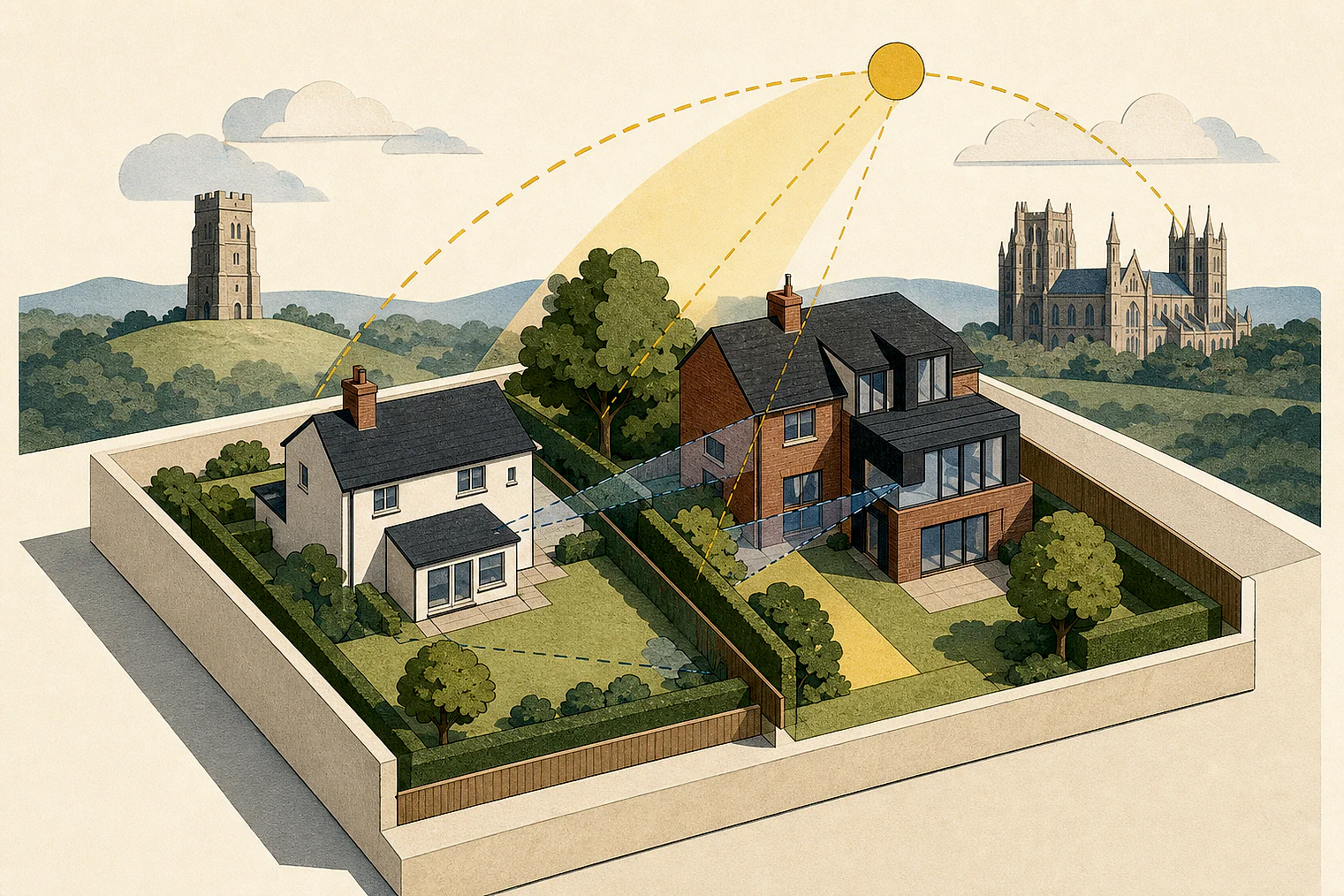
See how the selected examples addressed outlook, light, privacy and reduced visual dominance.
Recently refused?
Create a free account for a private planning workspace.
No payment at signup. Refusal-review ordering may not be open.
- Matched locally
- 10 of 56
- eligible decision families
- Allowed
- 1
- matched appeal records
- Dismissed
- 9
- matched appeal records
- Householder
- 8
- of 10 matched records
AI-assisted. Cited sources and wording were checked before publication. Based on 5 source-linked examples shown below. Review method and limits.
Planning Data area point: Somerset LPA (51.095822, −2.837565). This is the published representative point for the authority boundary, not a town hall, camera position or appeal site.
Somerset Council appeal findings
Somerset extensions: outlook, light and privacy
The selected examples have a different outcome mix from the matched local set. The allowed comparison is limited, and some dismissed extracts state only conclusions.
Counted against appeals
Dismissed proposals: harm to neighbours
Living conditions could be harmed
The inspector concluded that the proposal could harm nearby occupiers’ living conditions and gave that harm significant negative weight.
Rear extensions breached amenity safeguards
Inspectors concluded that the rear extensions conflicted with safeguards for the living conditions of nearby occupiers.
Helped or needed
Details that protected neighbour outlook
Set-back hipped roof reduced dominance
Being set in from the boundary and using a hipped roof reduced visual impact from the neighbour’s doors.
Rear outlook stayed largely open
The open outlook behind the property, including the decking beyond the extension, would remain largely unaffected.
Existing restricted views mattered
Side windows already had a restricted outlook, so further reduction was not considered significant.
Your refusal notice
Check these details
- Does the refusal identify lost light, outlook or privacy for a named neighbour?
- Is the extension set back from the boundary and shaped to reduce dominance?
- Do affected windows already have a restricted outlook, or an open view?
Appeal 90419 concerns future holiday occupiers, so it is at the edge of this neighbour-focused page. These decisions do not predict another result.
Appeal evidence examples
Compare allowed and dismissed appeal reasoning
Each example separates the development, the Inspector-stated issue that selected it, and the reasoning from the decision. Compare the facts as well as the outcome: these examples do not predict how a different proposal would be decided.
Allowed appeal examples
1 example
23 April 2025 · Allowed
Development described in the decision
erection of 2 storey extension to north (rear) elevation.
Issue identified by the Inspector
The effect of the proposed development on the living conditions of the occupants of [address], with respect to outlook, sunlight and privacy.
Paragraph 3 · Source page 1
Reasoning from the decision
The area located immediately outside of the glazed rear and side doors of No 136 would therefore feel more enclosed than at present. However, the set-in nature of the appeal development from the boundary and the proposed hipped roof design would help to reduce its visual impact, so that it would not appear visually dominant from No 136. Furthermore, the open outlook to the rear, including from the large section of decking beyond the extension, would remain largely unaffected. There would be a reduction in the outlook from the side windows in the main part of No 136, but given how restricted the outlook already is from these rooms, this would not have a significant adverse impact on the occupants’ living conditions. Therefore, the proposal would not appear unduly overbearing and would not unacceptably impact the living conditions of the occupants of No 136 in terms of outlook.
Paragraph 7 · Source page 2
Dismissed appeal examples
4 examples
15 June 2026 · Dismissed
Development described in the decision
conversion of garage and store to 2 no holiday lets.
Issue identified by the Inspector
The main issues are: • whether the site would provide a suitable location for the proposal, having particular regard to the spatial strategy of the Development Plan and to the accessibility of the site to services and facilities; and • the effect of the proposal on the living conditions of future holiday occupiers with particular regard to noise and outlook.
Paragraph 3 · Source page 1
Reasoning from the decision
For the above reasons, I therefore conclude that the proposal would fail to provide satisfactory living conditions for future holiday occupiers with particular regard to noise and outlook. It would therefore conflict with MDLP policies DP7 and DP22.
Paragraph 21 · Source page 4
1 June 2026 · Dismissed
Development described in the decision
outline planning permission with some matters reserved for the erection of up to 3 self-build dwellings plus associated infrastructure with details of access.
Issue identified by the Inspector
The main issues are: • the effect of the proposal on the character and appearance of the area, including the setting of the former [name], listed at [name], • the effect of the proposal on highway safety, • whether sufficient information has been provided to show that the biodiversity net gain objective is capable of being met, and • the effect of the proposal on the living conditions of the occupiers of dwellings at numbers 5, 7 and [address] (Nos. 5 to 9), and at numbers 3 and 4 Louvain1 (Nos. 3 and 4) in respect of light, outlook and privacy.
Paragraph 5 · Source pages 1, 2
Reasoning from the decision
For the reasons given above, the proposal could well harm the living conditions of occupiers of dwellings at numbers 5, 7 and [address], and numbers 3 and 4 Louvain. It would therefore conflict with MDLP policy DP7, which requires demonstrable protection of the amenity of users of neighbouring buildings. I give this harm and conflict significant negative weight.
Paragraph 31 · Source page 5
11 March 2026 · Dismissed
Development described in the decision
erection of multi-storey extension to rear of property.
Issue identified by the Inspector
The main issues are the effect of the proposal on: • the character and appearance of the area; and • the living conditions of occupiers of No. 2 Torrells with regards to outlook and light.
Paragraph 3 · Source page 1
Reasoning from the decision
Consequently, it would conflict with Policy DM1(e) of the TDCS and Policy D5 of the TSADMP which seek to protect the living conditions of occupiers of neighbouring dwellings. Furthermore, there would be conflict with the Framework which requires development to provide a high standard of amenity for existing and future users.
Paragraph 13 · Source page 2
7 January 2026 · Dismissed
Development described in the decision
described on the application form as ‘Double storey rear extension.’
Issue identified by the Inspector
The main issue is the effect of the development upon the living conditions of the occupiers of No [address] in respect of outlook.
Paragraph 2 · Source page 1
Reasoning from the decision
For the reasons above, I conclude that the proposed extension would have a harmful effect on the living conditions of the occupiers of No [address]. As such, it would fail to comply with the relevant provisions of Policy D25 of the Sedgemoor Local Plan 2019, and BE4 of the Cheddar Neighbourhood Plan 2018, which seek, in summary, to safeguard the amenity of the occupiers of nearby dwellings.
Paragraph 7 · Source page 2