
Stratford-on-Avon District Council appeal evidence
Refused over neighbour living conditions in Stratford-on-Avon?
See which local examples found harm to outlook and light, and which found privacy acceptable.
Recently refused?
Create a free account for a private planning workspace.
No payment at signup. Refusal-review ordering may not be open.
- Matched locally
- 12 of 80
- eligible decision families
- Allowed
- 4
- matched appeal records
- Dismissed
- 8
- matched appeal records
- Householder
- 9
- of 12 matched records
AI-assisted. Cited sources and wording were checked before publication. Based on 5 source-linked examples shown below. Review method and limits.
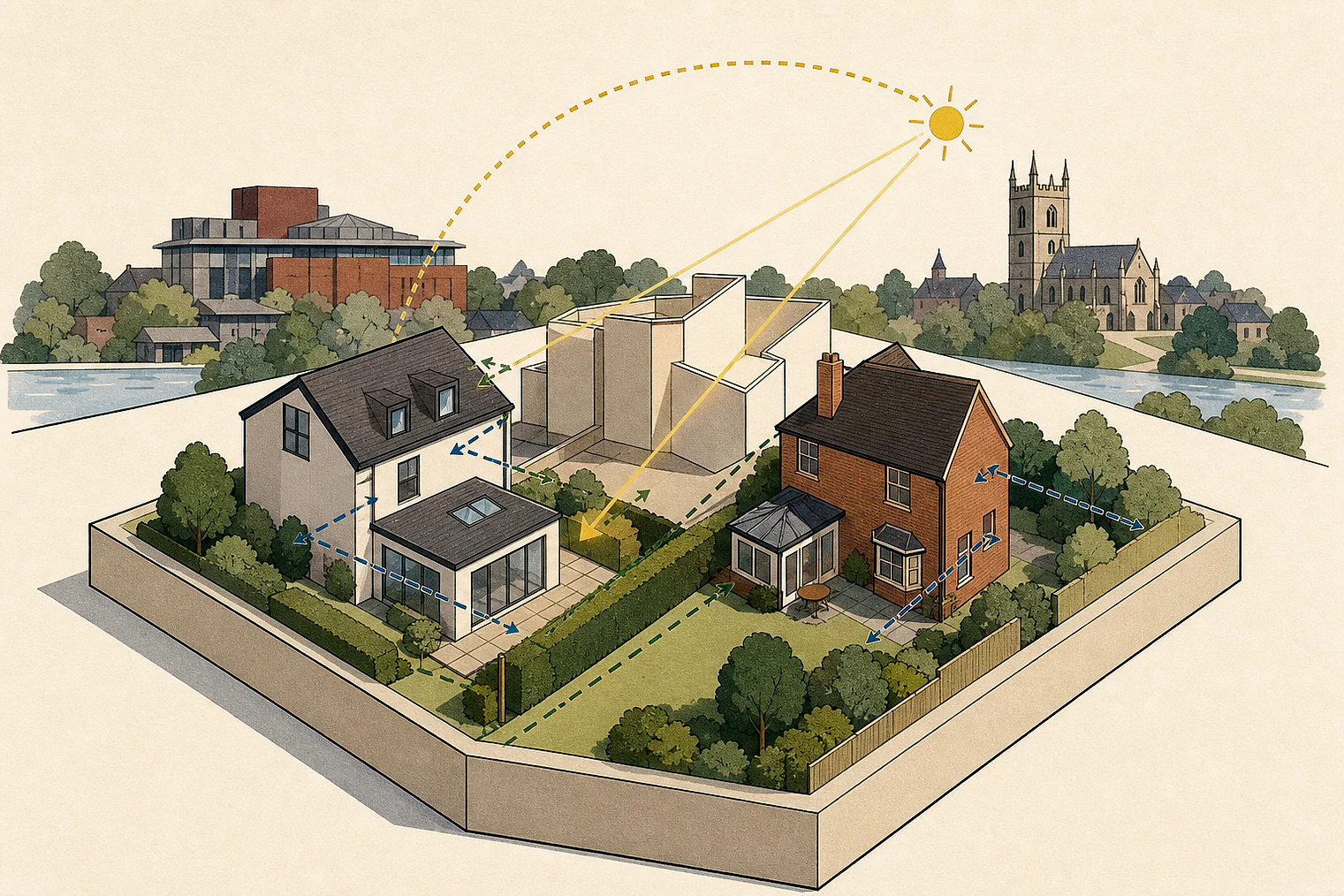
Planning Data area point: Stratford-on-Avon LPA (52.178824, −1.622946). This is the published representative point for the authority boundary, not a town hall, camera position or appeal site.
Stratford-on-Avon District Council appeal findings
Outlook, light and privacy in Stratford-on-Avon
Appeal 91125 concerns future occupiers and 84511 gives only character-and-appearance reasoning, placing both at this issue’s edge.
Counted against appeals
Harm to outlook and light
Extension harmed outlook and light
A two-storey rear extension was found to significantly harm No 22’s outlook and light.
Helped or needed
Privacy not found harmful
No privacy harm concluded
The allowed extracts concluded the proposals would not harm neighbouring occupiers’ privacy.
Your refusal notice
Check these details
- Does the refusal identify harm to outlook, light or privacy?
- Which neighbouring occupier does it say would be affected?
- Does the proposal change privacy, light or outlook for that neighbour?
The displayed examples have a different allowed-to-dismissed mix from the matched local set, and 30633 and 88858 give conclusions without detailed analysis. These decisions do not predict another result.
Appeal evidence examples
Compare allowed and dismissed appeal reasoning
Each example separates the development, the Inspector-stated issue that selected it, and the reasoning from the decision. Compare the facts as well as the outcome: these examples do not predict how a different proposal would be decided.
Allowed appeal examples
2 examples
31 March 2023 · Allowed
Development described in the decision
the formation of habitable room in roofspace with front and rear velux rooflights.
Issue identified by the Inspector
The main issue is the effect of the development on the living conditions of the occupiers of the adjoining residential properties with particular regard to privacy.
Paragraph 2 · Source page 1
Reasoning from the decision
For the above reasons the proposal would not adversely affect the living conditions of the occupiers of the adjoining residential properties and would accord with [name].9 and CS.20 of the Stratford-on-Avon District Core Strategy 2011-2031 (2016) which, amongst other matters, seek to ensure that the occupiers of neighbouring properties will be protected from an unacceptable loss of privacy.
Paragraph 9 · Source page 2
15 May 2026 · Allowed
Development described in the decision
[address]
Issue identified by the Inspector
The main issues are: the effect of the proposed development on the living conditions of neighbouring occupiers, with particular reference to privacy. whether the proposed development would provide satisfactory living conditions for future occupiers, with regard to the provision of private internal and external amenity space.
Paragraph 4 · Source page 1
Reasoning from the decision
Overall, I conclude that the proposed development would not harm the living conditions of neighbouring occupiers with particular regard to privacy. As such, it complies with Policy CS.9 of the Stratford-on-Avon District Core Strategy (2011 to 2031) ([name]) which requires, amongst other matters, for development to ensure that occupants of neighbouring buildings will be protected from unacceptable loss of privacy.
Paragraph 8 · Source page 2
Dismissed appeal examples
3 examples
31 March 2022 · Dismissed
Development described in the decision
described as ‘2 storey rear extension’.
Issue identified by the Inspector
The main issue is the effect of the proposed development on the living conditions of the occupiers of [address], with particular regards to outlook and light.
Paragraph 2 · Source page 1
Reasoning from the decision
I conclude that the proposed development would significantly harm the living conditions of the residents of No 22, with particular reference to outlook and light contrary to Policy CS.9 and CS.20 of the Stratford-on-Avon District Council Core Strategy 2011 to 2031 (2016) and the guidance contained within the Stratford-on-Avon District Council Development Requirements Supplementary Planning Document (2019) which together seek, amongst other things, to ensure a good standard of space and amenity for occupiers and that development protects neighbouring buildings from loss of daylight. The proposal is also at odds with the advice set out in paragraph 130 of the Framework that seeks high standards of amenity for existing users.
Paragraph 8 · Source page 2
29 June 2026 · Dismissed
Development described in the decision
change of use of land to stationing of 9 static caravans and 9 touring caravans for residential occupation, new vehicular access, associated hardstanding, bunds and post and rail fencing.
Issue identified by the Inspector
In light of the above, the main issues therefore are: i) whether the site is reasonably located with regard to access to services and facilities by sustainable modes of transport; ii) the effect of the development on the character and appearance of the area; iii) whether the development, and the wider area, would be safe from flooding and be suitably drained; and iv) whether the development would provide satisfactory living conditions for its future occupiers with regard to the provision of domestic facilities for day to day living.
Paragraph 6 · Source page 2
Reasoning from the decision
In summary, the development could provide satisfactory living conditions for its future occupiers. It would therefore accord with policy CS.21 as referred to above, and [name] policy CS.9 which aims to ensure all development achieves high quality design.
Paragraph 27 · Source page 5
17 February 2026 · Dismissed
Development described in the decision
erection of 1no. dwelling and associated landscaping.
Issue identified by the Inspector
Given the forgoing, the main issues raised by this appeal are: • the effect of the proposed development on the character and appearance of the area; • the effect of the proposed development on the living conditions of the neighbouring occupiers of [address], with regard to outlook; and • whether the proposed development makes adequate provision for [name] (BNG).
Paragraph 3 · Source page 1
Reasoning from the decision
My attention has been drawn to other examples of development nearby, whereby a contemporary design approach has been achieved. There is no question that such design could be acceptable in principle in this area. Inevitably, it is the detail and specific context of any development which determines whether it is acceptable in practice. Having considered the design and layout of this proposal, and its effect on the character and appearance of this area, for the reasons given, I consider that there would be unacceptable harm. Given this, these examples do not add weight in favour of the development. Accordingly, as I am required to do, I have determined the case before me on its own merits.
Paragraph 11 · Source page 2