
Tewkesbury Borough Council appeal evidence
Refused over inappropriate Green Belt development in Tewkesbury?
See the selected examples of Green Belt harm, public views and facts recorded in an allowed self-build appeal.
Recently refused?
Create a free account for a private planning workspace.
No payment at signup. Refusal-review ordering may not be open.
- Matched locally
- 9 of 46
- eligible decision families
- Allowed
- 2
- matched appeal records
- Dismissed
- 7
- matched appeal records
- Householder
- 5
- of 9 matched records
AI-assisted. Cited sources and wording were checked before publication. Based on 5 source-linked examples shown below. Review method and limits.
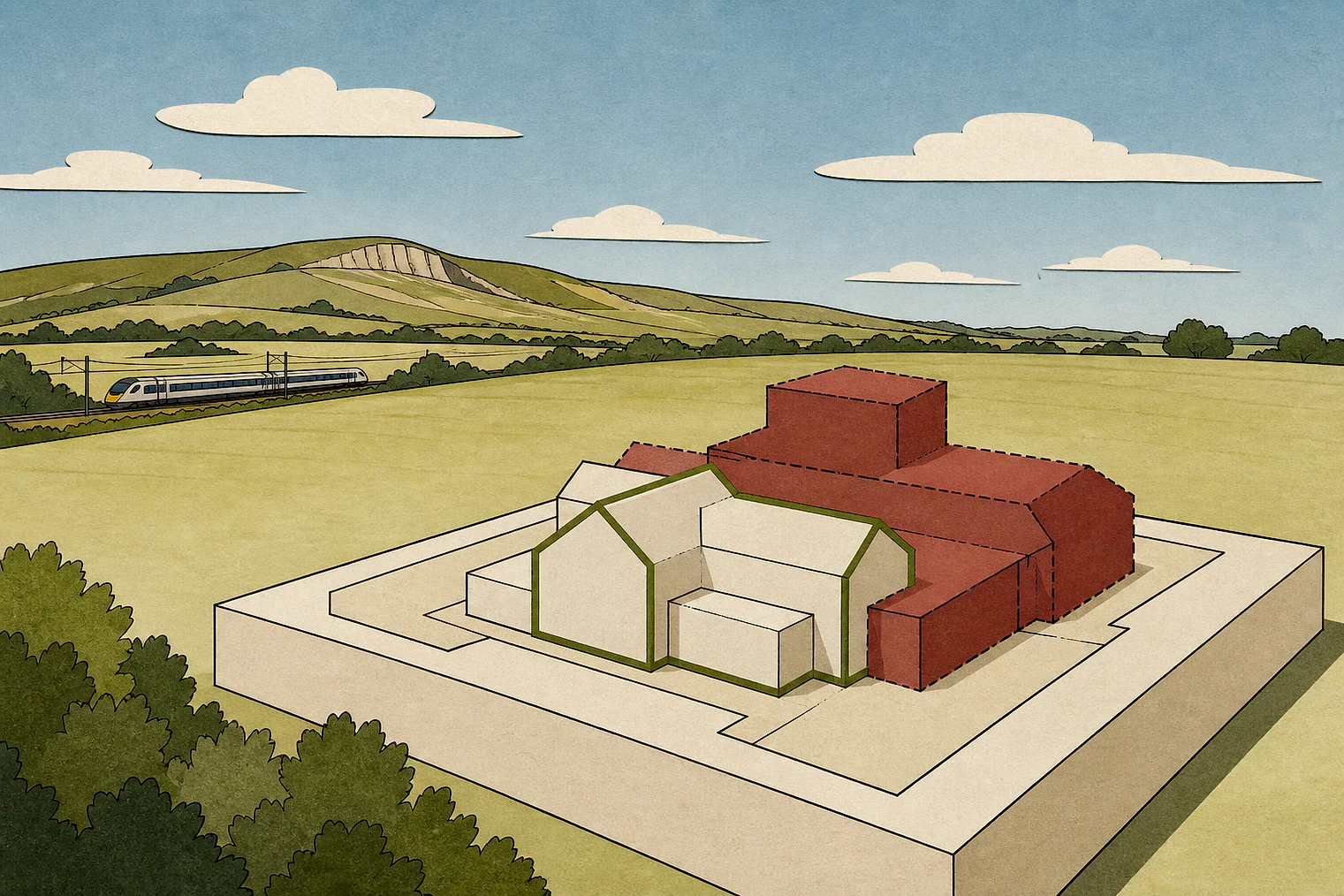
Planning Data area point: Tewkesbury LPA (51.945616, −2.087312). This is the published representative point for the authority boundary, not a town hall, camera position or appeal site.
Tewkesbury Borough Council appeal findings
Footpath views and development size in Tewkesbury’s Green Belt
The selected examples cover dwellings, an extension and commercial use, limiting direct comparison with a single refused proposal.
Counted against appeals
Tewkesbury dismissals: openness and views
Extension reduced Green Belt openness
The Inspector treated the loss of openness as substantial harm. Other considerations did not outweigh it.
Footpath views exposed cabin and vehicles
Screening from the road did not prevent clear views from a public footpath, causing modest harm to visual openness.
Infill dwelling harmed openness too
The Inspector found the dwelling inappropriate and said harm to Green Belt openness carried substantial weight.
Helped or needed
Allowed self-build: limited scale and unmet need
Limited scale near existing buildings
In the allowed self-build appeal, limited scale and location near existing built form and the A46 did not fundamentally undermine Green Belt purposes.
Unmet housing need was accepted
The Inspector found demonstrable unmet need after the Council accepted it could not demonstrate a supply of deliverable housing sites.
Your refusal notice
Check these details
- Does the refusal identify harm to Green Belt openness?
- Could a public footpath give clear views of the proposal?
- Does the refusal assess removals that reduce the floor-area increase?
The car-dealership example is an edge-of-scope commercial comparison, and the allowed extension extract does not explain its allowed outcome. These decisions do not predict another result.
Appeal evidence examples
Compare allowed and dismissed appeal reasoning
Each example separates the development, the Inspector-stated issue that selected it, and the reasoning from the decision. Compare the facts as well as the outcome: these examples do not predict how a different proposal would be decided.
Allowed appeal examples
2 examples
27 February 2026 · Allowed
Development described in the decision
the erection of 1no. self-build dwelling.
Issue identified by the Inspector
As such, the main issue is whether the site is suitable for residential development, having regard to its location, the proposed land use and the amount of development, with specific reference to access to services and facilities and: • whether the proposal would be inappropriate development in the Green Belt, having regard to the National Planning Policy Framework (the Framework) and any relevant development plan policies.
Paragraph 6 · Source pages 1, 2
Reasoning from the decision
Given the limited scale of development and its location near to existing built form and the junction of the [site address] and the A46, the proposal would not fundamentally undermine the purposes (taken together) of the remaining Green Belt across the area of the plan. The Council accepts that it cannot demonstrate a 5 year supply of deliverable housing sites, and therefore the proposal meets the criteria of demonstrable unmet need. The scale of development does not meet the Framework major development definition, and so the ‘[name] requirements of paragraphs 156-157 are not applicable.
Paragraph 13 · Source page 3
27 November 2025 · Allowed
Development described in the decision
Proposed two storey side extension and minor changes to parking/vehicle turning area. Replacement windows.
Issue identified by the Inspector
The main issues are: • Whether condition 4 is necessary and reasonable having regard to protecting the openness of the Green Belt; and • Whether condition 5 is necessary with regards to screening the extension.
Paragraph 2 · Source page 1
Reasoning from the decision
The approved extension would extend the floor area of the original building well beyond the 50% increase in size generally accepted by the Council as constituting a proportionate addition. Without the partial removal of the garage, the overall increase in floor area would be significant and result in a disproportionate addition to the original building. On this basis, the development would not meet exception c) of paragraph 154 of the National Planning Policy Framework (Framework) and would thus constitute inappropriate development in the Green Belt. The Framework sets out that such development should not be approved except in very special circumstances.
Paragraph 4 · Source page 2
Dismissed appeal examples
3 examples
3 March 2022 · Dismissed
Development described in the decision
described as ‘Double side storey and single rear storey extension’.
Issue identified by the Inspector
The main issues are: • whether the proposal would be inappropriate development in the Green Belt for the purposes of the National Planning Policy Framework (the Framework) and development plan policy; • the effect of the proposal on the openness of the Green Belt; and • whether any harm by reason of inappropriateness, and any other harm, would be clearly outweighed by other considerations so as to amount to the very special circumstances required to justify the proposal.
Paragraph 4 · Source page 1
Reasoning from the decision
I find that this proposal would be inappropriate development in the Green Belt and would lead to a reduction in openness of the Green Belt. I attach substantial weight to the resulting harm. The other considerations in this appeal would not outweigh this harm and therefore the proposal would conflict with policies of the JCS in this regard. Nor would the other considerations clearly outweigh the harm to the Green Belt, as required by the Framework.
Paragraph 21 · Source page 4
17 April 2026 · Dismissed
Development described in the decision
residential infill development of 1 No detached dwelling house (self/custom build).
Issue identified by the Inspector
The main issues are whether the site is suitable for residential development having regard to its location, the proposed land use and the amount of development, with particular regard to: • whether the proposed development would be inappropriate development in the Green Belt, having regard to the National Planning Policy Framework (the Framework) and any relevant development plan policies; • whether the site would be a suitable location for the proposed development, having regard to local and national policy, and accessibility to services and facilities; and • whether other considerations clearly outweigh the harm to the Green Belt and any other harm as to amount to very special circumstances.
Paragraph 4 · Source page 1
Reasoning from the decision
I have concluded that the proposed development would be inappropriate development and would therefore, by definition, be harmful to the Green Belt. I have also found that there would be harm to the openness of the Green Belt. These are matters to which I give substantial weight as required by paragraph 153 of the Framework.
Paragraph 35 · Source page 6
19 January 2026 · Dismissed
Development described in the decision
use of land to the rear of the site for a car dealership, including a temporary sales cabin.
Issue identified by the Inspector
The main issues are (i) whether the proposal would constitute inappropriate development in the Green Belt, (ii) its effect on biodiversity, (iii) whether it would increase the risk of flooding on the site or elsewhere, and (iv) if the scheme would constitute inappropriate development in the Green Belt, whether the harm by reason of inappropriateness and any other harm is clearly outweighed by other factors so as to amount to the very special circumstances necessary to justify it.
Paragraph 4 · Source page 1
Reasoning from the decision
The site lies to the back of a complex of commercial buildings. The development would not be easily seen from the road nor from the car park area to the front of the complex due to the screening effect of the buildings. However, on my visit I saw that there are clear views of the site from a public footpath that leads from the highway across a field to the west. From this public vantage point, the sales cabin and the vehicles would be visible and so there would be harm to the visual openness of the Green Belt. The development would be near to the other buildings within the complex and it would not be prominent. Also, I note the close proximity of the site to the edge of the Green Belt and the housing area on the other side of the road. Nonetheless, the proposal would not preserve the spatial and visual openness of the Green Belt but instead it would cause a modest level of harm.
Paragraph 8 · Source page 2