
Wyre Borough Council appeal evidence
Refused over neighbours’ living conditions in Wyre?
See the selected local examples on light, outlook, noise and movement around neighbouring homes.
Recently refused?
Create a free account for a private planning workspace.
No payment at signup. Refusal-review ordering may not be open.
- Matched locally
- 12 of 32
- eligible decision families
- Allowed
- 5
- matched appeal records
- Dismissed
- 7
- matched appeal records
- Householder
- 9
- of 12 matched records
AI-assisted. Cited sources and wording were checked before publication. Based on 5 source-linked examples shown below. Review method and limits.
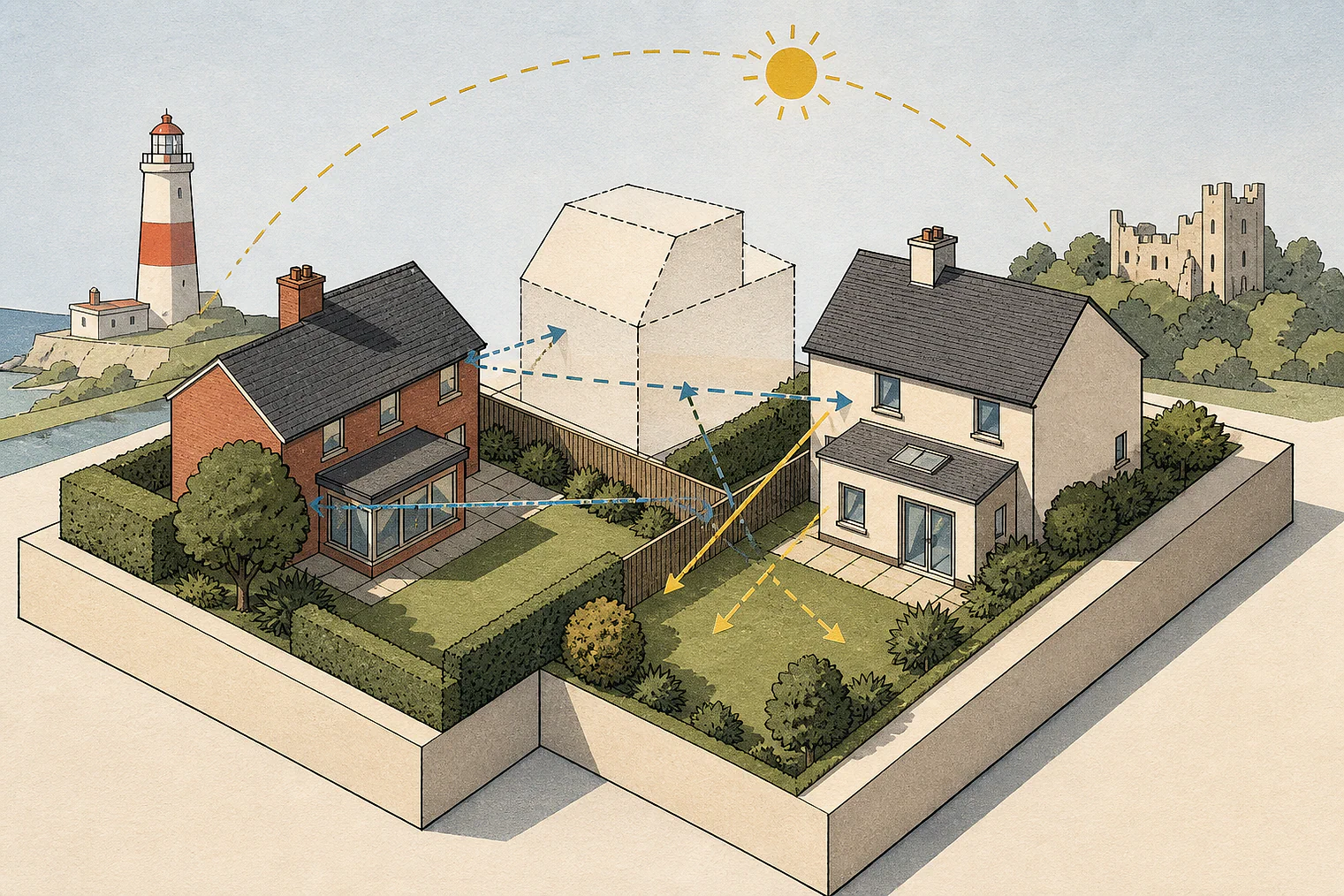
Planning Data area point: Wyre LPA (53.902932, −2.853874). This is the published representative point for the authority boundary, not a town hall, camera position or appeal site.
Wyre Borough Council appeal findings
Wyre neighbour effects: spacing, height and activity
Appeals 85954 and 60559 give conclusions on neighbour effects without supporting analysis; 57752 also involves a design issue.
Counted against appeals
Too close and too tall beside neighbours
Light, outlook and amenity space
A considerable separation shortfall and substantial dwelling height harmed light, outlook and private amenity space.
Helped or needed
No added scale or activity
No extension or extra bedrooms
The care-home proposal involved no extension and no additional bedrooms.
No significant movement difference
The Inspector found no significant difference in activity or staff and visitor movements from a single family.
Your refusal notice
Check these details
- Does the refusal notice identify a separation shortfall, height, light or outlook?
- Would your scheme add bedrooms, an extension, or staff and visitor movements?
- Does the refusal notice name private amenity space, noise or disturbance?
The selected cases concern care-home use, a dwelling and extensions, so their facts are not interchangeable. These decisions do not predict another result.
Appeal evidence examples
Compare allowed and dismissed appeal reasoning
Each example separates the development, the Inspector-stated issue that selected it, and the reasoning from the decision. Compare the facts as well as the outcome: these examples do not predict how a different proposal would be decided.
Allowed appeal examples
2 examples
10 April 2026 · Allowed
Development described in the decision
the change of use from residential dwelling (Class C3) to residential care home (Class C2) for up to two children.
Issue identified by the Inspector
The main issues are the effect of the proposed development on: • the living conditions of occupiers of nearby residential properties, with particular regard to noise and disturbance; and • highway safety with particular regard to the provision of off-street car parking and the potential for restricting vehicle and pedestrian movements.
Paragraph 3 · Source page 1
Reasoning from the decision
[name] understand that some building works have been taking place at the appeal property, for the purposes of this appeal, the proposal seeks approval for the change of use only. Based on the submitted details, the building would not be extended, and the number of bedrooms would remain unchanged. As such, I find that there would not be a significant difference in the level of activity and comings and goings of a children’s home of the scale proposed and that of a single family. Therefore, in this regard, I do not find the concerns of the Council to be persuasive. I consider that the proposal would not lead to harm to the living conditions of neighbours from noise and disturbance from the coming and goings of staff and visitors.
Paragraph 9 · Source page 2
25 November 2024 · Allowed
Development described in the decision
a single storey rear extension and new front porch.
Issue identified by the Inspector
The main issue in the appeal is the effect of the proposed development on the living conditions of the occupiers of the neighbouring property with particular reference to outlook, overshadowing and privacy.
Paragraph 3 · Source page 1
Reasoning from the decision
For the reasons given, I consider that the proposed development would be acceptable in terms of its effect on the living conditions of neighbouring occupiers and therefore complies with Policy CDMP3 of the Wyre Local Plan 2011-2031 (incorporating partial review of 2022) (adopted 2023) which seeks to ensure that development does not have an unacceptably adverse impact on the amenity of occupants of surrounding properties. Nor does it conflict with the SPD insofar as it seeks to safeguard residential amenity.
Paragraph 9 · Source page 2
Dismissed appeal examples
3 examples
27 March 2026 · Dismissed
Development described in the decision
described as a retrospective application for as built dwelling.
Issue identified by the Inspector
The main issues are: • The effect of the development on the living conditions of neighbouring occupiers with particular regard to outlook, light and private amenity space; and • The effect of the development on the character and appearance of the area.
Paragraph 7 · Source page 2
Reasoning from the decision
Consequently, given the considerable shortfall from the required separation distances, the substantial height of the dwelling, and the resulting impacts on light, outlook, and the enjoyment of private amenity space, the development causes unacceptable harm to the living conditions of the neighbouring occupiers. Thus, there would be conflict with Policy CDMP3 of the WLP which requires, amongst other things, that development must not have an unacceptably adverse impact on the amenity of occupants and users of surrounding or nearby properties.
Paragraph 19 · Source page 3
16 March 2026 · Dismissed
Development described in the decision
described as ‘Erection of 6no two storey dwellings with associated access and landscaping.’
Issue identified by the Inspector
The main issues are: • the effect of the development on the character and appearance of the area; • whether the development would be suitably located having regard to relevant development plan policies; • the effect of the development on flood risk; • the effect of the development on highway safety with regard to access and the provision of parking; and • the effect of the development on the living conditions of neighbouring occupiers, with regard to outlook and privacy.
Paragraph 9 · Source page 2
Reasoning from the decision
For these reasons, the development would not harm the living conditions of neighbouring occupiers, with regard to outlook and privacy. As such, and in this regard, it would not conflict with the relevant provisions of Policy CDMP3 of the Wyre Local Plan. This policy restricts development that adversely effects nearby residents, amongst other things.
Paragraph 47 · Source page 7
30 September 2024 · Dismissed
Development described in the decision
roof-lift to create first floor bedrooms; front and rear extensions.
Issue identified by the Inspector
The main issues in this appeal are: - • The effect of the proposal on the character and appearance of the area. • The effect of the proposal on the living conditions of the adjacent residents.
Paragraph 2 · Source page 1
Reasoning from the decision
As such I do not find material harm in the respect of the harm to the living conditions of No18 [name] from the extensions as proposed. However, whilst I have not found harm in this in this matter, that does not overcome the material harm caused to character and appearance of the locality by the overall design and dominance of the proposals.
Paragraph 10 · Source page 2