
Local planning policy field guide
London Borough of Bromley planning policy summary
Explore London Borough of Bromley’s planning requirements for common proposals, with the local tests, application evidence and official documents gathered in one place.
AI-generated from the linked official sources; not editorially reviewed. How these summaries are prepared.
- Local answers
- 21
- Official documents cited
- 2
- Planning sections
- 12
- Sources checked
- 5 September 2026
What this guide covers
A bounded first release covering the adopted Bromley Local Plan and the current validation and local information requirements for common development-management questions.
Popular checks
Start with a common planning question

Section 1
Consent, policy and location
Current development plan and policy hierarchy
What current plan documents and retained policies does the authority say form the development plan, and how should conflicts or transitions be handled?
Bromley's Local Plan was adopted as the borough's statutory Local Plan on 16 January 2019 and is used with the current London Plan to determine applications. The council is reviewing the Local Plan, but the review material has not been treated as adopted policy here.
- When this answer applies
- All planning applications in Bromley, with the London Plan and any applicable neighbourhood or site-specific policy considered alongside it.
Details and exceptions
- The current London Plan can supersede older regional-policy references within the 2019 Local Plan, and the live policies map should be checked for site designations.
Sources used
- Bromley Local Plan (opens in a new tab)Development plan— Local Plan landing page, adoption and development-plan status; Local Plan paragraphs 1.2.1–1.2.3
Other planning topics11
Keep these national checklist topics in mind alongside the local requirements above.
- Neighbourhood plan applicability
- Site allocations and site-specific policy
- Design codes and masterplans
- Settlement boundaries
- Countryside development
- Green Belt development
- Local separation and green-wedge designations
- Planning permission and application route
- Permitted development and local limitations
- Prior approval requirements
- Article 4 directions
Section 2
Neighbour amenity
Daylight, sunlight, overshadowing and overbearing impact
How does the authority assess daylight, sunlight, overshadowing and overbearing impact?
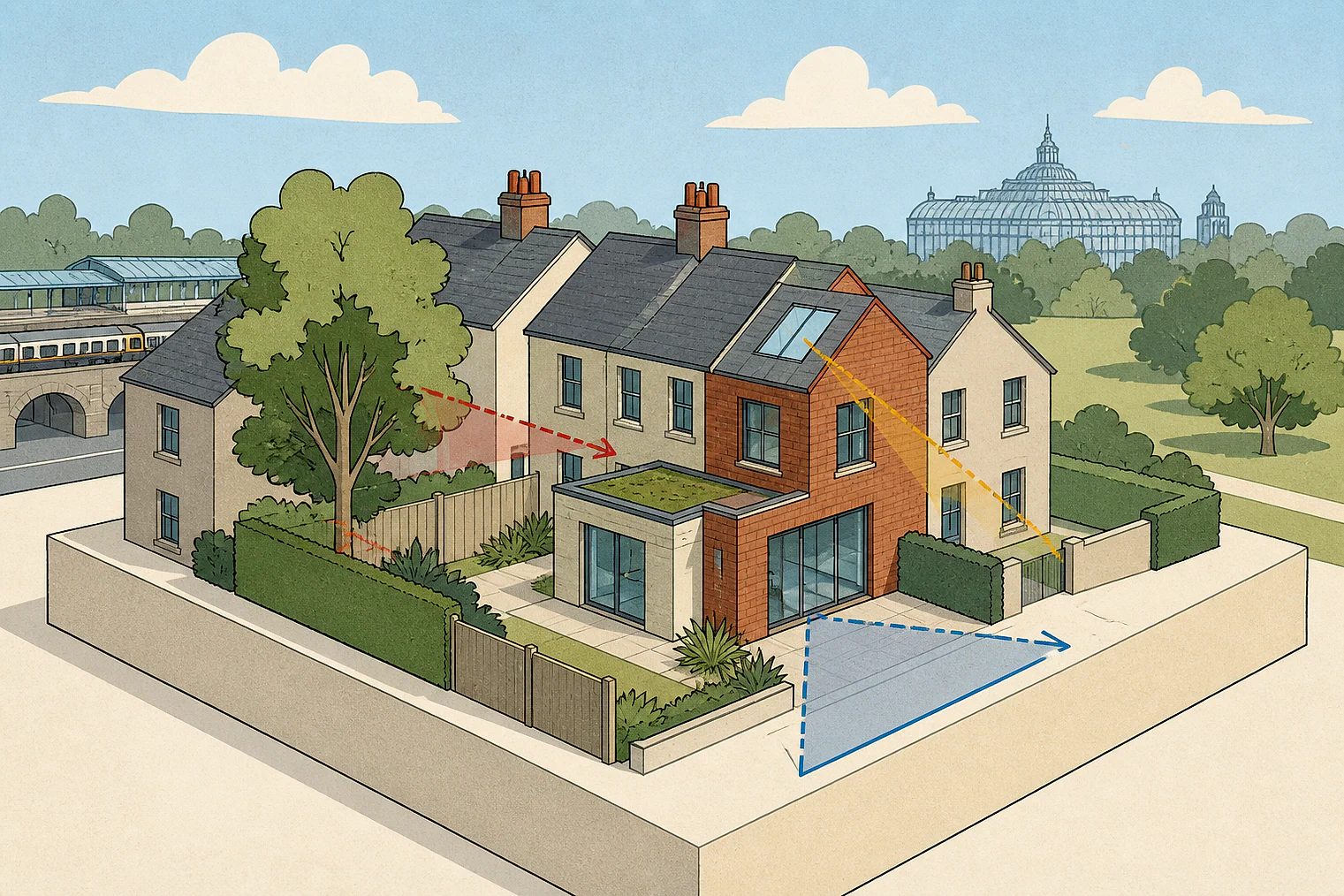
Policy 37 requires adequate daylight and sunlight between buildings and protects existing and future occupiers from inadequate daylight, sunlight and overshadowing. It places these effects within a wider assessment of design, scale, layout, privacy, noise and disturbance.
- When this answer applies
- All development, including extensions, where buildings or outdoor spaces may affect or receive daylight, sunlight or shadow.
Details and exceptions
- The policy sets no single numerical daylight or overshadowing test; the relationship and evidence are assessed in context.
Sources used
- Bromley Local Plan (opens in a new tab)Development plan— Policy 37, General Design of Development, Local Plan p. 117
Related local appeal evidence
Neighbour living conditions
167 matched decision families in this local evidence view.
- 62 allowed
- 105 dismissed
Privacy, overlooking and separation
How does the authority assess privacy, overlooking and separation between buildings or amenity areas?
Policy 37 requires development to respect the privacy and amenity of neighbouring and future occupiers. Policy 3 separately requires backland and garden development to avoid unacceptable loss of privacy, sunlight or daylight and to provide a high standard of separation and landscaping.
- When this answer applies
- Development close to homes or private amenity space, with additional criteria for backland and garden sites.
Details and exceptions
- The Local Plan does not state one borough-wide minimum separation distance for every development type; orientation, windows, levels, screening and character are assessed together.
Sources used
- Bromley Local Plan (opens in a new tab)Development plan— Policy 37, Local Plan p. 117; Policy 3, Local Plan p. 38
Noise and vibration
What does the authority say about tests, limits, evidence and mitigation for noise and vibration?
Policy 119 requires a full noise and vibration assessment for development likely to generate effects on noise-sensitive receptors. It expects noise-sensitive layouts to avoid exposed parts of a site, protects existing noise-generating uses through suitable design, and normally seeks a new source to be 10 dB below the typical background LA90 level at a sensitive receptor where cumulative effects or an unsatisfactory environment are at issue.
- When this answer applies
- Noise- or vibration-generating development and noise-sensitive development near an existing source.
Details and exceptions
- The acoustic methodology, rating periods and suitable internal and external standards must be agreed for the particular source and receptor; the policy's 10 dB criterion is not the only assessment.
Sources used
- Bromley Local Plan (opens in a new tab)Development plan— Policy 119, Noise Pollution, Local Plan pp. 221–222
Other planning topics3
Keep these national checklist topics in mind alongside the local requirements above.
- Outlook and enclosure
- Odour, fumes and dust
- Artificial light and glare
Section 3
Design, form and character
Side spacing and terracing
What does the authority say about side gaps, spacing and avoiding a terracing effect?
Policy 8 normally requires a building two or more storeys high, including an extension, to retain at least 1 metre from the side boundary for the building's full height and length. More generous spacing is expected where that is the established local pattern.
- When this answer applies
- New residential development and residential extensions of two or more storeys.
Details and exceptions
- The stated minimum is a normal policy expectation; local character and existing higher separation standards can require more space.
Sources used
Character, context and placemaking
What does the authority say about responding to local character, townscape, context, public realm, legibility and inclusive or safe design?
Policy 37 expects high-quality design that complements the scale, proportion, form, layout and materials of adjacent buildings, contributes to the street scene or landscape, respects views and heritage, and integrates landscaping, inclusive access, security and waste storage.
- When this answer applies
- All development proposals, including extensions, to the extent each criterion is relevant.
Details and exceptions
- Major proposals should also provide the design material described in paragraph 5.0.11, and the current London Plan and applicable design guidance should be read alongside the local policy.
Sources used
- Bromley Local Plan (opens in a new tab)Development plan— Policy 37 and paragraph 5.0.11, Local Plan pp. 117–119
Related local appeal evidence
Area character and appearance
361 matched decision families in this local evidence view.
- 126 allowed
- 228 dismissed
- 7 other
Other planning topics7
Keep these national checklist topics in mind alongside the local requirements above.
- Layout, siting and building lines
- Scale, height and massing
- Extensions
- Roof alterations and dormers
- Outbuildings and ancillary structures
- Materials and architectural detail
- Boundaries, frontages and entrances
Section 4
Residential quality and housing form
Internal space standards
What does the authority say about internal space, room size, ceiling height and storage?
Policy 4 requires new housing to meet the minimum dwelling space standards in the London Plan and associated housing guidance, as updated, alongside practical private amenity space and a layout and density that respect local character.
- When this answer applies
- All new housing development.
Details and exceptions
- The numerical space standards are held in the current London Plan rather than reproduced as a current table in this summary.
Sources used
Accessible and adaptable homes
What does the authority say about wheelchair, accessible and adaptable housing standards or proportions?
Policy 4 expects 90% of new housing to meet Building Regulations requirement M4(2) for accessible and adaptable dwellings and 10% to meet M4(3) for wheelchair-user dwellings.
- When this answer applies
- All new housing development.
Details and exceptions
- The current London Plan and Building Regulations definitions and implementation requirements must be used when designing the scheme.
Sources used
- Bromley Local Plan (opens in a new tab)Development plan— Policy 4 criteria i–j, Housing Design, Local Plan p. 40
Other planning topics10
Keep these national checklist topics in mind alongside the local requirements above.
- Private amenity space
- Shared amenity and play space
- Housing mix, size and density
- Older-person, care and supported housing
- Build to rent
- Student and co-living accommodation
- Annexes and ancillary accommodation
- Subdivision and flat conversion
- HMOs and room-based shared housing
- Infill, backland and garden development
Section 5
Movement, parking and servicing
Access, highway safety and visibility
What does the authority say about access, highway safety and visibility?
Policy 32 requires the potential effect of development on road safety to be considered and prevents a significant adverse effect. Where a proposal creates a safety risk or worsens an existing problem, the council expects agreed mitigation, including on-site work or a contribution to an off-site solution.
- When this answer applies
- Development that changes access, traffic movements or conditions for any road user.
Details and exceptions
- The necessary design and mitigation depend on site visibility, collision and traffic evidence, highway function and current highway guidance.
Sources used
- Bromley Local Plan (opens in a new tab)Development plan— Policy 32 and paragraph 4.0.18, Road Safety, Local Plan p. 110
Related local appeal evidence
Highway safety
22 matched decision families in this local evidence view.
- 3 allowed
- 18 dismissed
- 1 other
Transport impacts, mitigation and monitoring
What does the authority say about assessing transport effects and securing mitigation, travel measures and monitoring?
Policy 31 requires a significant travel generator to submit a Transport Assessment, identify network effects and mitigation, and where needed implement a Travel Plan, Construction Logistics Plan and Delivery and Servicing Plan. It also seeks walking, cycling, public-transport and highway improvements proportionate to the effect.
- When this answer applies
- Development likely to generate significant travel.
Details and exceptions
- Assessment scope and plan requirements depend on the proposal and should follow current Transport for London and highway-authority guidance.
Sources used
- Bromley Local Plan (opens in a new tab)Development plan— Policy 31 and paragraphs 4.0.10–4.0.17, Local Plan pp. 109–110
Other planning topics8
Keep these national checklist topics in mind alongside the local requirements above.
- Vehicle parking
- Accessible parking
- Cycle parking and storage
- Electric-vehicle charging
- Turning, emergency access and tracking
- Servicing, loading and deliveries
- Refuse and recycling storage and collection
- Active travel and public transport
Section 6
Heritage, archaeology and views
Listed buildings and their setting
What does the authority say about works affecting a listed building or its setting, including separate consent?
Policy 38 permits development involving a listed building or its setting where the building's character, appearance and special interest are preserved and its setting is not harmed. Harm is assessed under the applicable national substantial- or less-than-substantial-harm test.
- When this answer applies
- Development, alterations, demolition or change of use involving a listed building or its setting.
Details and exceptions
- Listed-building consent may be required separately, and the current National Planning Policy Framework tests must be used rather than the paragraph numbers printed in the 2019 plan.
Sources used
- Bromley Local Plan (opens in a new tab)Development plan— Policy 38, Statutory Listed Buildings, Local Plan p. 120
Conservation areas
What does the authority say about development in or affecting a conservation area, including demolition?
Policy 41 requires development in a conservation area to preserve or enhance its character, appearance and significance by responding to existing layout, scale, form, materials and landscape features and by using high-quality materials.
- When this answer applies
- Development, engineering work, alterations, extensions or changes of use within a conservation area.
Details and exceptions
- The relevant conservation-area appraisal and any Article 4 direction should be checked for local detail and permitted-development restrictions.
Sources used
- Bromley Local Plan (opens in a new tab)Development plan— Policy 41, Conservation Areas, Local Plan p. 122
Archaeology
What does the authority say about when archaeological interest should be assessed, evaluated, recorded or preserved?
Policy 46 requires an archaeological assessment for excavation or ground works in an Area of Archaeological Significance, with field evaluation before determination where necessary. It protects Scheduled Monuments and nationally important archaeology and requires investigation, recording or in-situ preservation according to significance.
- When this answer applies
- Ground-disturbing development in an Area of Archaeological Significance or on a site with archaeological potential, and development affecting a Scheduled Monument or its setting.
Details and exceptions
- The Greater London Archaeological Advisory Service and the current designation mapping should establish the proportionate evidence and preservation strategy.
Sources used
- Bromley Local Plan (opens in a new tab)Development plan— Policy 46, Scheduled Monuments and Archaeology, Local Plan p. 126
Other planning topics2
Keep these national checklist topics in mind alongside the local requirements above.
- Non-designated heritage assets
- Historic landscapes and important views
Section 7
Nature, landscape and open space
Trees and tree preservation
What does the authority say about trees, root protection, replacement and protected-tree constraints?
Policy 73 requires proposals to account for trees on the site and adjoining land that should be retained for visual amenity or wildlife habitat. The council uses Tree Preservation Orders where appropriate, seeks replacement planting when felling is accepted, and expects a tree survey and arboricultural implications assessment where significant trees may be affected.
- When this answer applies
- Development affecting existing trees on or next to the site.
Details and exceptions
- Tree Preservation Order and conservation-area controls must be checked separately, and survey scope should follow the current applicable arboricultural standard.
Sources used
- Bromley Local Plan (opens in a new tab)Development plan— Policy 73 and paragraphs 5.3.8–5.3.10, Local Plan p. 153
Protected species
What does the authority say about surveys, avoidance, mitigation and licensing-related planning considerations for protected species?
Policy 72 does not permit development or a change of use that adversely affects protected species unless measures can secure their survival, reduce disturbance or provide alternative habitat.
- When this answer applies
- Development capable of affecting a protected species or its habitat.
Details and exceptions
- Current wildlife law, survey timing and species guidance apply; a policy-compliant mitigation strategy does not replace any separate licence.
Sources used
- Bromley Local Plan (opens in a new tab)Development plan— Policy 72 and paragraph 5.3.7, Protected Species, Local Plan p. 152
Other planning topics8
Keep these national checklist topics in mind alongside the local requirements above.
- Hedgerows
- Ancient woodland and veteran trees
- Designated habitats and impact zones
- Biodiversity net gain
- Nationally designated landscapes
- Landscape character and visual impact
- Local Green Space
- Green infrastructure, open space and recreation
Section 8
Flooding, environment and climate
Flood risk and the sequential approach
What does the authority say about flood zones, sequential and exception tests, vulnerability, levels and resilience?
Policy 115 applies the sequential and exception tests and requires a Flood Risk Assessment for every application in identified Flood Risk Areas and for major development elsewhere in the borough. Development should reduce flood risk compared with the existing situation and safely manage residual risk.
- When this answer applies
- All major development and any development in Environment Agency Flood Zones 2 or 3 or a mapped surface-water flood-risk hotspot.
Details and exceptions
- Use the latest flood maps, Strategic Flood Risk Assessment, climate-change allowances and national flood-risk guidance for the site.
Sources used
- Bromley Local Plan (opens in a new tab)Development plan— Policy 115, Reducing Flood Risk, Local Plan p. 216
Drainage and sustainable drainage
What does the authority say about surface-water hierarchy, runoff, attenuation, SuDS, adoption and maintenance?
Policy 116 expects all development to incorporate SuDS or demonstrate another sustainable surface-water approach as far as possible. A site-specific Flood Risk Assessment is required in Flood Zones 2 and 3 and in mapped Flood Zone 1 surface-water hotspots.
- When this answer applies
- All development, with a specific evidence trigger for the mapped flood-risk locations in the policy.
Details and exceptions
- Drainage design should use the current London Plan drainage hierarchy and current Lead Local Flood Authority guidance rather than relying on superseded regional references.
Sources used
- Bromley Local Plan (opens in a new tab)Development plan— Policy 116 and paragraphs 7.0.28–7.0.32, Local Plan pp. 218–219
Energy, carbon and sustainable construction
What does the authority say about energy hierarchy, operational or embodied carbon, renewable energy and sustainable construction for ordinary development?
Policies 123 and 124 require sustainable design to be demonstrated and require major development to provide an energy and carbon-reduction strategy following the energy hierarchy, investigate heat-network and renewable-energy opportunities, and address any permitted on-site shortfall through an identified off-site project or carbon-offset payment.
- When this answer applies
- All development for sustainable-design principles, with the detailed energy strategy applying to major development.
Details and exceptions
- Current London Plan energy targets, carbon factors and Greater London Authority guidance supersede the historic figures quoted in the supporting text.
Sources used
Other planning topics8
Keep these national checklist topics in mind alongside the local requirements above.
- Coastal change and erosion
- Contaminated land
- Land stability and mining legacy
- Air quality
- Water environment, wastewater and nutrients
- Overheating and climate resilience
- Water efficiency
- Agricultural land and soils
Section 9
Housing delivery and contributions
Affordable housing
What does the authority say about affordable-housing thresholds, percentages, tenure or mix, delivery and exceptions?
Local Plan Policy 2 seeks affordable housing where a scheme can provide 11 or more homes or more than 1,000 square metres of residential floorspace, and seeks 35% provision with a 60:40 rented-to-intermediate split unless evidence supports a different outcome. Below-policy provision requires an independently assessed viability appraisal.
- When this answer applies
- Housing development meeting the Local Plan's unit or floorspace threshold.
Details and exceptions
- The current London Plan threshold approach, national policy, tenure definitions and scheme-specific viability apply alongside this older local policy; confirm the applicable route before relying on the local threshold.
Sources used
- Bromley Local Plan (opens in a new tab)Development plan— Policy 2 and paragraphs 2.1.38–2.1.42, Local Plan pp. 33–37
Section 106 and infrastructure contributions
What does the authority say about planning obligations, infrastructure contributions, calculation and delivery?
Policy 125 requires development to provide the infrastructure, facilities, amenities and other planning benefits necessary to support it and uses planning obligations, alongside other funding mechanisms, to mitigate development effects and deliver required infrastructure in time.
- When this answer applies
- Development that creates site-specific mitigation or infrastructure needs.
Details and exceptions
- The current Planning Obligations SPD, the borough and Mayoral Community Infrastructure Levy regimes and the statutory planning-obligation tests determine the mechanism and amount.
Sources used
- Bromley Local Plan (opens in a new tab)Development plan— Policy 125, Delivery and Implementation, Local Plan pp. 230–234
Other planning topics3
Keep these national checklist topics in mind alongside the local requirements above.
- Community Infrastructure Levy
- Viability
- Delivery, phasing and monitoring
Section 10
Application evidence and validation
Local validation list and core information
What does the authority say is required by its current local validation list, including forms, ownership notices, plans and core information?
Bromley's current validation and local information list was approved on 12 December 2024 and sets the national and local documents needed for registration. The council also publishes application-type checklists, and current guidance requires separate electronic files for submitted plans and documents.
- When this answer applies
- Every application, using the requirements and checklist for the application type, scale and location.
Details and exceptions
- Validation establishes whether enough information has been supplied to register the application; it does not establish policy compliance or prevent proportionate later requests.
Sources used
- Planning Validation Requirements (opens in a new tab)Validation requirement— Planning Validation Requirements page, Validation and local information requirements list; guidance introduction, p. 4
Other planning topics11
Keep these national checklist topics in mind alongside the local requirements above.
- Design and Access and Planning Statements
- Heritage and archaeology evidence
- Trees, landscape, ecology and BNG evidence
- Flood, drainage and water evidence
- Transport, parking and travel evidence
- Ground and pollution evidence
- Energy, sustainability and climate evidence
- Affordable housing, viability and contributions evidence
- Construction, demolition and waste evidence
- Environmental Impact Assessment
- Fire statements and planning-gateway evidence
Section 11
Economic, community and specialist uses
Other planning topics22
Keep these national checklist topics in mind alongside the local requirements above.
- Employment sites and premises
- Retail, town centres and main-town-centre uses
- Community facilities
- Tourism and visitor accommodation
- Agriculture and farm diversification
- Rural workers' dwellings
- Equestrian development
- Traveller, Gypsy and showpeople sites
- Caravan, camping and holiday parks
- Aviation, airports and aerodrome safeguarding
- Telecommunications
- Advertisements and signage
- Shopfront design
- Solar energy
- Wind energy
- Battery energy storage
- Other renewable and low-carbon infrastructure
- Hazardous installations and pipelines
- Defence, radar and technical safeguarding
- Ports and strategic transport infrastructure
- Minerals
- Waste development
Section 12
Separate consents and private matters
Other planning topics6
Keep these national checklist topics in mind alongside the local requirements above.
- Building Regulations
- Party Wall matters
- Private rights to light
- Covenants, boundaries and ownership
- Highway licences and adoption
- Environmental and other permits
Source library
Official documents used
Every requirement above links to its supporting document and source location. Browse all of the cited London Borough of Bromley sources together here.
Browse 2 cited documents
- Bromley Local Plan (opens in a new tab)Development plan
London Borough of Bromley · Adopted 16 January 2019
View official document page (opens in a new tab) - Planning Validation Requirements (opens in a new tab)Validation requirement
London Borough of Bromley · Adopted 12 December 2024
View official document page (opens in a new tab)