
Local planning policy field guide
Cornwall Council planning policy summary
Explore Cornwall Council’s planning requirements for common proposals, with the local tests, application evidence and official documents gathered in one place.
AI-generated from the linked official sources; not editorially reviewed. How these summaries are prepared.
- Local answers
- 37
- Official documents cited
- 4
- Planning sections
- 12
- Sources checked
- 5 September 2026
What this guide covers
A first source-verified selection of common development-plan, housing, amenity, design, transport, climate, landscape, ecology, heritage, flood and coastal requirements across the Cornwall Council planning area. Made neighbourhood plans, allocations, saved policies and mapped designations must also be checked for the site.
Popular checks
Start with a common planning question


Section 1
Consent, policy and location
Current development plan and policy hierarchy
What current plan documents and retained policies does the authority say form the development plan, and how should conflicts or transitions be handled?
Cornwall's development plan includes the Strategic Policies and Community Network Area sections, Site Allocations DPD, Minerals Safeguarding DPD, Climate Emergency DPD and every made neighbourhood plan for its area. Saved policies also continue where identified by the council.
- When this answer applies
- All planning applications in the Cornwall Council planning area.
Details and exceptions
- The August 2026 council notice says new national policy must be considered and can reduce the weight of inconsistent local or neighbourhood-plan provisions.
- Check the policies map, saved-policy schedule and any made neighbourhood plan for the address.
Sources used
- Cornwall Local Plan: Strategic Policies (2010-2030) (opens in a new tab)Plan status— Strategic Policies, Saved policies and Policies Map sections
- Cornwall Interim Policy Position Statement (opens in a new tab)Official guidance— Sections 1.2 and 2.1, pp.3 and 5
Neighbourhood plan applicability
What does the authority say about which made neighbourhood plans apply and where?
Every made neighbourhood plan forms part of the development plan for its area, including its site allocations, design policies, principal-residence policies and Local Green Spaces where applicable.
- When this answer applies
- Sites within a made neighbourhood-plan area.
Details and exceptions
- Housing-supply provisions in an older neighbourhood plan may carry reduced weight; current national-policy protection depends on the plan's age and housing provision.
Sources used
- Cornwall Interim Policy Position Statement (opens in a new tab)Official guidance— Sections 2.1 and 3.4, pp.5 and 9
Site allocations and site-specific policy
What does the authority say about allocations, safeguarded land and site-specific policies?
Adopted site-allocation requirements still inform development of allocated sites, including their infrastructure and design standards, even though the council says housing growth cannot now be restricted only to allocated sites.
- When this answer applies
- Allocated sites and proposals whose context makes an adopted allocation a relevant benchmark.
Details and exceptions
- The council's interim position treats the locational restriction differently from the detailed requirements for developing an allocated site.
Sources used
- Cornwall Interim Policy Position Statement (opens in a new tab)Official guidance— Section 3.3, Site Allocations DPD, pp.8-9
Settlement boundaries
How does the authority treat development inside or outside defined settlement limits?
A settlement or neighbourhood-plan boundary remains evidence of built form, but the council says an out-of-date housing boundary cannot by itself justify refusing new housing. Scale, services, connections and integration with the settlement are assessed case by case.
- When this answer applies
- Housing proposals at or outside a settlement boundary.
Details and exceptions
- The smallest settlements and National Landscapes retain a stronger focus on infill, rounding off and rural-exception routes.
- The August 2026 national-policy change makes this especially date-sensitive.
Sources used
- Cornwall Interim Policy Position Statement (opens in a new tab)Official guidance— Sections 3.2, 3.4 and 3.5(a), pp.7-10
Countryside development
What does the authority say about development in the countryside or rural areas outside settlements?
New open-countryside homes are limited to special circumstances such as a broadly comparable replacement, subdivision, suitable reuse, essential temporary rural-worker accommodation or an evidenced full-time rural-worker need.
- When this answer applies
- New dwellings outside the physical boundaries of existing settlements.
Details and exceptions
- The council's interim position says Policy 7 remains supported by national policy, but location and sustainability still require a case-specific assessment.
- Reuse normally requires a lawful existing use and a building at least ten years old.
Sources used
- Cornwall Local Plan Strategic Policies 2010-2030 (opens in a new tab)Development plan— Policy 7 and paragraphs 2.32-2.37, pp.41-42
- Cornwall Interim Policy Position Statement (opens in a new tab)Official guidance— Section 3.2, Policy 7, p.8
Other planning topics7
Keep these national checklist topics in mind alongside the local requirements above.
- Design codes and masterplans
- Green Belt development
- Local separation and green-wedge designations
- Planning permission and application route
- Permitted development and local limitations
- Prior approval requirements
- Article 4 directions
Section 2
Neighbour amenity
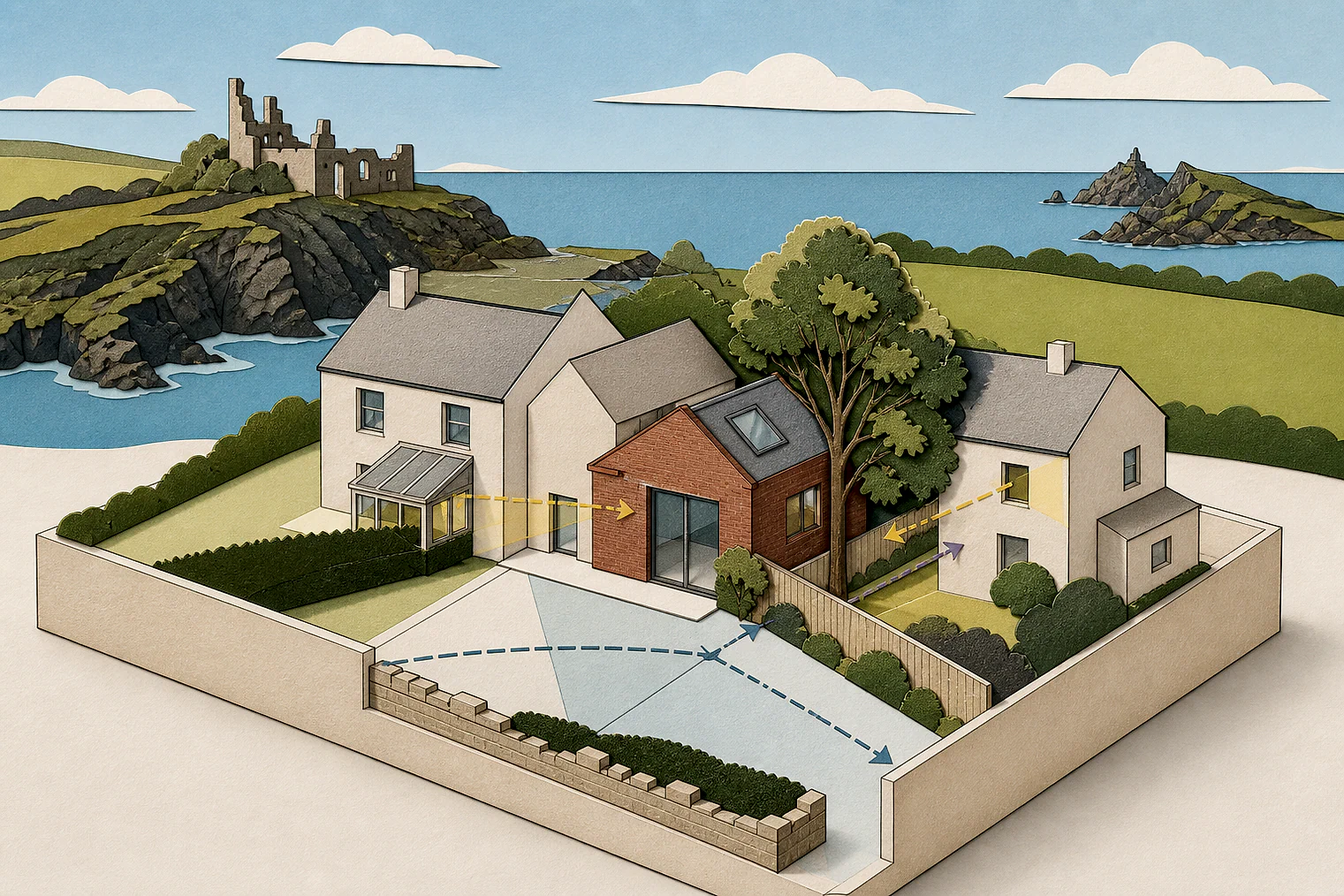
Daylight, sunlight, overshadowing and overbearing impact
How does the authority assess daylight, sunlight, overshadowing and overbearing impact?
Development must avoid unreasonable overshadowing and overbearing effects on nearby occupiers.
- When this answer applies
- Development whose height, mass, position or orientation could affect neighbouring buildings or outdoor space.
Details and exceptions
- The Local Plan does not set a universal 45-degree test in this policy; assessment is site-specific and may draw on current design guidance.
Sources used
- Cornwall Local Plan Strategic Policies 2010-2030 (opens in a new tab)Development plan— Policy 12(2)(b), Design, pp.50-51
Related local appeal evidence
Neighbour living conditions
29 matched decision families in this local evidence view.
- 5 allowed
- 23 dismissed
- 1 other
Privacy, overlooking and separation
How does the authority assess privacy, overlooking and separation between buildings or amenity areas?
Design must protect neighbours and occupiers from overlooking and unreasonable loss of privacy.
- When this answer applies
- Development capable of overlooking homes, gardens or other sensitive spaces.
Details and exceptions
- Policy 12 states an outcome, not a universal separation distance; context, levels, orientation and guidance determine the response.
Sources used
- Cornwall Local Plan Strategic Policies 2010-2030 (opens in a new tab)Development plan— Policy 12(2)(a), Design, pp.50-51
Noise and vibration
What does the authority say about tests, limits, evidence and mitigation for noise and vibration?
Design must protect against unreasonable noise and disturbance, while development standards require noise and vibration impacts to be avoided or mitigated during construction, operation and restoration.
- When this answer applies
- Noise-generating proposals and noise-sensitive development near existing sources.
Details and exceptions
- The acceptable level and evidence depend on source, receptor, timing, background conditions and current technical guidance.
Sources used
- Cornwall Local Plan Strategic Policies 2010-2030 (opens in a new tab)Development plan— Policies 12(2)(c) and 13(5), pp.51-53
Other planning topics3
Keep these national checklist topics in mind alongside the local requirements above.
- Outlook and enclosure
- Odour, fumes and dust
- Artificial light and glare
Section 3
Design, form and character
Character, context and placemaking
What does the authority say about responding to local character, townscape, context, public realm, legibility and inclusive or safe design?
Design must sustain Cornwall's distinctiveness and respond to landscape, seascape and townscape context through appropriate scale, density, layout, height, mass, movement, public and private space and local character.
- When this answer applies
- All development.
Details and exceptions
- The expected response is location-specific and may be refined by a neighbourhood plan, allocation, conservation appraisal or the Cornwall Design Guide.
Sources used
- Cornwall Local Plan Strategic Policies 2010-2030 (opens in a new tab)Development plan— Policy 12(1), Design, pp.50-51
Related local appeal evidence
Area character and appearance
80 matched decision families in this local evidence view.
- 24 allowed
- 55 dismissed
- 1 other
Other planning topics8
Keep these national checklist topics in mind alongside the local requirements above.
- Layout, siting and building lines
- Scale, height and massing
- Side spacing and terracing
- Extensions
- Roof alterations and dormers
- Outbuildings and ancillary structures
- Materials and architectural detail
- Boundaries, frontages and entrances
Section 4
Residential quality and housing form
Internal space standards
What does the authority say about internal space, room size, ceiling height and storage?
Policy 13 applies the Nationally Described Space Standard to affordable housing so it has sufficient, flexible internal space.
- When this answer applies
- Affordable housing within new development.
Details and exceptions
- The adopted policy wording does not state the same local-plan requirement for every market home; check national standards and current guidance separately.
Sources used
- Cornwall Local Plan Strategic Policies 2010-2030 (opens in a new tab)Development plan— Policy 13(1), Development standards, pp.52-53
Accessible and adaptable homes
What does the authority say about wheelchair, accessible and adaptable housing standards or proportions?
Housing development of at least 10 dwellings should provide 25% of homes to Building Regulations M4(2) accessible-and-adaptable standard unless site-specific factors make that unsuitable.
- When this answer applies
- Housing development of 10 or more dwellings.
Details and exceptions
- The site-specific exception needs evidence; any separate wheelchair-user requirement must be checked elsewhere.
Sources used
- Cornwall Local Plan Strategic Policies 2010-2030 (opens in a new tab)Development plan— Policy 13 and paragraph 2.82, pp.51-53
Housing mix, size and density
What does the authority say about dwelling mix, size and density for market housing?
Housing schemes of 10 or more dwellings should provide a locally evidenced mix of sizes, types, prices and tenures; sites of 200 or more dwellings should consider specialist housing where demand exists.
- When this answer applies
- Housing development of at least 10 dwellings, with the specialist-housing clause starting at 200 dwellings.
Details and exceptions
- Use current local housing-needs evidence; the interim statement says Policy 6 continues to carry significant weight.
Sources used
- Cornwall Local Plan Strategic Policies 2010-2030 (opens in a new tab)Development plan— Policy 6, Housing mix, pp.40-41
- Cornwall Interim Policy Position Statement (opens in a new tab)Official guidance— Section 3.2, Policy 6, p.8
Other planning topics9
Keep these national checklist topics in mind alongside the local requirements above.
- Private amenity space
- Shared amenity and play space
- Older-person, care and supported housing
- Build to rent
- Student and co-living accommodation
- Annexes and ancillary accommodation
- Subdivision and flat conversion
- HMOs and room-based shared housing
- Infill, backland and garden development
Section 5
Movement, parking and servicing
Access, highway safety and visibility
What does the authority say about access, highway safety and visibility?
Every development must provide safe and suitable access for all users and avoid an unmanageable or unmitigated significant adverse impact on the local or strategic road network.
- When this answer applies
- All development affecting access or highway conditions.
Details and exceptions
- The necessary visibility, geometry, tracking and mitigation depend on the proposal, road and current highway evidence.
Sources used
- Cornwall Local Plan Strategic Policies 2010-2030 (opens in a new tab)Development plan— Policy 27, Transport and accessibility, p.84
Related local appeal evidence
Highway safety
6 matched decision families in this local evidence view.
- 2 allowed
- 4 dismissed
Vehicle parking
What does the authority say about vehicle-parking quantities, dimensions, layout and flexibility?
Proposals must meet the council's parking standards while prioritising non-car modes. Cars should be accommodated without dominating layouts, and provision should respond to accessibility, active travel and local context.
- When this answer applies
- Development creating parking demand or changing existing parking.
Details and exceptions
- The numerical amount comes from the current Parking Standards Guidance rather than Policy T2 itself.
Sources used
- Climate Emergency Development Plan Document (opens in a new tab)Development plan— Policy T2, Parking, pp.30-31
Cycle parking and storage
What does the authority say about cycle parking, storage and end-of-trip facilities?
Development should provide prominent, accessible, secure and convenient cycle parking for all users, including provision at homes and near development access points.
- When this answer applies
- Development generating cycle-parking demand.
Details and exceptions
- Capacity and detailed layout come from current parking and design guidance and the development's use and scale.
Sources used
- Climate Emergency Development Plan Document (opens in a new tab)Development plan— Policies T1(3) and T2(2-4), pp.30-31
Electric-vehicle charging
What does the authority say about electric-vehicle charging and passive provision through planning policy or conditions?
Schemes should support electric vehicles and e-bikes with charging points; parking layouts should prioritise charging spaces ahead of conventional private-car spaces.
- When this answer applies
- Development providing vehicle or cycle parking.
Details and exceptions
- The DPD notes that mandatory charging requirements are managed through Building Regulations, so planning and building-control requirements must both be checked.
Sources used
- Climate Emergency Development Plan Document (opens in a new tab)Development plan— Policy T1(6), paragraphs 9.15-9.18 and Policy T2(1), pp.30-31
Active travel and public transport
What does the authority say about walking, wheeling, cycling and public-transport connections or improvements?
New development should minimise travel and follow a hierarchy of walking, cycling, public transport, car clubs, electric vehicles and lastly private fossil-fuelled vehicles, with inclusive connections into existing settlements and networks.
- When this answer applies
- New development, with scale affecting the extent of network improvements or contributions.
Details and exceptions
- Access and mitigation also need to satisfy the strategic Local Plan transport policy and site-specific highway evidence.
Sources used
- Climate Emergency Development Plan Document (opens in a new tab)Development plan— Policy T1, Sustainable Transport, p.30
- Cornwall Local Plan Strategic Policies 2010-2030 (opens in a new tab)Development plan— Policy 27, Transport and accessibility, p.84
Other planning topics5
Keep these national checklist topics in mind alongside the local requirements above.
- Accessible parking
- Turning, emergency access and tracking
- Servicing, loading and deliveries
- Refuse and recycling storage and collection
- Transport impacts, mitigation and monitoring
Section 6
Heritage, archaeology and views
Listed buildings and their setting
What does the authority say about works affecting a listed building or its setting, including separate consent?
Development must protect, conserve and where appropriate enhance designated heritage assets and their settings; any harm needs justification and is weighed against substantial public rather than private benefits.
- When this answer applies
- Development affecting a listed building or its setting.
Details and exceptions
- The required assessment is proportionate to significance and the type and degree of harm; separate listed-building consent may be required.
Sources used
- Cornwall Local Plan Strategic Policies 2010-2030 (opens in a new tab)Development plan— Policy 24, Historic environment, pp.79-80
Conservation areas
What does the authority say about development in or affecting a conservation area, including demolition?
Development should maintain the special character and appearance of conservation areas, especially positive elements identified in the relevant conservation-area appraisal.
- When this answer applies
- Development in or affecting a conservation area.
Details and exceptions
- Use the local appraisal and assess setting as well as the application site itself.
Sources used
- Cornwall Local Plan Strategic Policies 2010-2030 (opens in a new tab)Development plan— Policy 24, Historic environment, pp.79-80
Other planning topics3
Keep these national checklist topics in mind alongside the local requirements above.
- Non-designated heritage assets
- Archaeology
- Historic landscapes and important views
Section 7
Nature, landscape and open space
Trees and tree preservation
What does the authority say about trees, root protection, replacement and protected-tree constraints?
Major development should retain or establish tree canopy covering at least 15% of the site, excluding priority habitat. Most minor schemes should still avoid harm and provide new canopy where appropriate and practicable.
- When this answer applies
- The 15% target applies to major development; Policy G3 identifies exceptions for householder and specified change-of-use minor proposals.
Details and exceptions
- A different percentage can be agreed where significant ecological, heritage, landscape or operational reasons are fully evidenced.
Sources used
- Climate Emergency Development Plan Document (opens in a new tab)Development plan— Policy G3 and paragraphs 6.11-6.17, pp.13-14
Ancient woodland and veteran trees
What does the authority say about buffers and impact tests for ancient woodland, ancient trees and veteran trees?
Development must avoid loss or deterioration of ancient woodland and veteran trees unless the site's development need or benefits clearly outweigh the loss.
- When this answer applies
- Development affecting ancient woodland, ancient woodland sites or veteran trees.
Details and exceptions
- National policy can impose a stronger exceptional-reasons test, so use the current national position as well as the adopted plan.
Sources used
- Cornwall Local Plan Strategic Policies 2010-2030 (opens in a new tab)Development plan— Policy 23(3)(e) and paragraphs 2.168-2.169, pp.74-76
Protected species
What does the authority say about surveys, avoidance, mitigation and licensing-related planning considerations for protected species?
Development must avoid adverse effects on protected species and priority habitats wherever possible; relevant applications need ecological evidence describing value, impact, mitigation and enhancement.
- When this answer applies
- Development with potential to affect protected or priority species or habitat.
Details and exceptions
- Statutory species tests and survey timing apply separately; compensation follows only after avoidance and mitigation have been exhausted.
Sources used
- Cornwall Local Plan Strategic Policies 2010-2030 (opens in a new tab)Development plan— Policy 23(3-4) and paragraphs 2.165-2.169, pp.73-76
Designated habitats and impact zones
What does the authority say about designated habitats, ecological networks, consultation zones and strategic mitigation areas?
Housing, student or tourist accommodation inside an identified recreational zone of influence must secure suitable on-site management, alternative recreation or financial mitigation before approval. European sites otherwise receive the highest protection under the habitats tests.
- When this answer applies
- The stated accommodation types within a vulnerable European site's mapped zone of influence, and any development capable of affecting a designated habitat.
Details and exceptions
- The applicable zone, tariff, assessment and mitigation package must be checked against the current mitigation strategy and habitats evidence.
Sources used
- Cornwall Local Plan Strategic Policies 2010-2030 (opens in a new tab)Development plan— Policy 22 and Policy 23(3), pp.70 and 74-76
Biodiversity net gain
What does the authority say about biodiversity-net-gain metrics, percentages, exemptions, delivery and monitoring?
Non-exempt development must achieve at least 10% biodiversity net gain, or any higher national percentage, using the latest statutory metric. Gains must follow the mitigation hierarchy, normally be on site first and be secured and managed for at least 30 years.
- When this answer applies
- Development within the statutory and Policy G2 biodiversity-net-gain regime, subject to exemptions and small-site provisions.
Details and exceptions
- Use the current statutory exemptions, metric, biodiversity gain plan and off-site register or credit rules; these may have changed since DPD adoption.
Sources used
- Climate Emergency Development Plan Document (opens in a new tab)Development plan— Policy G2 and paragraphs 6.6-6.10, pp.12-13
Nationally designated landscapes
What does the authority say about development in or affecting National Landscapes, National Parks and Heritage Coasts?
Great weight is given to conserving and enhancing the Cornwall and Tamar Valley National Landscapes and their settings. Major development is refused unless exceptional-circumstances and public-interest tests are met.
- When this answer applies
- Development within or affecting the setting of a National Landscape.
Details and exceptions
- Scale, local need, landscape capacity and the current management plan are material; the adopted document uses the former AONB terminology.
Sources used
- Cornwall Local Plan Strategic Policies 2010-2030 (opens in a new tab)Development plan— Policy 23(2)(a) and paragraph 2.150, pp.71 and 74-75
Green infrastructure, open space and recreation
What does the authority say about retaining or providing green infrastructure, open space, recreation and play space?
Green infrastructure must lead site design, retain and connect existing natural features, integrate accessible space and sustainable drainage, and include long-term management. Homes should normally have a usable garden broadly equal to their footprint or other communal green space.
- When this answer applies
- Development where green-infrastructure measures are appropriate to its scale and nature.
Details and exceptions
- Policy G1 contains ten design and maintenance principles; the precise package depends on existing habitat, site form and proposal scale.
Sources used
- Climate Emergency Development Plan Document (opens in a new tab)Development plan— Policy G1, Green Infrastructure Design and Maintenance, pp.11-12
Other planning topics3
Keep these national checklist topics in mind alongside the local requirements above.
- Hedgerows
- Landscape character and visual impact
- Local Green Space
Section 8
Flooding, environment and climate
Flood risk and the sequential approach
What does the authority say about flood zones, sequential and exception tests, vulnerability, levels and resilience?
Development should first avoid flood-risk areas, use current flood and surface-water maps including climate projections, preserve exceedance routes and reduce risk to the site and surroundings.
- When this answer applies
- Development in or capable of affecting an area of fluvial, tidal, surface-water or groundwater risk.
Details and exceptions
- The national sequential and exception tests and proposal vulnerability remain controlling; use current Environment Agency and council evidence.
Sources used
- Cornwall Local Plan Strategic Policies 2010-2030 (opens in a new tab)Development plan— Policy 26 and paragraph 2.199, pp.82-83
- Climate Emergency Development Plan Document (opens in a new tab)Development plan— Policy CC3, Reduction of Flood Risk, p.45
Drainage and sustainable drainage
What does the authority say about surface-water hierarchy, runoff, attenuation, SuDS, adoption and maintenance?
Sustainable drainage should use above-ground, non-buried systems where feasible, integrate with green space and biodiversity, reduce flood risk and include a clear maintenance plan. Schemes of 10 dwellings or more or over 0.5 hectares also require a long-term water-management plan under the strategic policy.
- When this answer applies
- Development requiring surface-water management; the long-term plan threshold is 10 dwellings or more than 0.5 hectares.
Details and exceptions
- Coastal-cliff infiltration has additional restrictions and the discharge solution must reflect site geology, groundwater and heritage.
Sources used
- Cornwall Local Plan Strategic Policies 2010-2030 (opens in a new tab)Development plan— Policy 26(2-3), pp.82-83
- Climate Emergency Development Plan Document (opens in a new tab)Development plan— Policy CC4, Sustainable Drainage System Design, p.45
Coastal change and erosion
What does the authority say about coastal change, erosion, tidal and shoreline-management areas?
New development in the mapped Coastal Vulnerability Zone needs a Coastal Vulnerability Assessment showing consistency with the Shoreline Management Plan, safety for its lifetime, safe access and no unacceptable effect on coastal processes or adaptation.
- When this answer applies
- Development, including replacement buildings, inside the Coastal Vulnerability Zone unless Policy CC1 defines it as exempt.
Details and exceptions
- Candidate Coastal Change Management Areas and any local adaptation plan add further place-specific requirements.
- Infiltration drainage within 5 metres of the vulnerability-zone boundary needs specific stability evidence.
Sources used
- Climate Emergency Development Plan Document (opens in a new tab)Development plan— Policies CC1-CC2 and paragraphs 12.1-12.14, pp.41-44
Energy, carbon and sustainable construction
What does the authority say about energy hierarchy, operational or embodied carbon, renewable energy and sustainable construction for ordinary development?
Residential development must target net-zero carbon and submit an Energy Statement demonstrating space-heating demand below 30 kWh per square metre per year, total energy below 40 kWh per square metre per year and on-site renewable generation matching consumption. Major non-residential development above 1,000 square metres should reach BREEAM Excellent or better.
- When this answer applies
- New residential development and major non-residential development; transition provisions apply to some earlier outline permissions.
Details and exceptions
- Technical feasibility and viability can alter the renewable or offset route, but the policy prioritises fabric and energy-consumption thresholds first.
Sources used
- Climate Emergency Development Plan Document (opens in a new tab)Development plan— Policy SEC1(1-3), pp.38-39
Water efficiency
What does the authority say about potable-water efficiency and consumption standards?
Dwellings, including conversions, reversions and changes of use, should achieve estimated consumption of no more than 110 litres per person per day. Schemes of 50 or more homes and non-residential development of at least 1,000 square metres should add water reuse, recycling and rainwater harvesting.
- When this answer applies
- All dwellings for the consumption target; the larger-scheme threshold governs reuse and harvesting.
Details and exceptions
- The dwelling target is subject to feasibility and must be demonstrated through the applicable planning and building-control evidence.
Sources used
- Climate Emergency Development Plan Document (opens in a new tab)Development plan— Policy SEC1(5), Water, p.40
Other planning topics6
Keep these national checklist topics in mind alongside the local requirements above.
- Contaminated land
- Land stability and mining legacy
- Air quality
- Water environment, wastewater and nutrients
- Overheating and climate resilience
- Agricultural land and soils
Section 9
Housing delivery and contributions
Affordable housing
What does the authority say about affordable-housing thresholds, percentages, tenure or mix, delivery and exceptions?
Affordable housing is triggered by a net increase above 10 dwellings or more than 1,000 square metres of housing floorspace. In designated rural areas and National Landscapes it is triggered above 5 dwellings, with a financial contribution for schemes of 6-10 homes. The plan's five value-zone targets range from 25% to 50%.
- When this answer applies
- Eligible housing proposals meeting the dwelling, floorspace or designated-rural-area threshold.
Details and exceptions
- Value zone, tenure, viability, current national rules and the Affordable Housing SPD determine the amount and delivery form.
- The interim statement says Policy 8 remains supported, but the August 2026 national-policy review is ongoing.
Sources used
- Cornwall Local Plan Strategic Policies 2010-2030 (opens in a new tab)Development plan— Policy 8 and paragraphs 2.38-2.55, pp.42-45
- Cornwall Interim Policy Position Statement (opens in a new tab)Official guidance— Section 3.2, Policy 8, p.8
Section 106 and infrastructure contributions
What does the authority say about planning obligations, infrastructure contributions, calculation and delivery?
Developer contributions are sought for necessary physical, social, economic and green infrastructure affected by a proposal, through site-specific mitigation, financial contributions and maintenance or management arrangements.
- When this answer applies
- Development creating an infrastructure need that meets the statutory planning-obligation tests.
Details and exceptions
- The amount and mechanism depend on site impacts, the current infrastructure schedule, CIL position and statutory necessity, direct relationship and proportionality tests.
Sources used
- Cornwall Local Plan Strategic Policies 2010-2030 (opens in a new tab)Development plan— Policy 28, Infrastructure, pp.84-85
Viability
What does the authority say about when and how viability evidence may affect policy requirements or contributions?
Where evidence shows the full affordable-housing quota would make a scheme unable to proceed, the council considers subsidy, tenure or phasing flexibility, serviced land, a reduced on-site percentage or an off-site contribution before using review or deferred mechanisms.
- When this answer applies
- A proposal claiming that the Policy 8 affordable-housing requirement is not viable.
Details and exceptions
- A viability case needs appropriate evidence and does not automatically remove the obligation.
Sources used
- Cornwall Local Plan Strategic Policies 2010-2030 (opens in a new tab)Development plan— Policy 10, Managing viability, p.47
Other planning topics2
Keep these national checklist topics in mind alongside the local requirements above.
- Community Infrastructure Levy
- Delivery, phasing and monitoring
Section 10
Application evidence and validation
Other planning topics12
Keep these national checklist topics in mind alongside the local requirements above.
- Local validation list and core information
- Design and Access and Planning Statements
- Heritage and archaeology evidence
- Trees, landscape, ecology and BNG evidence
- Flood, drainage and water evidence
- Transport, parking and travel evidence
- Ground and pollution evidence
- Energy, sustainability and climate evidence
- Affordable housing, viability and contributions evidence
- Construction, demolition and waste evidence
- Environmental Impact Assessment
- Fire statements and planning-gateway evidence
Section 11
Economic, community and specialist uses
Solar energy
What does the authority say about siting, scale, landscape, heritage, ecology, agricultural land and restoration for solar photovoltaic development?
Building-mounted solar is supported and encouraged. Ground-mounted schemes should focus on previously developed land and avoid best and most versatile agricultural land unless exceptionally justified.
- When this answer applies
- Solar-energy development requiring planning permission.
Details and exceptions
- Landscape, heritage, agricultural use, biodiversity, glint and glare, cumulative effects and restoration remain proposal-specific.
Sources used
- Climate Emergency Development Plan Document (opens in a new tab)Development plan— Policy RE1(1) and (3), pp.34-35
Wind energy
What does the authority say about location, community support, landscape, noise, ecology and separation for wind turbines?
Wind proposals must be in a broad suitable area on the policies map, an area identified by a made neighbourhood plan or order, or repower an existing turbine or wind farm. Community-identified impacts must be made acceptable and shadow flicker, noise, aviation and nearby-habitation effects addressed.
- When this answer applies
- Wind-energy development requiring planning permission.
Details and exceptions
- European-site buffers, flight paths, landscape, heritage, radar and national wind policy can independently determine acceptability.
Sources used
- Climate Emergency Development Plan Document (opens in a new tab)Development plan— Policy RE1(2), Wind energy, pp.34-35
Battery energy storage
What does the authority say about battery energy-storage development?
Energy storage is supported where it is co-located with renewable generation, relieves grid constraints, contributes to Cornwall's renewable target or enables further renewable deployment.
- When this answer applies
- Battery or other energy-storage development requiring planning permission.
Details and exceptions
- Fire safety, landscape, heritage, ecology, access, noise, drainage and restoration still require project-specific assessment.
Sources used
- Climate Emergency Development Plan Document (opens in a new tab)Development plan— Policy RE1(6), Energy storage, pp.35-36
Other planning topics19
Keep these national checklist topics in mind alongside the local requirements above.
- Employment sites and premises
- Retail, town centres and main-town-centre uses
- Community facilities
- Tourism and visitor accommodation
- Agriculture and farm diversification
- Rural workers' dwellings
- Equestrian development
- Traveller, Gypsy and showpeople sites
- Caravan, camping and holiday parks
- Aviation, airports and aerodrome safeguarding
- Telecommunications
- Advertisements and signage
- Shopfront design
- Other renewable and low-carbon infrastructure
- Hazardous installations and pipelines
- Defence, radar and technical safeguarding
- Ports and strategic transport infrastructure
- Minerals
- Waste development
Section 12
Separate consents and private matters
Other planning topics6
Keep these national checklist topics in mind alongside the local requirements above.
- Building Regulations
- Party Wall matters
- Private rights to light
- Covenants, boundaries and ownership
- Highway licences and adoption
- Environmental and other permits
Source library
Official documents used
Every requirement above links to its supporting document and source location. Browse all of the cited Cornwall Council sources together here.
Browse 4 cited documents
Cornwall Council
Cornwall Council
View official document page (opens in a new tab)- Climate Emergency Development Plan Document (opens in a new tab)Development plan
Cornwall Council · Adopted 21 February 2023
View official document page (opens in a new tab) - Cornwall Interim Policy Position Statement (opens in a new tab)Official guidance
Cornwall Council · Adopted 27 March 2025
View official document page (opens in a new tab)