
Liverpool City Council appeal evidence
Refused over highway safety in Liverpool?
Learn what selected local examples say about vehicle trips, pedestrian movement, parking and driver visibility.
Recently refused?
Create a free account for a private planning workspace.
No payment at signup. Refusal-review ordering may not be open.
- Matched locally
- 13 of 166
- eligible decision families
- Allowed
- 7
- matched appeal records
- Dismissed
- 6
- matched appeal records
- Householder
- 6
- of 13 matched records
AI-assisted. Cited sources and wording were checked before publication. Based on 5 source-linked examples shown below. Review method and limits.
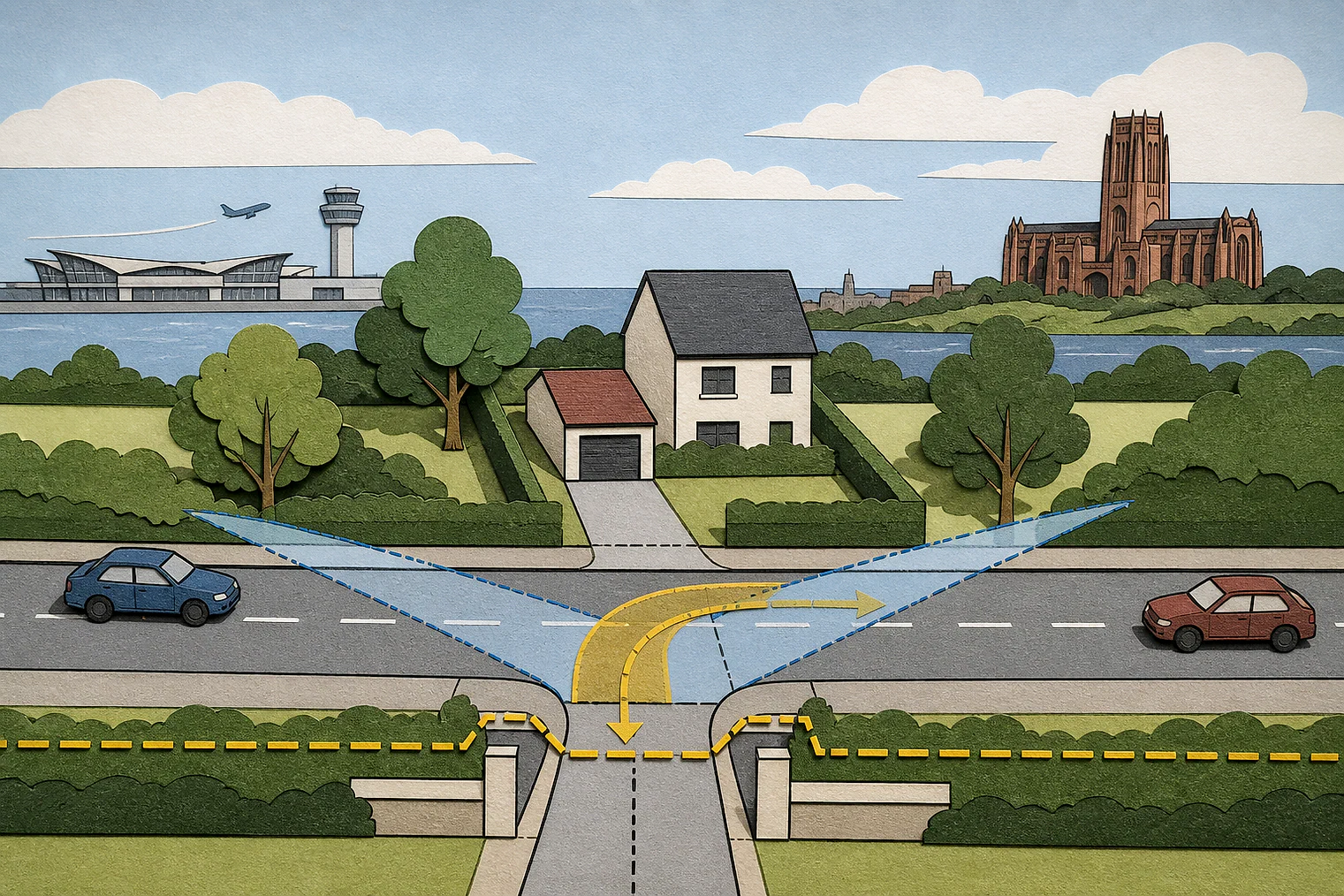
Planning Data area point: Liverpool LPA (53.395498, −2.917048). This is the published representative point for the authority boundary, not a town hall, camera position or appeal site.
Liverpool City Council appeal findings
Liverpool trips, pavements and visibility
The selected examples lean more towards allowed decisions than the matched local set. The dismissal extracts are multi-issue, including a home-extension extract that found no highway harm.
Counted against appeals
Car-park trips into Liverpool city centre
Extra trips remained a concern
Limiting long stays did not answer concern that the car park would attract more vehicle trips, congestion and pressure on highway safety.
Helped or needed
Street hubs, pavement space and visibility
Small change to pavement space
The Hub was only marginally different from the telephone booth and ATM. Its small depth meant any busy-period pedestrian impediment would be brief.
Visibility and pedestrians were not harmed
The extract concludes that the Hub would not harm driver visibility or the pedestrian environment.
Transport land was not compromised
The extract concludes that the Hub would not compromise land used for transport functions.
Your refusal notice
Check these details
- Does the refusal identify extra vehicle trips, not just parking duration?
- Does it show how pedestrians or drivers would be affected at the site?
- Does it compare your proposal with existing street furniture or transport land?
Several extracts give only their conclusion, and the examples range from street hubs to a car park and home extension. These decisions do not predict another result.
Appeal evidence examples
Compare allowed and dismissed appeal reasoning
Each example separates the development, the Inspector-stated issue that selected it, and the reasoning from the decision. Compare the facts as well as the outcome: these examples do not predict how a different proposal would be decided.
Allowed appeal examples
3 examples
26 June 2026 · Allowed
Development described in the decision
the installation of 1no. [address] Hub and removal of associated BT payphones. Appeal B Ref: 6005694 [site address] , [site address] , Ropewalks, Vauxhall, Liverpool [postcode]
Issue identified by the Inspector
The main issue with specific regard to Appeal A is the effect of the proposal on highway safety.
Paragraph 5 · Source page 2
Reasoning from the decision
The introduction of a street hub at this location would result in a structure positioned slightly closer to the two existing poles than the current telephone booth and ATM. However, the proposed siting would only be marginally different to the existing situation. It would not be much wider than the existing arrangement of the ATM and telephone booth in this location. I am also cognisant of the two existing poles, which would be located in line with the proposed development. Pedestrians would be seeking to avoid these pieces of street furniture, thereby positioning themselves in other areas of the pavement which serves this area of [address]. As such, the proposed development under Appeal A would not impede pedestrian movement beyond a level which is currently experienced in this location. Any impediment of the movement of pedestrians that may occur in busy periods would be brief, owing to the overall small depth of the appeal structure.
Paragraph 13 · Source page 3
20 April 2026 · Allowed
Development described in the decision
the installation of 1no. [address] Hub and removal of associated BT payphones.
Issue identified by the Inspector
For Appeal A, the main issues are the effect of the Hub on: • on the character and appearance of the area; and • highway safety, with particular regard to driver visibility and the pedestrian environment.
Paragraph 5 · Source page 2
Reasoning from the decision
Accordingly, in relation to Appeal A, the Hub would not be harmful to highway safety with regard to driver visibility and the pedestrian environment. As such, it would accord with LP policies UD4, TP1, TP3, and TP6. Such policies require, amongst other things, an inclusive, well-designed pedestrian environment, that development does not compromise existing transport infrastructure, schemes or Appeal Decisions 6004441 & 6004444 land that may be safeguarded for a transport function, and that walking is actively encouraged through a well-designed pedestrian environment.
Paragraph 17 · Source pages 3, 4
20 April 2026 · Allowed
Development described in the decision
the installation of 1no. [address] Hub and removal of associated BT payphones.
Issue identified by the Inspector
For Appeal A, the main issues are the effect of the Hub on: • the character and appearance of the area; and • highway safety, with particular regard to driver visibility.
Paragraph 5 · Source page 2
Reasoning from the decision
Accordingly, in relation to Appeal A, the Hub would not harm highway safety with regard to driver visibility. As such, it would accord with LP Policy TP8 which, amongst other things, requires that car parking is usable and safe. In addition, as it would not compromise land used for transport functions, it would also accord with LP Policy TP3, which has not been provided, but I have had sight of it in respect of other recent appeals.
Paragraph 16 · Source page 3
Dismissed appeal examples
2 examples
10 June 2026 · Dismissed
Development described in the decision
for the demolition of the building and the use of land as a surface car park (23 spaces) for a period of two years.
Issue identified by the Inspector
The main issues are: • whether the development would prejudice the delivery of future development proposals within the appeal site; • the effect of the scheme upon the character or appearance of the [address] Conservation Area (CA) and the setting of the Grade II Listed No. [address]; • the effect of the scheme upon highway safety, congestion, accessible car parking, sustainable travel and climate change; and, • whether the surface water drainage of the development has been adequately addressed.
Paragraph 4 · Source page 1
Reasoning from the decision
It has been suggested that a condition could be imposed to restrict long-stay commuter use. However, I am not persuaded that such a condition would address the broader issue of the development attracting additional vehicle trips into the city centre. The associated impacts, namely increased congestion, pressure on highway safety and reduced uptake of sustainable transport modes, would arise irrespective of the duration of any stay. As such, a condition of this nature would not overcome the fundamental conflict identified.
Paragraph 17 · Source page 4
11 November 2025 · Dismissed
Development described in the decision
first floor extension over bungalow to form house.
Issue identified by the Inspector
The main issues are: a) the effect of the proposed development on the living conditions of occupiers of the host dwelling, with particular regard to amenity space and outlook. b) the effect of the proposed development on the character and appearance of the area; and c) whether or not the proposal would give rise to highway safety issues and/or inconvenience for road users arising from any additional demand for on-street parking.
Paragraph 3 · Source page 1
Reasoning from the decision
Given the small increase in demand for parking which would likely arise from the proposed development and the availability of parking spaces in the vicinity of the site, off-street parking in this instance would not be necessary. Indeed, in the absence of any specific parking standards for such developments or any compelling evidence to suggest otherwise, the lack of off-street parking would be unlikely to cause inconvenience for road users nor would it have an adverse effect on highway safety or visual amenity. It would therefore accord with Policy TP8, and the broader aims of Policy UD2 of the LLP, which collectively seek to ensure that design solutions are appropriate to their context.
Paragraph 16 · Source page 3