
West Suffolk Council appeal evidence
Refused over neighbour living conditions in West Suffolk?
See the privacy, outlook and space concerns in the selected West Suffolk examples.
Recently refused?
Create a free account for a private planning workspace.
No payment at signup. Refusal-review ordering may not be open.
- Matched locally
- 9 of 54
- eligible decision families
- Allowed
- 0
- matched appeal records
- Dismissed
- 8
- matched appeal records
- Householder
- 6
- of 9 matched records
AI-assisted. Cited sources and wording were checked before publication. Based on 5 source-linked examples shown below. Review method and limits.
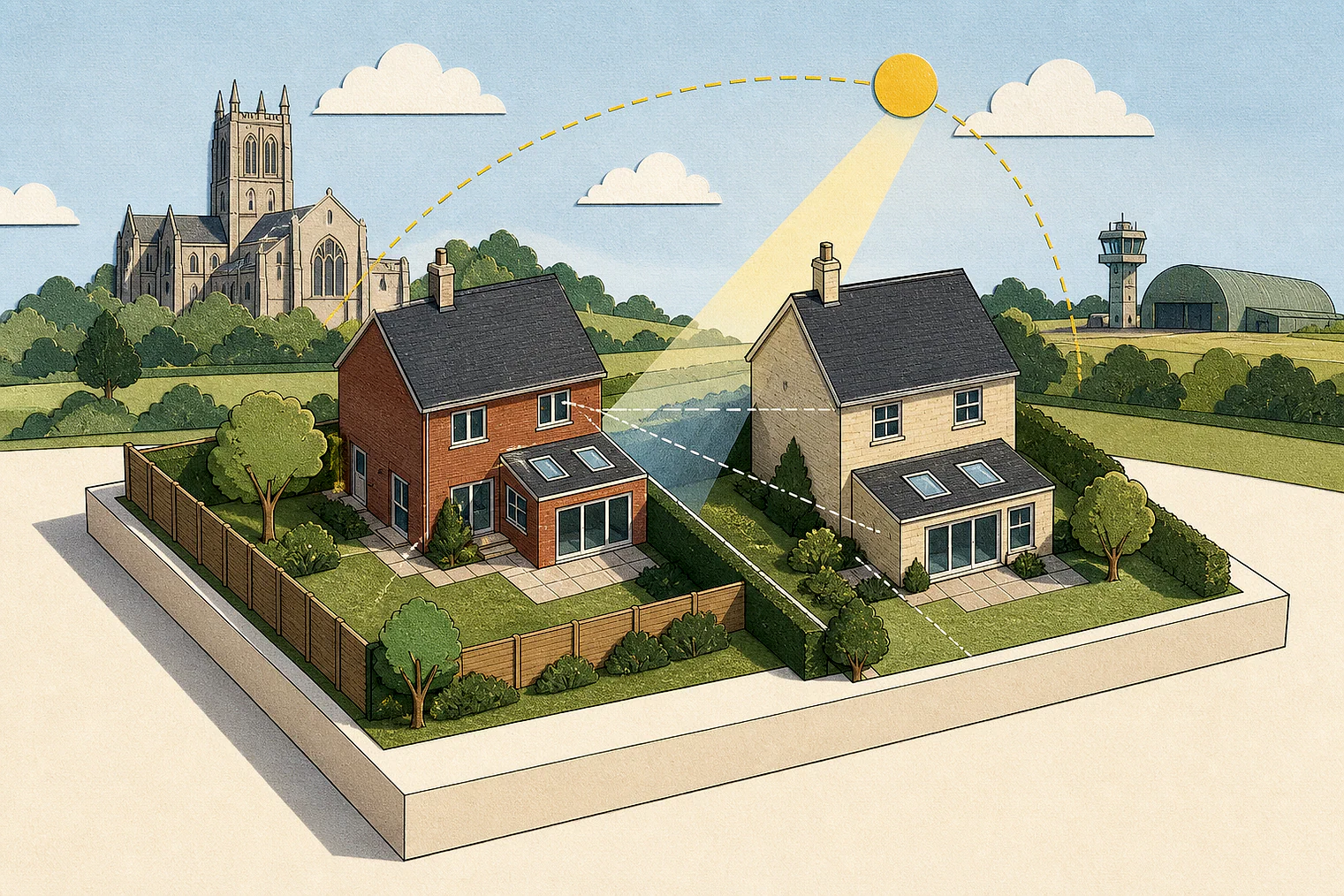
Planning Data area point: West Suffolk LPA (52.277877, 0.622218). This is the published representative point for the authority boundary, not a town hall, camera position or appeal site.
West Suffolk Council appeal findings
West Suffolk privacy, outlook and outdoor space
No allowed appeal appears in the matched local set. The selected examples include an outlook passage from a case with another main issue, so it is limited evidence.
Counted against appeals
West Suffolk privacy and amenity harm
Close dormers caused privacy loss
The dormers’ proximity and size would create a new, significant loss of privacy for neighbours.
Apartment amenity fell short
The Inspector concluded the apartment conversion would not provide adequate privacy, outlook or outdoor amenity space for future residents.
Climbing-frame harm lacked detail
The extract concludes that the climbing frame harmed neighbours’ living conditions but gives no reasoning beyond that conclusion.
No allowed example matched
No allowed West Suffolk comparator
This snapshot has no allowed local example for this issue.
Privacy changes had to preserve rooms
The dismissed dormer example shows that a privacy fix still had to leave a future habitable room suitable.
Future amenity needed proof
The apartment example shows that future residents still needed adequate privacy, outlook and outdoor amenity space.
Outlook alone did not settle it
An edge example found no outlook harm, but that did not alter the conclusion on its first main issue.
Your refusal notice
Check these details
- Do your drawings show the distance and views between new windows and neighbours?
- Would any privacy condition leave future habitable rooms suitable?
- Does the refusal raise privacy, outlook or outdoor space for future residents?
The climbing-frame extract gives only a conclusion, and the selected split-decision passage does not identify the successful part. These decisions do not predict another result.
Appeal evidence examples
Read the reasoning in matched appeal decisions
Each example separates the development, the Inspector-stated issue that selected it, and the reasoning from the decision. Compare the facts as well as the outcome: these examples do not predict how a different proposal would be decided.
Dismissed appeal examples
4 examples
29 May 2026 · Dismissed
Development described in the decision
the conversion and infill of lower ground floor to create an apartment including conversion of internal and external storage areas.
Issue identified by the Inspector
The main issue is whether the proposed development would provide adequate living conditions for the future residents with particular regard to noise, disturbance, privacy, outlook, outdoor amenity space and security.
Paragraph 2 · Source page 1
Reasoning from the decision
[name] am satisfied that the proposal would be adequate in terms of noise, disturbance and security, I conclude that the proposal would not provide adequate living conditions for future residents with particular regard to privacy, outlook and outdoor amenity space. It would conflict with Policies SP4 and LP9 of the West Suffolk Local Plan 2024 – 2041 (July 2025) where amongst other things they require development to be of a high architectural quality, ensuring that the amenity of residents and users is protected.
Paragraph 9 · Source page 2
10 March 2026 · Dismissed
Development described in the decision
Planning Application – 5no dwellings and associated access without complying with a condition attached to planning permission [name]/18/1206/FUL, dated 19 September 2019.
Issue identified by the Inspector
The main issues are: • The effect of the proposed development on the character and appearance of the surrounding area. • The effect of the proposed development on the living conditions of the occupiers of the adjacent properties on The Pines and [address], with particular reference to privacy and outlook.
Paragraph 6 · Source page 2
Reasoning from the decision
The proximity and size of the dormer windows on Plot 5 to the property of [address] would cause a new and significant loss of privacy to the occupants of [address]. It would not be possible to condition these windows to be fixed and obscurely glazed, as this would prevent the future occupants of this plot from having suitable living conditions in this habitable room space. The new positioning of Plot 5 would have limited harm to the outlook of the occupants of 2a, as while Plot 5 is noticeably more visible it is set away from the common boundary. While the moving of Plot 5 has some benefit to the privacy and outlook of the occupants of [address], this does not overcome the harm to the occupants of 2a.
Paragraph 13 · Source page 3
29 October 2024 · Dismissed
Development described in the decision
described as “retrospective planning application for children's climbing frame”.
Issue identified by the Inspector
The main issue in this appeal is the effect of the development on the living conditions of the occupants of [address] with regards to privacy, outlook, and general disturbance.
Paragraph 3 · Source page 1
Reasoning from the decision
Policy DM24 of the Forest Heath and St Edmundsbury Local Plan: Joint Development Management Policies Document 2015 (the LP) states that development within the curtilage of dwellings will be permitted, provided the proposals will not adversely affect the residential amenity of occupants of nearby properties. For the reasons set out above, I find that the proposal is harmful to the living conditions of the occupants of [address], and so, does not comply with this policy. There is also conflict with the National Planning Policy Framework in respect of achieving a high standard of amenity for existing and future users.
Paragraph 9 · Source page 2
6 November 2023 · Dismissed
Development described in the decision
first floor extension to create two bedrooms, shower room and storage together with internal alterations.
Issue identified by the Inspector
The main issues are the effect of the proposal on (1) the character and appearance of the appeal property and the wider area; and (2) the living conditions of occupants of [address], with particular reference to outlook.
Paragraph 3 · Source page 1
Reasoning from the decision
I therefore conclude that the proposal would not result in harm to the outlook for occupants of [address] to a degree that living conditions would be harmed. In this regard, the proposal would accord with [name] DM2 g.v. & g.vi, and DM24 c), and the requirement in the Framework to create places with a high standard of amenity for existing and future users. However, this does not alter my conclusion on the first main issue.
Paragraph 15 · Source page 3
Other appeal outcomes
1 example
31 October 2023 · Split Decision
Development described in the decision
Householder planning application - a. two storey side extension b. extension of dormer to side elevation c. detached garage.
Issue identified by the Inspector
The main issues in this appeal are the effect of the proposed development on (i) the character and appearance of the area; and (ii) the living conditions of occupiers of [address].
Paragraph 6 · Source page 2
Reasoning from the decision
I find that the proposed two storey side extension would harm the living conditions of the occupiers of [address]. There is conflict with Policies DM2 and DM24 of the Local Plan which amongst other things seek to ensure developments will not adversely affect the residential amenity of occupants of nearby properties.
Paragraph 15 · Source page 3