
London Borough of Southwark appeal evidence
Refused over neighbours’ living conditions in Southwark?
See how selected Southwark examples treated privacy, outlook and amenity space.
Recently refused?
Create a free account for a private planning workspace.
No payment at signup. Refusal-review ordering may not be open.
- Matched locally
- 21 of 62
- eligible decision families
- Allowed
- 6
- matched appeal records
- Dismissed
- 15
- matched appeal records
- Householder
- 21
- of 21 matched records
AI-assisted. Cited sources and wording were checked before publication. Based on 5 source-linked examples shown below. Review method and limits.
Planning Data area point: Southwark LPA (51.47424, −0.074031). This is the published representative point for the authority boundary, not a town hall, camera position or appeal site.
London Borough of Southwark appeal findings
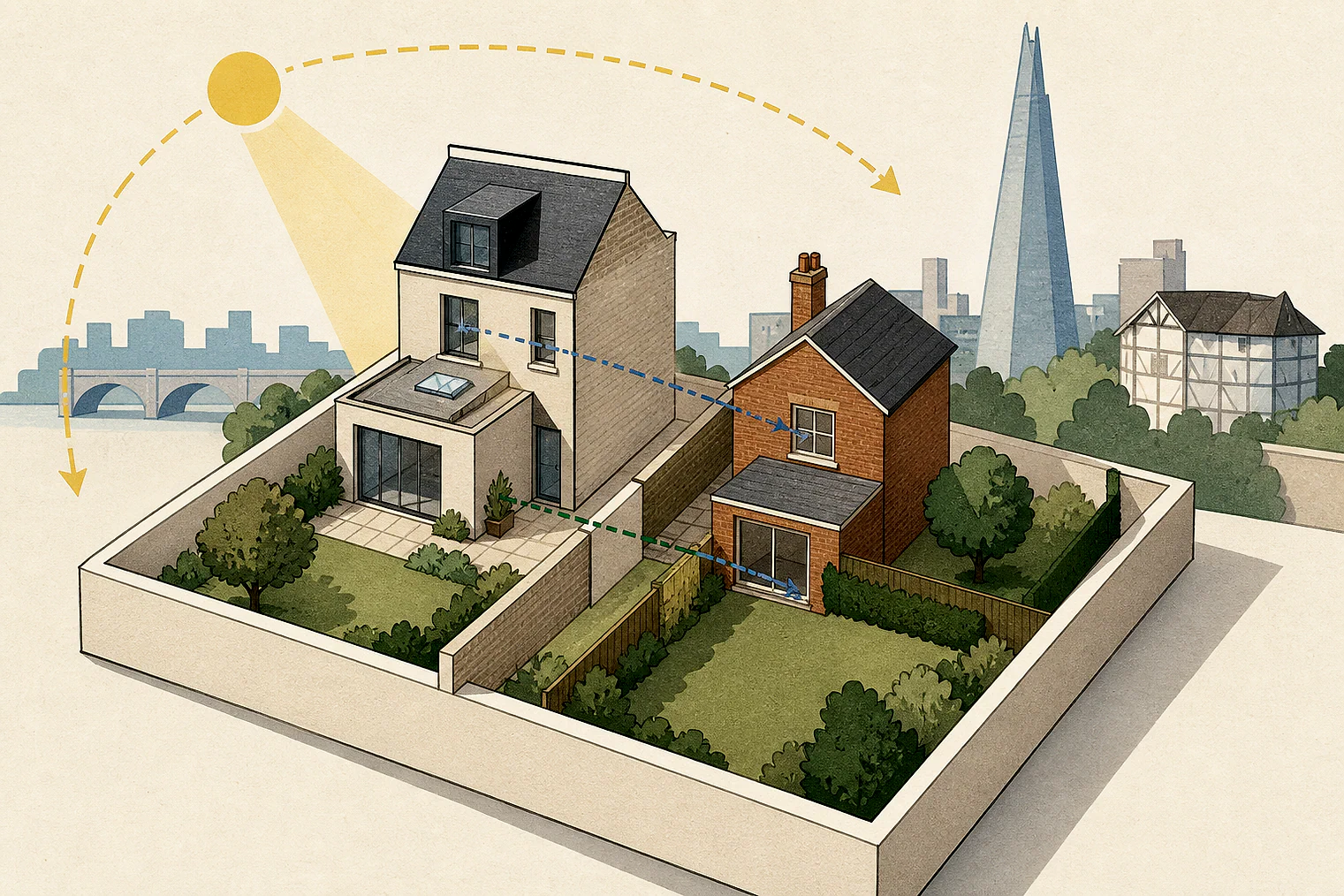
Southwark neighbours: privacy, outlook and amenity space
The selected examples lean more towards dismissed appeals than the matched local set. Appeal 76790 gives a conclusion, not analysis, on living conditions.
Counted against appeals
Privacy, outlook and amenity-space concerns
Obscured glazing protected privacy
Reducing obscured glazing at a corner window created new views of rear windows and gardens, causing harmful actual and perceived overlooking.
Sunlight, privacy and outlook were harmful
The extract concludes that the mansard proposal harmed neighbours’ sunlight, privacy and outlook. It gives no further reasoning.
Amenity space was unacceptable
The extract concludes that living conditions for existing and future occupiers were unacceptable, with particular regard to amenity space.
Helped or needed
Outlook in a condition variation
No unacceptable outlook impact
The Inspector concluded that varying the condition would not unacceptably affect occupants’ outlook.
Your refusal notice
Check these details
- Does the refusal identify overlooking from a window, garden or other viewpoint?
- Does it specify loss of sunlight, privacy, outlook or usable amenity space?
- Does it say whose living conditions would be affected, and how?
Appeal 76790 sits at the issue’s edge: its extract says living conditions were not harmed, but dismissal rested on character and appearance. These decisions do not predict another result.
Appeal evidence examples
Compare allowed and dismissed appeal reasoning
Each example separates the development, the Inspector-stated issue that selected it, and the reasoning from the decision. Compare the facts as well as the outcome: these examples do not predict how a different proposal would be decided.
Allowed appeal examples
1 example
31 July 2023 · Allowed
Development described in the decision
the construction of a rear part single, part double storey extension without complying with a condition attached to planning permission Ref 20/AP/2716, dated 24 December 2020.
Issue identified by the Inspector
The main issues are 1) the effect that varying the condition would have on the living conditions of occupants of [address] with regard to outlook, and
Paragraph 6 · Source page 2
Reasoning from the decision
The variation of the disputed condition would therefore not have an unacceptable impact on the living conditions of occupants of no. [address] with regard to outlook. It would comply with Policy P56 of the Southwark Plan (2022) and Policy D4 of the London Plan (2021) which outline, amongst other things, that development should not be permitted when it causes an unacceptable loss of amenity to present or future occupiers or users, having regard to, amongst other things the outlook of occupiers. It would also comply with the requirement of the National Planning Policy Framework (2021) that development achieves a good standard of amenity.
Paragraph 13 · Source page 3
Dismissed appeal examples
4 examples
30 December 2022 · Dismissed
Development described in the decision
mansard roof extension to create additional ancillary floor space.
Issue identified by the Inspector
The main issue is the effect of the proposed development upon the living conditions of the occupiers of [address] (No 43) with particular regard to sunlight, privacy, and outlook.
Paragraph 3 · Source page 1
Reasoning from the decision
Therefore, I conclude that the proposal would harmfully affect the living conditions of the occupiers of No 43 with particular regard to sunlight, privacy, and outlook. Consequently, the development would be contrary to Policy P56 of the Southwark Plan 2022 and the 2015 [name] to the Residential Design Standards Supplementary Planning Document (2011) which amongst other things seeks to avoid unacceptable loss of amenity to present occupiers. Furthermore, the proposal would be in conflict with Section 12 of the National Planning Policy Framework, which seeks to achieve a high standard of amenity for existing and future users.
Paragraph 8 · Source page 2
13 March 2026 · Dismissed
Development described in the decision
construction of a single-storey rear extension (retrospective), including the installation of a patio door to the extension (proposed).
Issue identified by the Inspector
The main issues in this appeal are: • whether the proposal provides acceptable living conditions for existing and future occupiers, with particular regard to the provision of amenity space; and • whether the development exposes existing and neighbouring occupiers to an unacceptable fire safety risk.
Paragraph 3 · Source page 1
Reasoning from the decision
Therefore, I conclude that the proposal provides unacceptable living conditions for existing and future occupiers, with particular regard to the provision of amenity space. This is contrary to Policy D6 of the London Plan 2021 (London Plan) and Policies P15 and P56 of the Southwark Plan 2022. Together, these require development to provide high quality accommodation which does not cause an unacceptable loss of amenity to present or future occupiers, including the provision of usable private amenity space.
Paragraph 9 · Source page 2
21 January 2026 · Dismissed
Development described in the decision
erection of a rear roof extension over outrigger without complying with conditions attached to planning permission Ref 21/AP/3356, dated 19 November 2021.
Issue identified by the Inspector
Having regard to the above, the main issue is the effect of varying the conditions on the living conditions of the occupants of nos 17A and [address], with particular regard to privacy.
Paragraph 4 · Source page 2
Reasoning from the decision
For the reasons set out above, the proposed variation of conditions would reduce the extent of obscured glazing from the corner window. This would introduce new opportunities for overlooking of rear windows and the garden at neighbouring dwellings, nos 17A & [name] acknowledging that a degree of overlooking is typical in the area, the proposal would unacceptably increase both actual overlooking and a sense of overlooking, resulting in a noticeable and harmful loss of privacy for nos 17A & B’s occupants. Consequently, the proposal would harm the living conditions of the occupants of nos 17A and [address].
Paragraph 16 · Source page 3
23 September 2025 · Dismissed
Development described in the decision
erection of garden room.
Issue identified by the Inspector
The main issues are the effect of the development on the character and appearance of the area; and whether the development would provide acceptable living conditions for the existing occupiers of [address] (No 9) with particular regard to outlook.
Paragraph 2 · Source page 1
Reasoning from the decision
[name] have found that the proposed development would not harm the living conditions of the neighbouring occupiers, this does not outweigh the harm arising to the character and appearance of the area.
Paragraph 15 · Source page 3